Committee lays over bill that would tie extra fishing lines to walleye-stamp purchases; DNR warns of enforcement, sustainability risks
February 26, 2026 | 2026 Legislature MN, Minnesota
This article was created by AI summarizing key points discussed. AI makes mistakes, so for full details and context, please refer to the video of the full meeting. Please report any errors so we can fix them. Report an error »
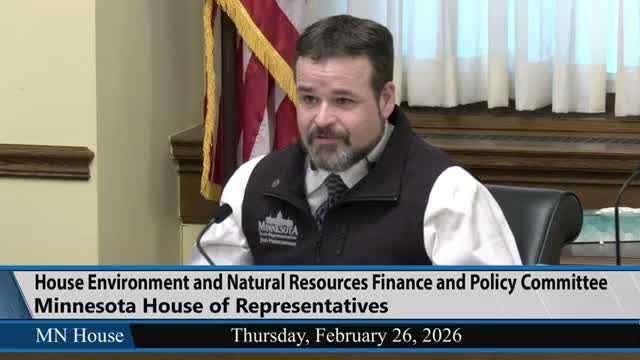
House File 624, sponsored in the Environment, Natural Resources and Policy Finance Committee, would offer anglers an incentive to buy a walleye or wildlife stamp by allowing a second fishing line in summer (and four lines in winter) for purchasers, the bill’s author said.
"Our goal is to increase opportunities to put fish in the lake but also fish in the live well," Representative Kozinski said while presenting the bill. He estimated Minnesota currently sells roughly 15,000 walleye stamps that generate about $90,000 a year and said increasing stamp purchases could fund more fish stocking and help recruit younger anglers.
Pat Rivers, deputy director for the Division of Fish and Wildlife at the Minnesota Department of Natural Resources, told the committee the agency supports efforts to get people outdoors but raised two central concerns. "This bill will increase fish mortality directly through anglers keeping more fish and indirectly through hooking mortality," Rivers said, adding that some of the state's large walleye lakes are near sustainable harvest levels. Rivers also warned that enforcement would be more complicated because officers would need to check every person in a boat to determine who holds the endorsement.
Members questioned both points. Representative Burkel asked how enforcement would differ from current practice; Rivers explained that crews would have to identify which boater holds the endorsement when multiple lines are deployed. Representative Falconer suggested a zoned approach — allowing multiple lines only on lakes where the DNR determines populations can sustain added harvest — and Rivers said zoning is possible but increases regulatory complexity.
Representative Kozinski said he is open to revisions, including focusing revenue or restrictions on particular species or spreading stocking across multiple species. The committee ultimately laid the bill over for possible inclusion in a future bill; Chair Heintzeman moved the layover motion and the committee carried it.
What happens next: The bill was laid over; no committee vote on final passage occurred. DNR testified it would monitor species and lake‑specific sustainability and enforcement implications should the Legislature advance the proposal.
Clarifying details: The author described the current walleye-stamp as a $5 purchase that generated about $90,000 in revenue; proposed stamp price points discussed ranged from $10–$15 in conversation but no price was set in the committee; enforcement concerns centered on boat‑by‑boat verification of who holds the endorsement; DNR noted potential impacts on muskie, lake trout and sturgeon and said certain lakes may already be at sustainable-harvest limits.
"Our goal is to increase opportunities to put fish in the lake but also fish in the live well," Representative Kozinski said while presenting the bill. He estimated Minnesota currently sells roughly 15,000 walleye stamps that generate about $90,000 a year and said increasing stamp purchases could fund more fish stocking and help recruit younger anglers.
Pat Rivers, deputy director for the Division of Fish and Wildlife at the Minnesota Department of Natural Resources, told the committee the agency supports efforts to get people outdoors but raised two central concerns. "This bill will increase fish mortality directly through anglers keeping more fish and indirectly through hooking mortality," Rivers said, adding that some of the state's large walleye lakes are near sustainable harvest levels. Rivers also warned that enforcement would be more complicated because officers would need to check every person in a boat to determine who holds the endorsement.
Members questioned both points. Representative Burkel asked how enforcement would differ from current practice; Rivers explained that crews would have to identify which boater holds the endorsement when multiple lines are deployed. Representative Falconer suggested a zoned approach — allowing multiple lines only on lakes where the DNR determines populations can sustain added harvest — and Rivers said zoning is possible but increases regulatory complexity.
Representative Kozinski said he is open to revisions, including focusing revenue or restrictions on particular species or spreading stocking across multiple species. The committee ultimately laid the bill over for possible inclusion in a future bill; Chair Heintzeman moved the layover motion and the committee carried it.
What happens next: The bill was laid over; no committee vote on final passage occurred. DNR testified it would monitor species and lake‑specific sustainability and enforcement implications should the Legislature advance the proposal.
Clarifying details: The author described the current walleye-stamp as a $5 purchase that generated about $90,000 in revenue; proposed stamp price points discussed ranged from $10–$15 in conversation but no price was set in the committee; enforcement concerns centered on boat‑by‑boat verification of who holds the endorsement; DNR noted potential impacts on muskie, lake trout and sturgeon and said certain lakes may already be at sustainable-harvest limits.
Don't Miss a Word: See the Full Meeting!
Go beyond summaries. Unlock every video, transcript, and key insight with a Founder Membership.
✓
Get instant access to full meeting videos
✓
Search and clip any phrase from complete transcripts
✓
Receive AI-powered summaries & custom alerts
✓
Enjoy lifetime, unrestricted access to government data
30-day money-back guarantee
