DNR pitches vehicle-registration 'outdoor recreation endorsement' to stabilize park funding; lawmakers press details on pricing, allocations and enforcement
February 26, 2026 | 2026 Legislature MN, Minnesota
This article was created by AI summarizing key points discussed. AI makes mistakes, so for full details and context, please refer to the video of the full meeting. Please report any errors so we can fix them. Report an error »
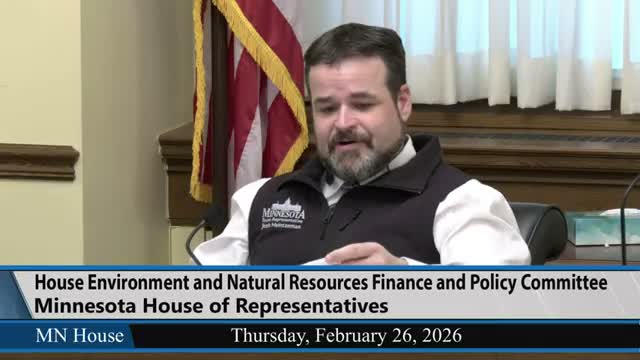
The Minnesota Department of Natural Resources laid out a multi-year plan Wednesday to create a more predictable funding stream for parks, trails and other public lands by offering an optional "outdoor recreation endorsement" (ORE) at the time of vehicle registration.
Commissioner Sarah Strommen (for the record) told the Environment, Natural Resources and Policy Finance Committee the idea grew from a DNR engagement initiative that began in 2021. The agency’s report proposes four steps — optimize existing funding, increase direct support, explore fees, and secure stable base funding — and said the endorsement is intended to address the last step.
Ben Berge, regional director (Bemidji), described the ORE as an opt‑in box at vehicle registration or renewal and as an on-site purchase option for visitors who did not buy it at registration. "Quite simply, the endorsement is a way for Minnesotans to support DNR's recreation and conservation work across the outdoor recreation system while lowering costs to gain access to our state parks and recreation areas," Berge said, citing Michigan’s recreation passport as a working model.
The DNR proposed a phased price path: $15 for years one and two, $17 for years three and four, and $19 at full implementation (year five). An on-site endorsement would carry an additional $12 fee. Commissioners said the model aims to replace current Minnesota park-pass revenue (about $8–$9 million annually) and to modestly augment that funding over time; the agency projected roughly $11 million in year one under their assumptions.
Lawmakers pressed on allocations and safeguards. Representative Purcell asked how DNR arrived at proposed percentages for distributing revenue across parks, wildlife management areas, state forests and scientific and natural areas; Commissioner Strommen said the agency surveyed division managers about minimal and full funding needs and converted those estimates into percentages, with a proposed 4% discretionary share to address urgent issues.
Members asked whether the endorsement would replace windshield stickers. Berge said the plan is to mark the license-year tab with a symbol (for example, a small "p" as Michigan does) so enforcement focuses on the plate tab rather than a window sticker; DNR said enforcement training and public education would be necessary but does not foresee major enforcement changes.
On capital needs, the DNR said the endorsement would not remove the need for bonding to address large deferred-maintenance backlogs; the endorsement could help with recurring maintenance but would not substitute for large capital projects.
What happens next: DNR requested lawmakers' questions and signaled readiness to provide more detailed numbers and implementation planning if the Legislature chooses to pursue the model.
Commissioner Sarah Strommen (for the record) told the Environment, Natural Resources and Policy Finance Committee the idea grew from a DNR engagement initiative that began in 2021. The agency’s report proposes four steps — optimize existing funding, increase direct support, explore fees, and secure stable base funding — and said the endorsement is intended to address the last step.
Ben Berge, regional director (Bemidji), described the ORE as an opt‑in box at vehicle registration or renewal and as an on-site purchase option for visitors who did not buy it at registration. "Quite simply, the endorsement is a way for Minnesotans to support DNR's recreation and conservation work across the outdoor recreation system while lowering costs to gain access to our state parks and recreation areas," Berge said, citing Michigan’s recreation passport as a working model.
The DNR proposed a phased price path: $15 for years one and two, $17 for years three and four, and $19 at full implementation (year five). An on-site endorsement would carry an additional $12 fee. Commissioners said the model aims to replace current Minnesota park-pass revenue (about $8–$9 million annually) and to modestly augment that funding over time; the agency projected roughly $11 million in year one under their assumptions.
Lawmakers pressed on allocations and safeguards. Representative Purcell asked how DNR arrived at proposed percentages for distributing revenue across parks, wildlife management areas, state forests and scientific and natural areas; Commissioner Strommen said the agency surveyed division managers about minimal and full funding needs and converted those estimates into percentages, with a proposed 4% discretionary share to address urgent issues.
Members asked whether the endorsement would replace windshield stickers. Berge said the plan is to mark the license-year tab with a symbol (for example, a small "p" as Michigan does) so enforcement focuses on the plate tab rather than a window sticker; DNR said enforcement training and public education would be necessary but does not foresee major enforcement changes.
On capital needs, the DNR said the endorsement would not remove the need for bonding to address large deferred-maintenance backlogs; the endorsement could help with recurring maintenance but would not substitute for large capital projects.
What happens next: DNR requested lawmakers' questions and signaled readiness to provide more detailed numbers and implementation planning if the Legislature chooses to pursue the model.
View the Full Meeting & All Its Details
This article offers just a summary. Unlock complete video, transcripts, and insights as a Founder Member.
✓
Watch full, unedited meeting videos
✓
Search every word spoken in unlimited transcripts
✓
AI summaries & real-time alerts (all government levels)
✓
Permanent access to expanding government content
30-day money-back guarantee
