Taxes committee hears LBO briefing on Tax Expenditure Review Commission; commission recommended modifications to several tax breaks
February 26, 2026 | 2026 Legislature MN, Minnesota
This article was created by AI summarizing key points discussed. AI makes mistakes, so for full details and context, please refer to the video of the full meeting. Please report any errors so we can fix them. Report an error »
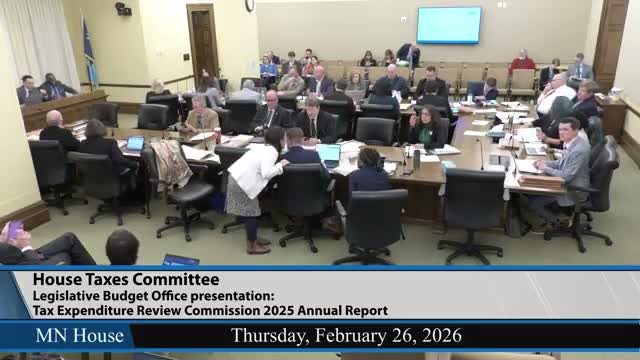
The Committee on Taxes heard a Legislative Budget Office briefing on the Tax Expenditure Review Commission’s annual legislative report and five evaluations on Feb. 26. LBO director-level staff said the commission met three times in 2025 and considered 5 evaluations covering 15 tax expenditures, and that the commission adopted procedures to produce recommendations to the Legislature.
Carlos Huerica of the Legislative Budget Office summarized the work and reminded members that tax expenditures are “spending through the tax code,” noting the commission’s role is to test whether those provisions meet statutory objectives under Minnesota law. Vlad Flouimo, an LBO economist, said the commission’s work included an initial review and in-depth evaluations against nine statutorily required components and that “the ninth component” permits the commission to recommend whether the Legislature should continue, repeal or modify a tax expenditure.
LBO staff said the commission voted to modify several policies that will be included in next year’s annual report. The presentation named the marriage credit and two sales-and-use-tax exemptions for renewable-energy systems (solar energy systems and wind energy conversion systems) as items the commission voted to modify. LBO staff emphasized that their evaluations often cannot isolate the impact of a single tax provision from overlapping federal, state and private incentives.
Members pressed staff for supporting data. Representative Lee and others asked for regional and rural-versus-metro breakdowns and for more granular incidence analysis; LBO staff said they would provide follow-up regional details (noting an Xcel Energy–specific breakdown was already produced). The committee’s discussion also raised broader budget tradeoffs: one member pointed out that the alcohol credits evaluation showed estimated foregone tax revenue exceeded the estimated economic impact attributed to the credits, and several members questioned whether other tools (for example, targeted direct-assistance programs) might better achieve objectives such as heating assistance.
The committee closed by previewing next week’s agenda items, including bills on pass-through entities and federal conformity, and adjourned. The minutes from prior meetings were adopted earlier in the session.
What’s next: LBO staff said more detail on the commission’s recommendations will appear in the TERC annual report and in follow-up materials, and committee members asked staff to circulate additional incidence and regional breakdowns for the evaluated tax expenditures.
Carlos Huerica of the Legislative Budget Office summarized the work and reminded members that tax expenditures are “spending through the tax code,” noting the commission’s role is to test whether those provisions meet statutory objectives under Minnesota law. Vlad Flouimo, an LBO economist, said the commission’s work included an initial review and in-depth evaluations against nine statutorily required components and that “the ninth component” permits the commission to recommend whether the Legislature should continue, repeal or modify a tax expenditure.
LBO staff said the commission voted to modify several policies that will be included in next year’s annual report. The presentation named the marriage credit and two sales-and-use-tax exemptions for renewable-energy systems (solar energy systems and wind energy conversion systems) as items the commission voted to modify. LBO staff emphasized that their evaluations often cannot isolate the impact of a single tax provision from overlapping federal, state and private incentives.
Members pressed staff for supporting data. Representative Lee and others asked for regional and rural-versus-metro breakdowns and for more granular incidence analysis; LBO staff said they would provide follow-up regional details (noting an Xcel Energy–specific breakdown was already produced). The committee’s discussion also raised broader budget tradeoffs: one member pointed out that the alcohol credits evaluation showed estimated foregone tax revenue exceeded the estimated economic impact attributed to the credits, and several members questioned whether other tools (for example, targeted direct-assistance programs) might better achieve objectives such as heating assistance.
The committee closed by previewing next week’s agenda items, including bills on pass-through entities and federal conformity, and adjourned. The minutes from prior meetings were adopted earlier in the session.
What’s next: LBO staff said more detail on the commission’s recommendations will appear in the TERC annual report and in follow-up materials, and committee members asked staff to circulate additional incidence and regional breakdowns for the evaluated tax expenditures.
View the Full Meeting & All Its Details
This article offers just a summary. Unlock complete video, transcripts, and insights as a Founder Member.
✓
Watch full, unedited meeting videos
✓
Search every word spoken in unlimited transcripts
✓
AI summaries & real-time alerts (all government levels)
✓
Permanent access to expanding government content
30-day money-back guarantee
