ECMC and Achieve Twin Cities present 'Discover Your Future' career‑exploration framework and pilot
February 26, 2026 | 2026 Legislature MN, Minnesota
This article was created by AI summarizing key points discussed. AI makes mistakes, so for full details and context, please refer to the video of the full meeting. Please report any errors so we can fix them. Report an error »
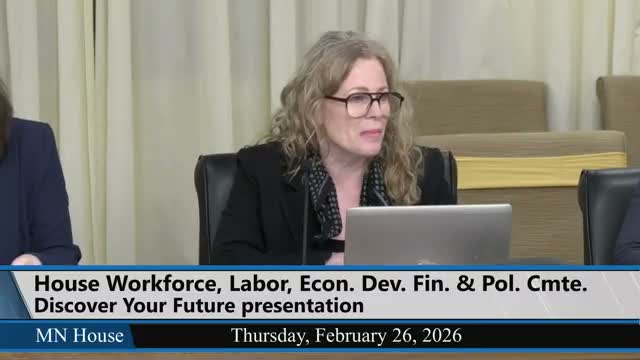
Representatives of ECMC Group and Achieve Twin Cities presented 'Discover Your Future' (D Y F) to the House workforce committee on Feb. 26, describing a statewide framework to give high school students consistent, measurable career‑exploration experiences.
Christine Noel, director of government affairs at ECMC Group, described the Minneapolis‑based nonprofit’s work on FAFSA outreach, financial literacy, paid cohorts and an Education Impact Fund. ECMC has invested roughly $32,000,000 in Minnesota program work and said it supports P‑20 as a recent grantee.
Heidi Johnson, chief of staff at ECMC Group, said D Y F is built from engagement with nearly 40 young adults and dozens of professional advisors. The framework has three components: (1) a consistent, flexible activity framework for students across phases (explore, expose, experience, elevate); (2) a data system to track activities and outcomes longitudinally; and (3) employer‑school partnerships to scale employer engagement. Johnson cited research findings from ECMC’s Harris Poll: employer concerns about work readiness (reliability as the top soft‑skill gap), widespread agreement that work‑based learning identifies long‑term talent, and statistics that an estimated 27,000 young people (ages 16–24) were disconnected in the Twin Cities in 2022, costing Minnesota taxpayers about $350 million annually.
Kendra Engles of Achieve Twin Cities described a pilot across Minneapolis–Saint Paul. Achieve serves over 15,000 students annually and reported that 93% of seniors engage with Achieve programming and that FAFSA completion reaches about 60% in Minneapolis and St. Paul compared to roughly 47% statewide. Early results from pilots emphasize earlier and more consistent career exposure, stronger employer engagement and integrated data systems so students' Personal Learning Plans (PLPs) persist across district transfers.
Committee members asked whether the framework can start earlier than high school and how programs will reach immigrant and underserved students. ECMC and Achieve said the model was intentionally flexible: it was launched in high school to leverage the existing PLP mandate but can be adapted for middle and elementary grades and for displaced or disengaged older learners. Achieve indicated partnerships with organizations focused on middle school exposure and said school‑embedded centers and collaboration with counselors are central to outreach.
No formal committee action was taken. Representatives and testifiers urged continued collaboration between schools, employers and funders to scale the framework while preserving local control over implementation.
Christine Noel, director of government affairs at ECMC Group, described the Minneapolis‑based nonprofit’s work on FAFSA outreach, financial literacy, paid cohorts and an Education Impact Fund. ECMC has invested roughly $32,000,000 in Minnesota program work and said it supports P‑20 as a recent grantee.
Heidi Johnson, chief of staff at ECMC Group, said D Y F is built from engagement with nearly 40 young adults and dozens of professional advisors. The framework has three components: (1) a consistent, flexible activity framework for students across phases (explore, expose, experience, elevate); (2) a data system to track activities and outcomes longitudinally; and (3) employer‑school partnerships to scale employer engagement. Johnson cited research findings from ECMC’s Harris Poll: employer concerns about work readiness (reliability as the top soft‑skill gap), widespread agreement that work‑based learning identifies long‑term talent, and statistics that an estimated 27,000 young people (ages 16–24) were disconnected in the Twin Cities in 2022, costing Minnesota taxpayers about $350 million annually.
Kendra Engles of Achieve Twin Cities described a pilot across Minneapolis–Saint Paul. Achieve serves over 15,000 students annually and reported that 93% of seniors engage with Achieve programming and that FAFSA completion reaches about 60% in Minneapolis and St. Paul compared to roughly 47% statewide. Early results from pilots emphasize earlier and more consistent career exposure, stronger employer engagement and integrated data systems so students' Personal Learning Plans (PLPs) persist across district transfers.
Committee members asked whether the framework can start earlier than high school and how programs will reach immigrant and underserved students. ECMC and Achieve said the model was intentionally flexible: it was launched in high school to leverage the existing PLP mandate but can be adapted for middle and elementary grades and for displaced or disengaged older learners. Achieve indicated partnerships with organizations focused on middle school exposure and said school‑embedded centers and collaboration with counselors are central to outreach.
No formal committee action was taken. Representatives and testifiers urged continued collaboration between schools, employers and funders to scale the framework while preserving local control over implementation.
View the Full Meeting & All Its Details
This article offers just a summary. Unlock complete video, transcripts, and insights as a Founder Member.
✓
Watch full, unedited meeting videos
✓
Search every word spoken in unlimited transcripts
✓
AI summaries & real-time alerts (all government levels)
✓
Permanent access to expanding government content
30-day money-back guarantee
