Committee adopts amendment to Safe at Home bill, expands eligibility and tightens disclosure rules
February 26, 2026 | 2026 Legislature MN, Minnesota
This article was created by AI summarizing key points discussed. AI makes mistakes, so for full details and context, please refer to the video of the full meeting. Please report any errors so we can fix them. Report an error »
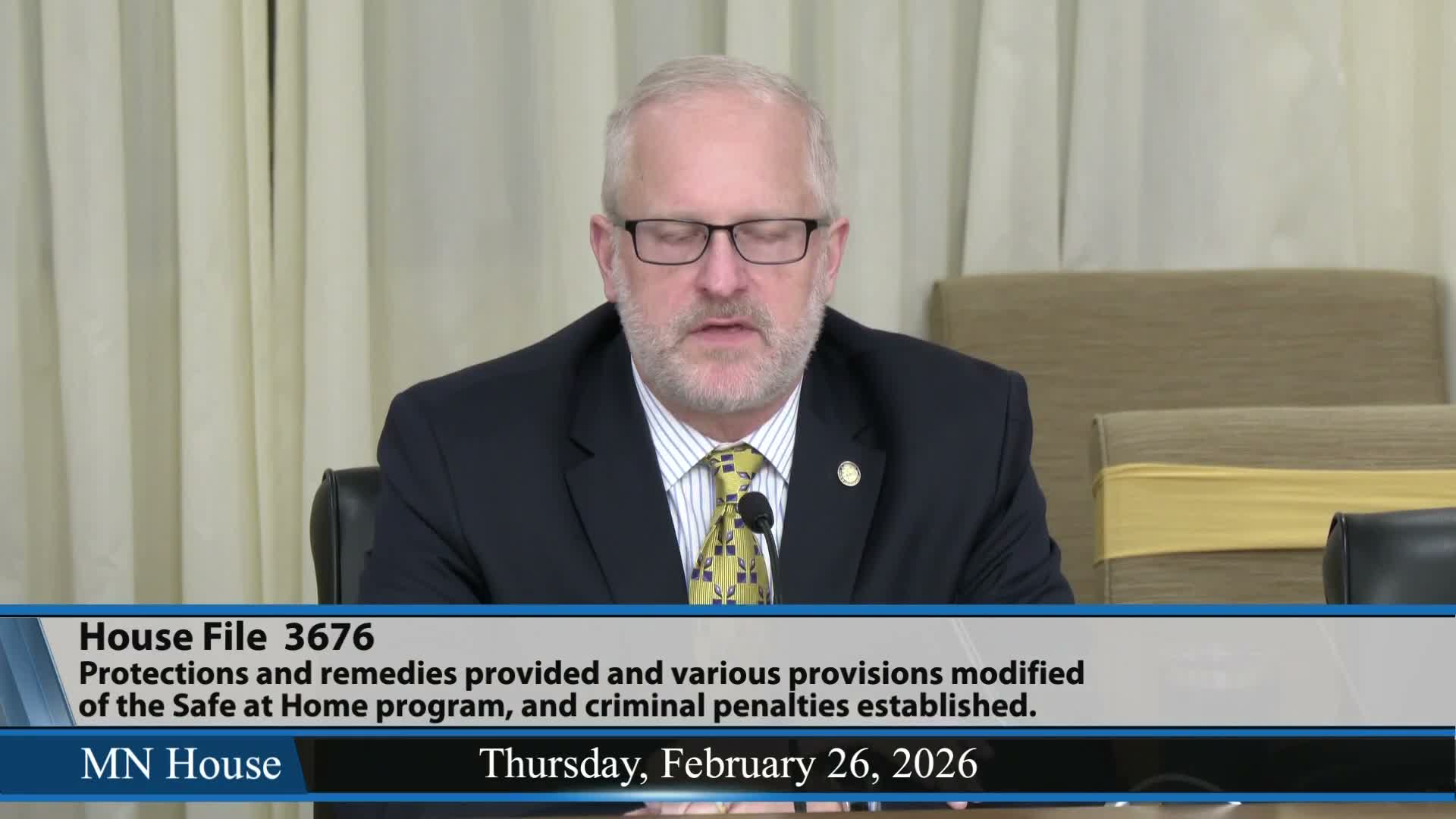
Representative Nash, sponsor of House File 3676, told the committee on Feb. 26 that the bill grew from a constituent’s experience in the Safe at Home address‑confidentiality program and aims to prevent inadvertent disclosures of participants’ previous names and addresses. “When you enter the Safe at Home program, you should become invisible at your request,” Nash said during his opening remarks.
Nicole Freeman, Government Relations Director for the Office of the Secretary of State, walked members through the bill’s provisions. The measure would: add “emancipated minor” to the list of eligible applicants and clarify what counts as a guardian for initial enrollment; require courts to make a written finding and notify the Secretary of State before disclosing a participant’s address; align penalties so that disclosures causing bodily harm are a felony; prohibit discrimination based on Safe at Home participation; designate agency point persons to speed participant inquiries; and allow a regular Safe at Home card to serve as proof of residence (not proof of identity) for obtaining state driver’s licenses or REAL ID.
Diana Yumadan, director of the Safe at Home program, said the office manages roughly 5,400 active participants (about 2,500 households) and described frequent cross‑agency issues—such as real property records, well disclosures and permits—where a designated contact would help resolve participant problems more quickly. “Enrolling in an address‑confidentiality program is a very big safety step,” Yumadan said, and initial enrollments should be made by a parent or court‑appointed guardian when a child is involved.
Members debated language in the A3 amendment that would permit the Safe at Home card to be used as proof of residence but not permit temporary cards issued during pre‑move enrollment to be used for that purpose; Freeman said temporary cards indicate intent to move and are not suitable as proof of residency. The committee also discussed—and removed for further work—two sections that would have required police trainings, with members and the author noting concerns about mandating training without funding.
Chair Scott put the A3 amendment to a voice vote; the chair announced the amendment was adopted. Later in the hearing, Chair Scott renewed his motion that House File 3676, as amended, be recommended to be re‑referred to the Committee on State Government Finance and Policy; the committee voted by voice and the motion was adopted.
Next steps: The committee recommended HF 3676, as amended, for referral to State Government Finance and Policy for further consideration and fiscal review.
Nicole Freeman, Government Relations Director for the Office of the Secretary of State, walked members through the bill’s provisions. The measure would: add “emancipated minor” to the list of eligible applicants and clarify what counts as a guardian for initial enrollment; require courts to make a written finding and notify the Secretary of State before disclosing a participant’s address; align penalties so that disclosures causing bodily harm are a felony; prohibit discrimination based on Safe at Home participation; designate agency point persons to speed participant inquiries; and allow a regular Safe at Home card to serve as proof of residence (not proof of identity) for obtaining state driver’s licenses or REAL ID.
Diana Yumadan, director of the Safe at Home program, said the office manages roughly 5,400 active participants (about 2,500 households) and described frequent cross‑agency issues—such as real property records, well disclosures and permits—where a designated contact would help resolve participant problems more quickly. “Enrolling in an address‑confidentiality program is a very big safety step,” Yumadan said, and initial enrollments should be made by a parent or court‑appointed guardian when a child is involved.
Members debated language in the A3 amendment that would permit the Safe at Home card to be used as proof of residence but not permit temporary cards issued during pre‑move enrollment to be used for that purpose; Freeman said temporary cards indicate intent to move and are not suitable as proof of residency. The committee also discussed—and removed for further work—two sections that would have required police trainings, with members and the author noting concerns about mandating training without funding.
Chair Scott put the A3 amendment to a voice vote; the chair announced the amendment was adopted. Later in the hearing, Chair Scott renewed his motion that House File 3676, as amended, be recommended to be re‑referred to the Committee on State Government Finance and Policy; the committee voted by voice and the motion was adopted.
Next steps: The committee recommended HF 3676, as amended, for referral to State Government Finance and Policy for further consideration and fiscal review.
Don't Miss a Word: See the Full Meeting!
Go beyond summaries. Unlock every video, transcript, and key insight with a Founder Membership.
✓
Get instant access to full meeting videos
✓
Search and clip any phrase from complete transcripts
✓
Receive AI-powered summaries & custom alerts
✓
Enjoy lifetime, unrestricted access to government data
30-day money-back guarantee
