Committee lays over bill to change handling of confidential business data in property tax appeals
February 26, 2026 | 2026 Legislature MN, Minnesota
This article was created by AI summarizing key points discussed. AI makes mistakes, so for full details and context, please refer to the video of the full meeting. Please report any errors so we can fix them. Report an error »
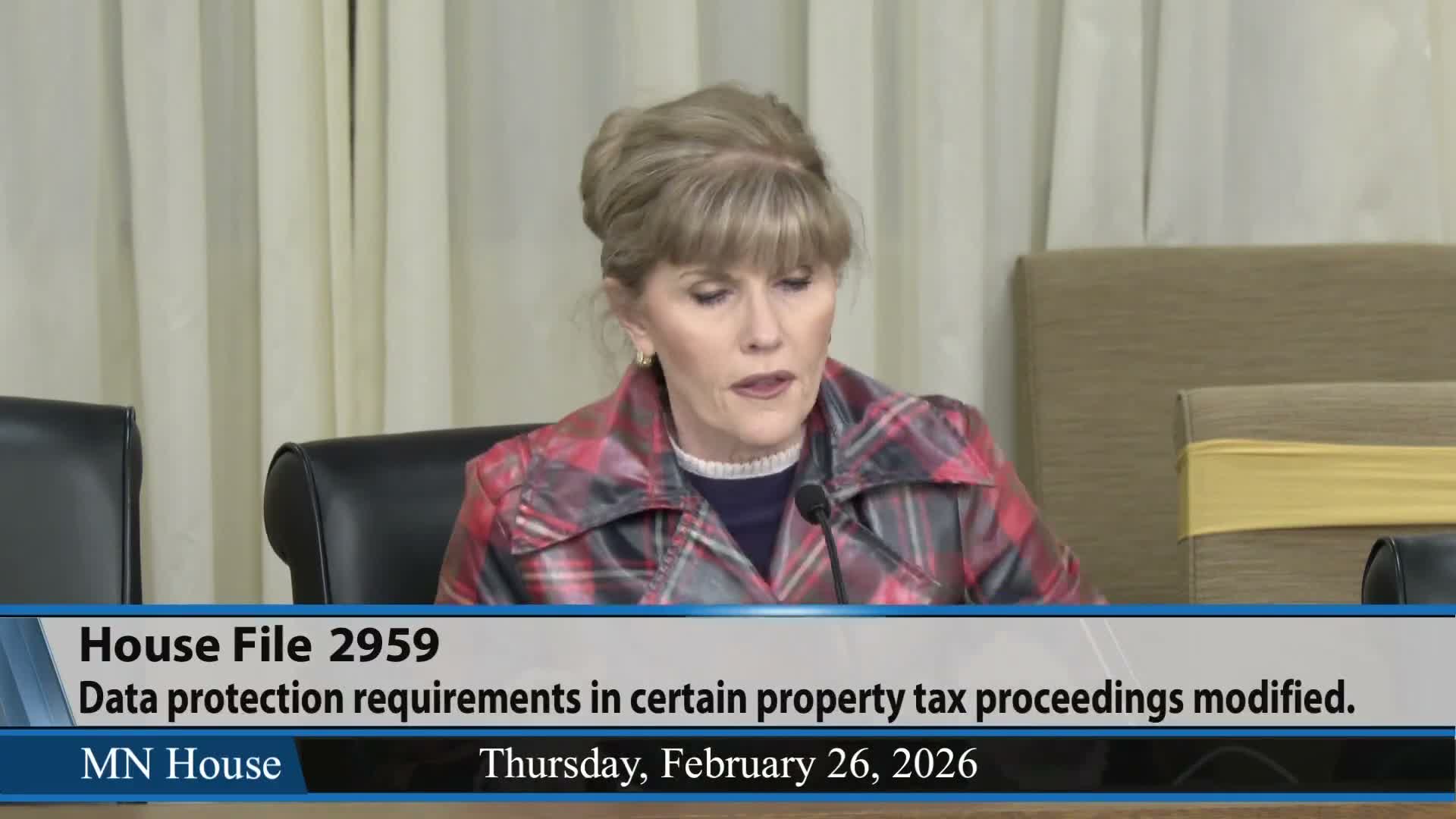
Chair Scott introduced House File 2959 and said the bill responds to a Minnesota Supreme Court decision calling on the legislature to clarify how income‑producing property (IPA) data and other sensitive business information are handled in tax appeals.
Lane Thor, a property tax professional, testified the bill protects confidential taxpayer data and prevents appeals from being dismissed on technicalities; he described current penalties as “extraordinary” and “draconian” and said the change would ensure appeals are decided on valuation merits rather than procedural errors. “Procedural perfection has begun to outweigh fairness in property tax appeals,” Thor said.
Alex Smith, a commercial real estate professional, testified the industry supports protections for proprietary deal terms, rent rolls and concessions, arguing that public disclosure during litigation can harm competitive position and settlement outcomes.
Rebecca Holshue, assistant Hennepin County attorney, opposed the bill. She said current law (citing Minn. Stat. §13.51) classifies the data as nonpublic and requires a court order and notice to owners before disclosure; she warned HF 2959 would eliminate those protections, increase litigation costs through case‑by‑case protective orders, and make it harder for the government to defend assessments — potentially shifting tax burdens to other property owners.
Ramsey County Assessor Pat Chapman echoed concerns about distributional effects, testifying the biggest negative impact would fall on residential taxpayers if large institutional owners obtain lower assessments. House Research (Mr. Hopkins) explained the statutory tension the Supreme Court has identified between chapter 13 (data practices) and chapter 278 (assessor records/evidence rules).
After extended questioning about aggregation of data, confidentiality in work files and the practical implications for assessors and plaintiffs, members said they needed more technical collaboration. Chair Scott laid HF 2959 over for further work and encouraged stakeholders to meet behind the scenes to try to craft a clearer solution.
Next steps: The committee did not take a vote on HF 2959; the bill was laid over for additional negotiation and technical clarification.
Lane Thor, a property tax professional, testified the bill protects confidential taxpayer data and prevents appeals from being dismissed on technicalities; he described current penalties as “extraordinary” and “draconian” and said the change would ensure appeals are decided on valuation merits rather than procedural errors. “Procedural perfection has begun to outweigh fairness in property tax appeals,” Thor said.
Alex Smith, a commercial real estate professional, testified the industry supports protections for proprietary deal terms, rent rolls and concessions, arguing that public disclosure during litigation can harm competitive position and settlement outcomes.
Rebecca Holshue, assistant Hennepin County attorney, opposed the bill. She said current law (citing Minn. Stat. §13.51) classifies the data as nonpublic and requires a court order and notice to owners before disclosure; she warned HF 2959 would eliminate those protections, increase litigation costs through case‑by‑case protective orders, and make it harder for the government to defend assessments — potentially shifting tax burdens to other property owners.
Ramsey County Assessor Pat Chapman echoed concerns about distributional effects, testifying the biggest negative impact would fall on residential taxpayers if large institutional owners obtain lower assessments. House Research (Mr. Hopkins) explained the statutory tension the Supreme Court has identified between chapter 13 (data practices) and chapter 278 (assessor records/evidence rules).
After extended questioning about aggregation of data, confidentiality in work files and the practical implications for assessors and plaintiffs, members said they needed more technical collaboration. Chair Scott laid HF 2959 over for further work and encouraged stakeholders to meet behind the scenes to try to craft a clearer solution.
Next steps: The committee did not take a vote on HF 2959; the bill was laid over for additional negotiation and technical clarification.
View the Full Meeting & All Its Details
This article offers just a summary. Unlock complete video, transcripts, and insights as a Founder Member.
✓
Watch full, unedited meeting videos
✓
Search every word spoken in unlimited transcripts
✓
AI summaries & real-time alerts (all government levels)
✓
Permanent access to expanding government content
30-day money-back guarantee
