Secretary of State outlines new business identity recovery process; office says 54 cases handled since Jan. 1
February 26, 2026 | 2026 Legislature MN, Minnesota
This article was created by AI summarizing key points discussed. AI makes mistakes, so for full details and context, please refer to the video of the full meeting. Please report any errors so we can fix them. Report an error »
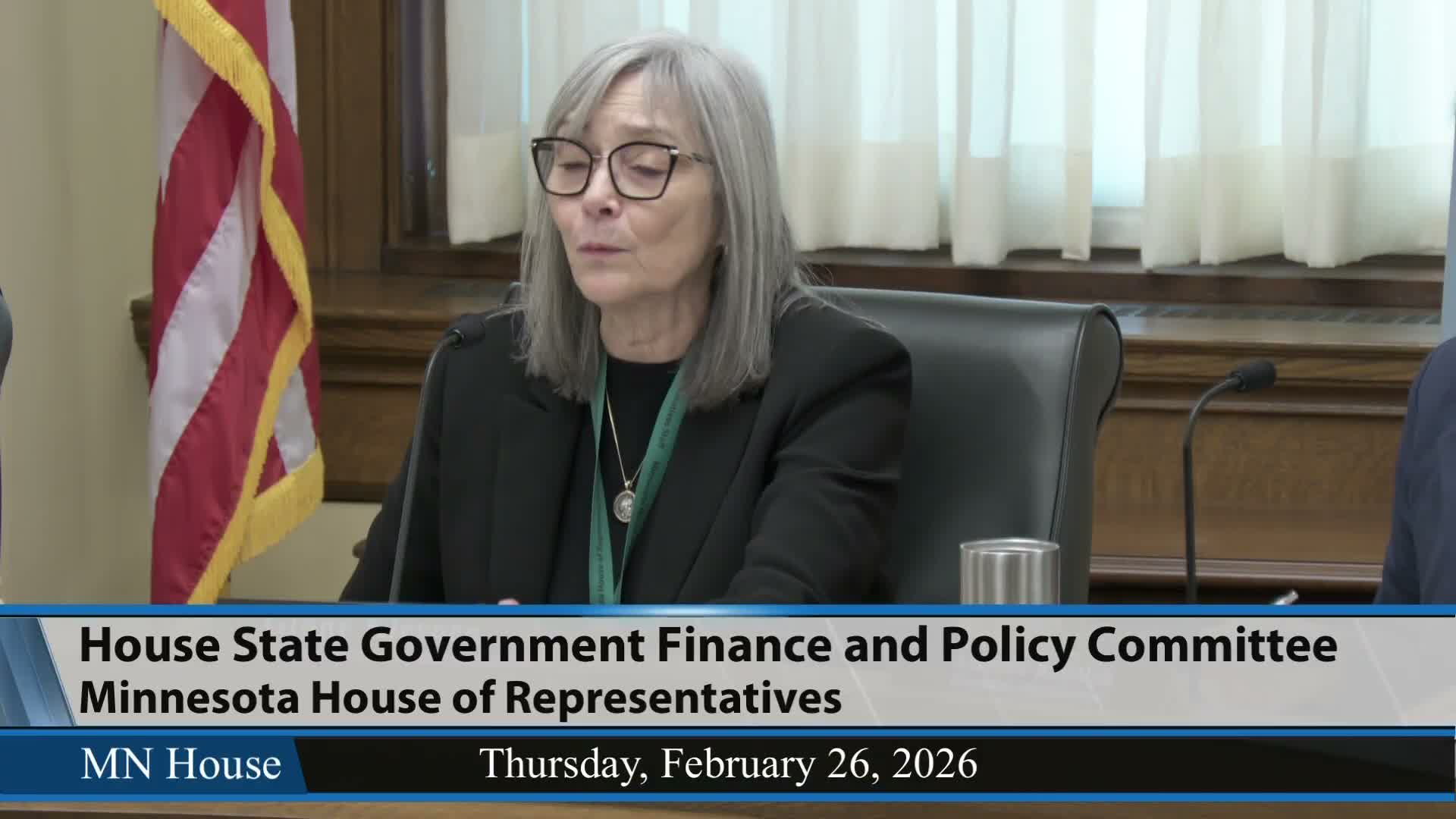
Steve Simon, Minnesota secretary of state, told the House Government Finance and Policy Committee on Feb. 26 that a new administrative process for business identity recovery is providing faster, lower‑cost relief to Minnesotans whose business filings were changed or created without their consent.
The program, enacted last year and effective Jan. 1, allows an individual who believes a filing was made without consent to submit a short declaration to the Secretary of State’s office. The office sends a notice to the party alleged to have made the filing; that party has 21 days to respond. If the notice is returned undeliverable or the party does not respond, the filing is deemed fraudulent and the office redacts the unauthorized information while leaving the filing visible in the system with a notation such as “removed per Minnesota statute 300,” Simon said.
“Before this law, our office had no legal authority to help victims except to tell them to pursue private litigation,” Simon said. The administrative track is designed to reduce the time and cost victims faced getting court orders to correct filings.
Simon provided early program statistics: the office received 54 declarations since the declaration form was posted on Dec. 24; 24 were resolved without any response from the alleged filer, 29 are awaiting the 21‑day deadline, and one was resolved through a phone call after parties clarified a misunderstanding. The office has used case data to inform outreach to business owners about options such as properly dissolving an inactive entity to reduce the risk of misuse.
The office explained that fraudulent filings are redacted rather than removed to preserve transparency for banks and other agencies that rely on the historical record. Anyone who disagrees with the office’s determination may appeal to district court, Simon said.
Simon and committee members discussed how most businesses are required to register with the Secretary of State’s office but that some categories — for example, certain sole proprietors — may be exempt from filing requirements. Committee members thanked staff and asked the nonpartisan staff and co-chairs to continue work on procedural questions related to minutes and roll-call practice during a tied legislature.
The committee did not take a formal vote on the administration of the recovery program; Simon said the office continues to refine implementation and educational outreach.
The program, enacted last year and effective Jan. 1, allows an individual who believes a filing was made without consent to submit a short declaration to the Secretary of State’s office. The office sends a notice to the party alleged to have made the filing; that party has 21 days to respond. If the notice is returned undeliverable or the party does not respond, the filing is deemed fraudulent and the office redacts the unauthorized information while leaving the filing visible in the system with a notation such as “removed per Minnesota statute 300,” Simon said.
“Before this law, our office had no legal authority to help victims except to tell them to pursue private litigation,” Simon said. The administrative track is designed to reduce the time and cost victims faced getting court orders to correct filings.
Simon provided early program statistics: the office received 54 declarations since the declaration form was posted on Dec. 24; 24 were resolved without any response from the alleged filer, 29 are awaiting the 21‑day deadline, and one was resolved through a phone call after parties clarified a misunderstanding. The office has used case data to inform outreach to business owners about options such as properly dissolving an inactive entity to reduce the risk of misuse.
The office explained that fraudulent filings are redacted rather than removed to preserve transparency for banks and other agencies that rely on the historical record. Anyone who disagrees with the office’s determination may appeal to district court, Simon said.
Simon and committee members discussed how most businesses are required to register with the Secretary of State’s office but that some categories — for example, certain sole proprietors — may be exempt from filing requirements. Committee members thanked staff and asked the nonpartisan staff and co-chairs to continue work on procedural questions related to minutes and roll-call practice during a tied legislature.
The committee did not take a formal vote on the administration of the recovery program; Simon said the office continues to refine implementation and educational outreach.
View the Full Meeting & All Its Details
This article offers just a summary. Unlock complete video, transcripts, and insights as a Founder Member.
✓
Watch full, unedited meeting videos
✓
Search every word spoken in unlimited transcripts
✓
AI summaries & real-time alerts (all government levels)
✓
Permanent access to expanding government content
30-day money-back guarantee
