Survivor advocates urge $2.5M–$3M boost to Alaska’s domestic violence grants
February 26, 2026 | 2026 Legislature Alaska, Alaska
This article was created by AI summarizing key points discussed. AI makes mistakes, so for full details and context, please refer to the video of the full meeting. Please report any errors so we can fix them. Report an error »
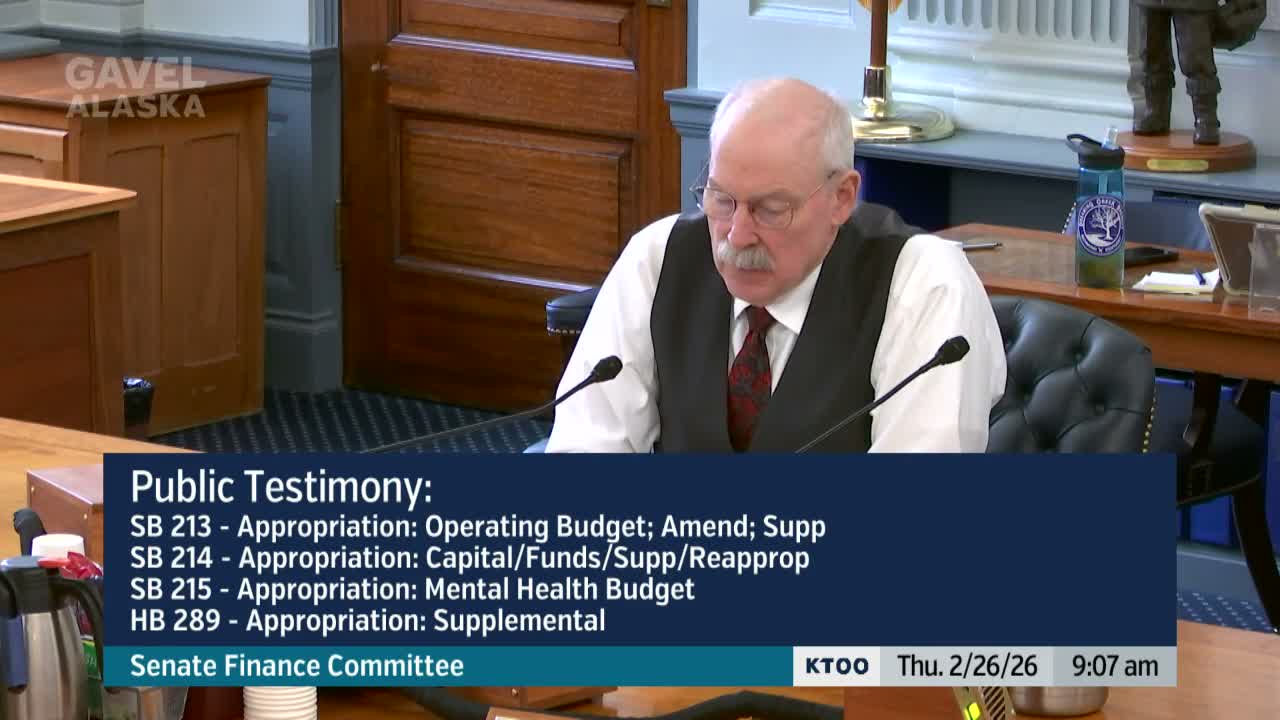
Advocates for survivors of domestic violence and sexual assault told the Alaska Senate Finance Committee on Feb. 26 that long‑flat state grant funding is forcing community programs to cut services just as demand rises.
Christine Pate, legal program director at the Alaska Network on Domestic Violence and Sexual Assault, asked the committee to increase the CDVSA budget by $3,000,000 and singled out a $500,000 request for civil legal services, explaining that ‘‘in the civil justice system there’s no right to counsel’’ and that survivors need help obtaining protection orders, custody and spousal support. She said her program provided legal services to 363 people in FY25 and relies on volunteers and contract attorneys.
Speakers from Cordova, Kodiak, Petersburg and Prince of Wales described similar strains. Peter Hefner, president of the board of Cordova Family Resources Center, said a $2.5 million CDVSA appropriation is necessary ‘‘to prevent reductions to community based organizations’’ that provide shelter, hotlines and advocacy. Penny Lampehl of the Kodiak Women’s Resource and Crisis Center said Kodiak and seven surrounding villages ‘‘depend on us’’ and that her center is at bare minimum staffing.
Julie Alexander, community outreach advocate on Prince of Wales Island, said grant funding has been flat since 2017 while prices have risen dramatically, and asked for $2,000,000 for direct services to survivors and $500,000 for legal services to absorb roughly 24% inflation since 2017. Kara Fry of Petersburg said demand for services in her program increased 53% from 2024 to 2025 and requested the same $2,500,000 increase with a $500,000 legal‑services allocation.
Laurie Morton, deputy director of the Alaska Network on Domestic Violence and Sexual Assault, explained the linkage between state general fund payouts and federal Victims of Crime Act reimbursements and asked for $1,000,000 in undesignated state general funds for the Violent Crimes Compensation Board to stabilize future federal reimbursements.
Advocates warned that without additional state funding, programs will face staff losses, reduced hotline coverage and closed shelter beds, leaving some communities without services. The committee did not take a vote; the testimony was offered as part of public comment on the FY27 operating and mental health budgets (Senate Bills 213, 214, 215) and the supplemental (House Bill 289).
Christine Pate, legal program director at the Alaska Network on Domestic Violence and Sexual Assault, asked the committee to increase the CDVSA budget by $3,000,000 and singled out a $500,000 request for civil legal services, explaining that ‘‘in the civil justice system there’s no right to counsel’’ and that survivors need help obtaining protection orders, custody and spousal support. She said her program provided legal services to 363 people in FY25 and relies on volunteers and contract attorneys.
Speakers from Cordova, Kodiak, Petersburg and Prince of Wales described similar strains. Peter Hefner, president of the board of Cordova Family Resources Center, said a $2.5 million CDVSA appropriation is necessary ‘‘to prevent reductions to community based organizations’’ that provide shelter, hotlines and advocacy. Penny Lampehl of the Kodiak Women’s Resource and Crisis Center said Kodiak and seven surrounding villages ‘‘depend on us’’ and that her center is at bare minimum staffing.
Julie Alexander, community outreach advocate on Prince of Wales Island, said grant funding has been flat since 2017 while prices have risen dramatically, and asked for $2,000,000 for direct services to survivors and $500,000 for legal services to absorb roughly 24% inflation since 2017. Kara Fry of Petersburg said demand for services in her program increased 53% from 2024 to 2025 and requested the same $2,500,000 increase with a $500,000 legal‑services allocation.
Laurie Morton, deputy director of the Alaska Network on Domestic Violence and Sexual Assault, explained the linkage between state general fund payouts and federal Victims of Crime Act reimbursements and asked for $1,000,000 in undesignated state general funds for the Violent Crimes Compensation Board to stabilize future federal reimbursements.
Advocates warned that without additional state funding, programs will face staff losses, reduced hotline coverage and closed shelter beds, leaving some communities without services. The committee did not take a vote; the testimony was offered as part of public comment on the FY27 operating and mental health budgets (Senate Bills 213, 214, 215) and the supplemental (House Bill 289).
View the Full Meeting & All Its Details
This article offers just a summary. Unlock complete video, transcripts, and insights as a Founder Member.
✓
Watch full, unedited meeting videos
✓
Search every word spoken in unlimited transcripts
✓
AI summaries & real-time alerts (all government levels)
✓
Permanent access to expanding government content
30-day money-back guarantee
