Norman staff seek direction on FY27 transit budget as microtransit costs loom
February 26, 2026 | Norman, Cleveland County, Oklahoma
This article was created by AI summarizing key points discussed. AI makes mistakes, so for full details and context, please refer to the video of the full meeting. Please report any errors so we can fix them. Report an error »
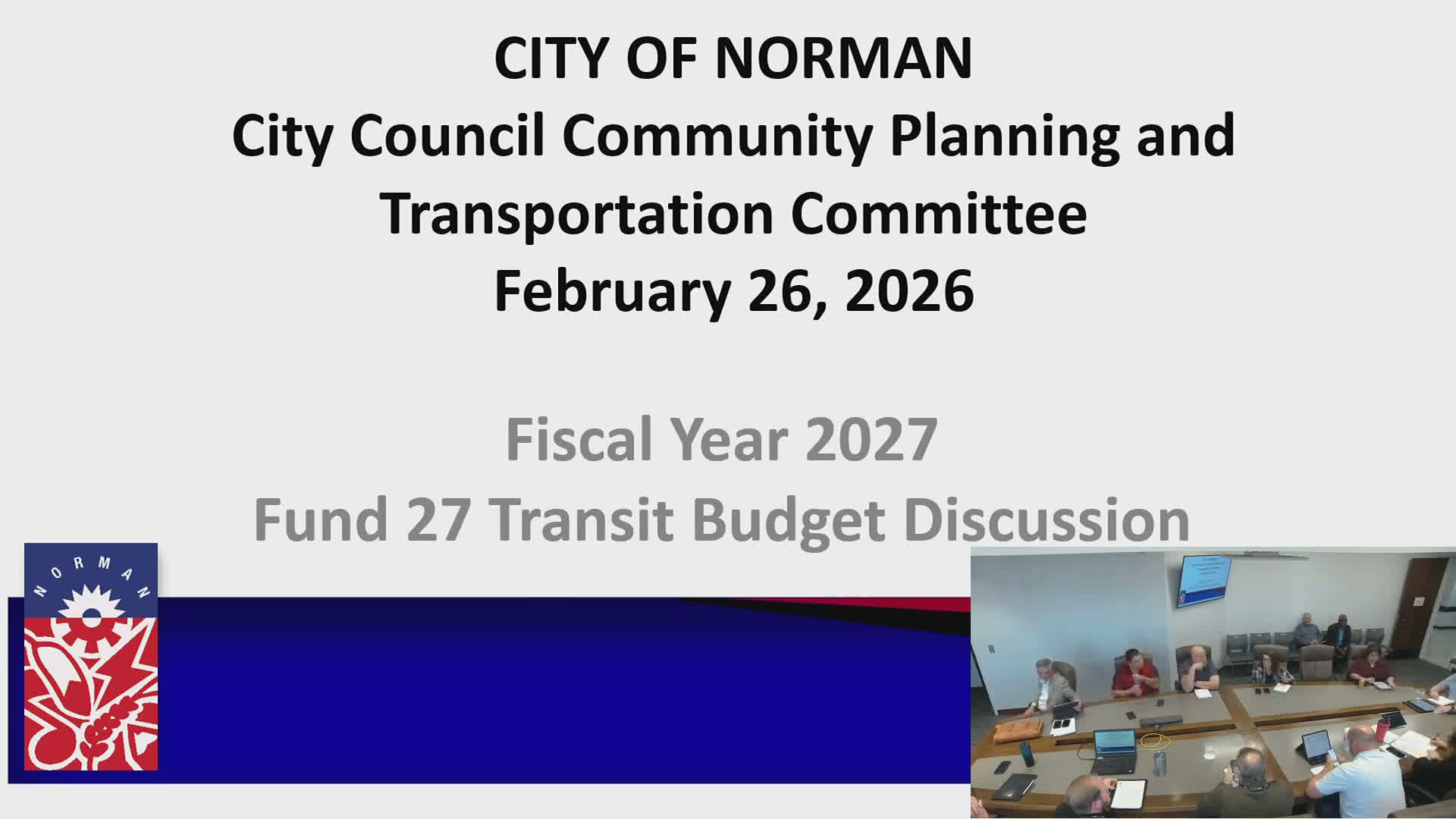
Taylor, the city transit staff presenter, opened the committee’s Feb. 26 discussion by reviewing January ridership and FY27 projections, calling out a projected $589,000 gap if the city funds all proposed service changes. He said the city currently receives most transit revenue from the FTA Section 5307 apportionment and the dedicated 1/8‑cent local transit sales tax and estimated total transit and parking revenues at about $6.9 million for the coming year.
Taylor warned of procurement and cost risks for vehicles on order: "we only have 1 bus that should be replaced that's not on order," and three large Gillig buses on contract could carry tariff-driven surcharges that would raise future costs. He also cited weather and a lost service weekday as reasons January system ridership dropped from nearly 40,000 to just under 35,000 year‑over‑year.
The committee spent most time on Norman on Demand, the city’s microtransit pilot launched in August 2023. Staff said a contractor estimate for 12 months of service is about $650,000; with the University of Oklahoma contributing roughly $131,000 this fiscal year, staff estimated a net city cost in the neighborhood of $518,000 if the university’s support holds. Councilors and staff repeatedly framed the service as ADA‑oriented and late‑night fill‑in service rather than a substitute for fixed routes; staff noted the ADA‑accessible vehicles increase per-trip cost.
A quick, on-the-record back‑of‑the‑napkin cost figure raised during the meeting placed Norman on Demand at roughly $21.22 per trip; staff said they would return with refined calculations and a clearer accounting of ADA versus general‑ridership trips. Taylor also described a pending competitive grant application, the "Embark Well" request to TSET (the Oklahoma Tobacco Settlement Endowment Trust), for $100,000 per year over three years that, if awarded, could subsidize microtransit operations for multiple years.
Councilors pressed for priorities if the city were to use the projected surplus: several members voiced support for adding modest security at the transit center (estimated $28,000 annually) to keep restrooms open during staffed hours and to protect customers, while suggesting microtransit hours or coverage could be trimmed to preserve reserve targets. Staff said they could phase frequency increases such as a proposed Route 110 half‑hour headway (estimated at about $335,000 annually) and would coordinate any changes with OU and the operator to avoid abrupt disruptions.
Staff emphasized the fund‑balance risk if the city used the entire projected surplus: doing so would exhaust the fund’s reserve for FY27. The committee asked staff to return with scenario options that show the effect of different combinations of (1) continuing full microtransit service, (2) trimming hours or zones to reduce cost, (3) funding transit‑center security, and (4) phasing frequency increases for fixed routes.
The committee did not make a formal motion on FY27 funding at the Feb. 26 meeting; staff will bring detailed budget options and contractor/OU coordination plans back in subsequent sessions.
Taylor warned of procurement and cost risks for vehicles on order: "we only have 1 bus that should be replaced that's not on order," and three large Gillig buses on contract could carry tariff-driven surcharges that would raise future costs. He also cited weather and a lost service weekday as reasons January system ridership dropped from nearly 40,000 to just under 35,000 year‑over‑year.
The committee spent most time on Norman on Demand, the city’s microtransit pilot launched in August 2023. Staff said a contractor estimate for 12 months of service is about $650,000; with the University of Oklahoma contributing roughly $131,000 this fiscal year, staff estimated a net city cost in the neighborhood of $518,000 if the university’s support holds. Councilors and staff repeatedly framed the service as ADA‑oriented and late‑night fill‑in service rather than a substitute for fixed routes; staff noted the ADA‑accessible vehicles increase per-trip cost.
A quick, on-the-record back‑of‑the‑napkin cost figure raised during the meeting placed Norman on Demand at roughly $21.22 per trip; staff said they would return with refined calculations and a clearer accounting of ADA versus general‑ridership trips. Taylor also described a pending competitive grant application, the "Embark Well" request to TSET (the Oklahoma Tobacco Settlement Endowment Trust), for $100,000 per year over three years that, if awarded, could subsidize microtransit operations for multiple years.
Councilors pressed for priorities if the city were to use the projected surplus: several members voiced support for adding modest security at the transit center (estimated $28,000 annually) to keep restrooms open during staffed hours and to protect customers, while suggesting microtransit hours or coverage could be trimmed to preserve reserve targets. Staff said they could phase frequency increases such as a proposed Route 110 half‑hour headway (estimated at about $335,000 annually) and would coordinate any changes with OU and the operator to avoid abrupt disruptions.
Staff emphasized the fund‑balance risk if the city used the entire projected surplus: doing so would exhaust the fund’s reserve for FY27. The committee asked staff to return with scenario options that show the effect of different combinations of (1) continuing full microtransit service, (2) trimming hours or zones to reduce cost, (3) funding transit‑center security, and (4) phasing frequency increases for fixed routes.
The committee did not make a formal motion on FY27 funding at the Feb. 26 meeting; staff will bring detailed budget options and contractor/OU coordination plans back in subsequent sessions.
Don't Miss a Word: See the Full Meeting!
Go beyond summaries. Unlock every video, transcript, and key insight with a Founder Membership.
✓
Get instant access to full meeting videos
✓
Search and clip any phrase from complete transcripts
✓
Receive AI-powered summaries & custom alerts
✓
Enjoy lifetime, unrestricted access to government data
30-day money-back guarantee
