Committee backs bill to prioritize Florida students at preeminent universities, adopts amendment
February 26, 2026 | 2026 Legislature FL, Florida
This article was created by AI summarizing key points discussed. AI makes mistakes, so for full details and context, please refer to the video of the full meeting. Please report any errors so we can fix them. Report an error »
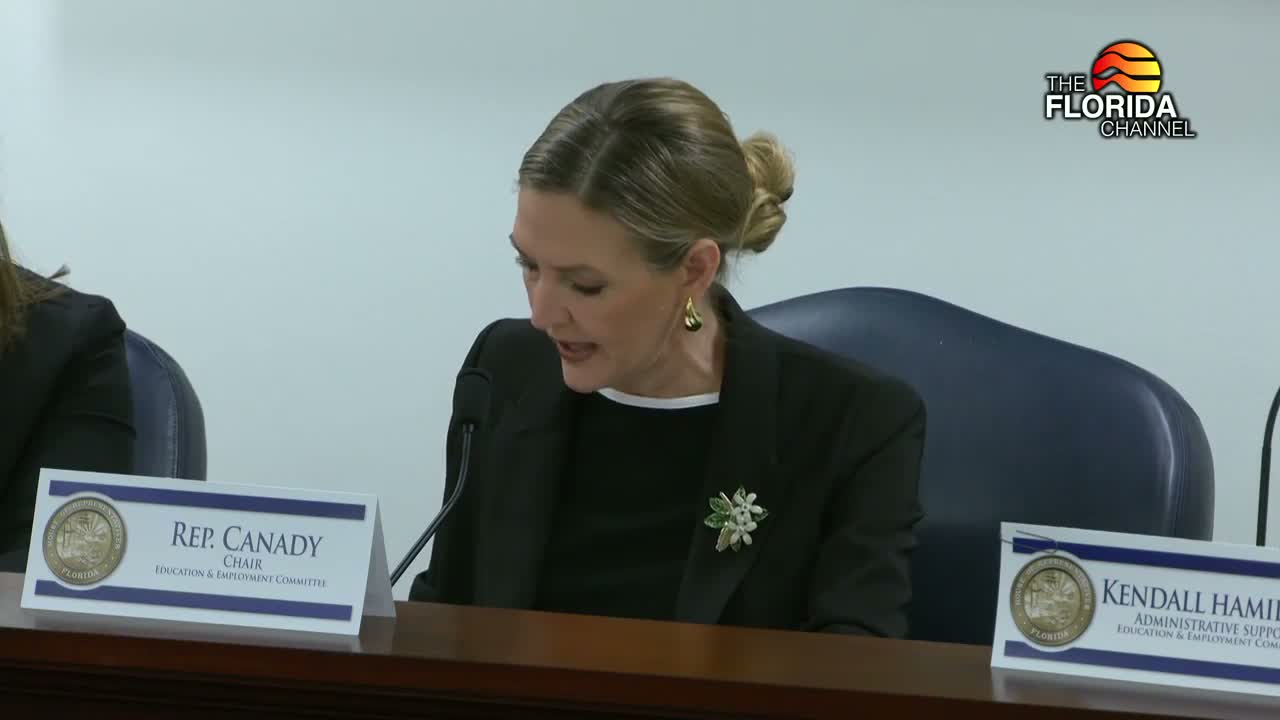
Representative Ken Cart Johnson introduced PCS for CS for HB 12‑79, saying the measure aims to ‘‘promote consistency and academic rigor, improve oversight and transparency’’ and open more seats at Florida’s preeminent universities for in‑state students. The sponsor told the committee the change is not intended to lower admissions standards and cited state university revenue of about $17 billion, characterizing the revenue impact as roughly 0.2 percent of that total.
The bill would require a 95 percent Florida‑resident enrollment target for the state’s preeminent universities, applied using a three‑year rolling average so funding penalties would not be applied immediately; the sponsor said a school would first be eligible to lose preeminent funding under the metric in 2030. The measure also revises a performance‑funding access metric to track the percentage of first‑year, fall‑term undergraduates receiving Pell Grants rather than all Pell recipients, and removes a statutory reference to the American Bar Association for some law schools while leaving accreditation options available.
During questioning, members pressed the sponsor on whether limiting out‑of‑state enrollment would harm university budgets. The sponsor responded that the 95 percent target affects only a small share of overall revenue and noted that, he said, 45 percent of out‑of‑state students receive fee waivers and therefore often pay in‑state rates. Members also asked about implementation issues such as weighted GPAs and engineering programs that require more than 120 credit hours; the sponsor said stakeholders had raised engineering as a specific concern and the bill was adjusted to avoid unfairly penalizing those programs.
Representative Kinkert Johnson offered amendment A‑1 to remove an adjustment to how the four‑year graduation rate metric is calculated; there was no debate on the amendment and the committee adopted it by voice vote. In public testimony, Marquise McMillan (Orange County Public Schools) waived in support. Bob Harris of Bridal Dental Assisting urged removing a section affecting dental assisting programs so they could be negotiated with stakeholders, saying the Board of Dentistry has overseen such programs for decades and calling the change ‘‘a solution to a problem that does not exist.’’ Edwin Bayou, an attorney and former counsel to the Board of Dentistry, also opposed the dental‑program change. Joanne Hart of the Florida Dental Association waived in support; Leticia Harmon of Florida Rising registered opposition.
After debate emphasizing the goal of keeping Florida students in state and noting continued work on details such as accreditation and Pell‑grant metrics, the committee voted by roll call: 17 yeas, 2 nays (Representative Harris and Ranking Member Henson). The bill was reported favorably.
Next steps: the committee reported HB 12‑79 favorably to the full House.
The bill would require a 95 percent Florida‑resident enrollment target for the state’s preeminent universities, applied using a three‑year rolling average so funding penalties would not be applied immediately; the sponsor said a school would first be eligible to lose preeminent funding under the metric in 2030. The measure also revises a performance‑funding access metric to track the percentage of first‑year, fall‑term undergraduates receiving Pell Grants rather than all Pell recipients, and removes a statutory reference to the American Bar Association for some law schools while leaving accreditation options available.
During questioning, members pressed the sponsor on whether limiting out‑of‑state enrollment would harm university budgets. The sponsor responded that the 95 percent target affects only a small share of overall revenue and noted that, he said, 45 percent of out‑of‑state students receive fee waivers and therefore often pay in‑state rates. Members also asked about implementation issues such as weighted GPAs and engineering programs that require more than 120 credit hours; the sponsor said stakeholders had raised engineering as a specific concern and the bill was adjusted to avoid unfairly penalizing those programs.
Representative Kinkert Johnson offered amendment A‑1 to remove an adjustment to how the four‑year graduation rate metric is calculated; there was no debate on the amendment and the committee adopted it by voice vote. In public testimony, Marquise McMillan (Orange County Public Schools) waived in support. Bob Harris of Bridal Dental Assisting urged removing a section affecting dental assisting programs so they could be negotiated with stakeholders, saying the Board of Dentistry has overseen such programs for decades and calling the change ‘‘a solution to a problem that does not exist.’’ Edwin Bayou, an attorney and former counsel to the Board of Dentistry, also opposed the dental‑program change. Joanne Hart of the Florida Dental Association waived in support; Leticia Harmon of Florida Rising registered opposition.
After debate emphasizing the goal of keeping Florida students in state and noting continued work on details such as accreditation and Pell‑grant metrics, the committee voted by roll call: 17 yeas, 2 nays (Representative Harris and Ranking Member Henson). The bill was reported favorably.
Next steps: the committee reported HB 12‑79 favorably to the full House.
View the Full Meeting & All Its Details
This article offers just a summary. Unlock complete video, transcripts, and insights as a Founder Member.
✓
Watch full, unedited meeting videos
✓
Search every word spoken in unlimited transcripts
✓
AI summaries & real-time alerts (all government levels)
✓
Permanent access to expanding government content
30-day money-back guarantee
