Legislative audit finds widespread grant oversight failures at Behavioral Health Administration
February 27, 2026 | 2026 Legislature MN, Minnesota
This article was created by AI summarizing key points discussed. AI makes mistakes, so for full details and context, please refer to the video of the full meeting. Please report any errors so we can fix them. Report an error »
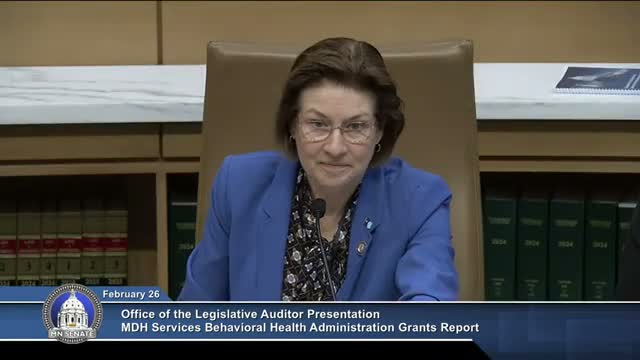
ST. PAUL, Minn. — A performance audit presented Feb. 26 to the Minnesota House Health and Human Services Finance and Policy Committee found substantial lapses in how the Department of Human Services' Behavioral Health Administration (BHA) managed grants, including failures to follow competitive bidding, missing monitoring and questionable payments.
Deputy Legislative Auditor Laurie Lyson, presenting results from an Office of the Legislative Auditor (OLA) performance audit covering July 2022 through December 2024, told the committee that BHA spent about $425 million on behavioral‑health grants during the audit period, including nearly $192 million to nongovernmental organizations. OLA focused its testing on nongovernmental grantees and reported 13 findings, four of them repeats of problems identified in a 2021 review.
Lyson outlined multiple problems: 15 of 24 single‑source grants tested did not meet requirements that justify bypassing competitive solicitations; OLA estimated $4.6 million was paid to grantees where other entities could have provided services. Auditors found BHA paid more than $915,000 to six grantees for work performed before grant agreements were finalized and identified nearly $42,000 in overpayments to two grantees for services auditors could not verify.
The audit raised serious monitoring and reconciliation deficiencies. For grants that required monitoring visits, auditors determined BHA could not demonstrate completion of 27 of 67 required site visits in their sample. Financial reconciliations were incomplete for 63 of 71 tested transactions: 25 had no documentation, 37 had limited documentation, and two reconciliations were completed after final payment. OLA’s own follow‑up financial reconciliations questioned $296,000 across 11 grantees tested.
Lyson also described an on‑site review of one grantee and 14 subcontractors where auditors could not determine whether services were provided. For a $1.6 million grant, auditors questioned a first payment of $672,000 for a single month; the grant manager who authorized that payment later left DHS and, according to OLA, worked as a consultant for the grantee.
"We determined BHA did not comply with most of the criteria we tested," Lyson said.
Committee members reacted sharply. "These are gross failures at the lowest level," said Senator Grama, who pointed to the large questioned invoice, the repeated audit findings and what she described as backdating or falsification of records in some cases.
DHS Commissioner Shereen Gandhi responded that the department takes the findings seriously and has already opened internal investigations. Gandhi said DHS's internal audits division investigated after an employee reported concerns, that DHS referred matters to the Bureau of Criminal Apprehension and that the Attorney General's Office is working to recoup funds. She said investigators completed interviews and investigative reports were delivered to human resources for review and action.
"We are using the findings as our roadmap for prioritizing the work to continue strengthening the oversight and integrity of the behavioral health grants," Gandhi said, adding many corrective actions are scheduled to be completed by midyear and the remainder by the end of the year.
Gandhi told the committee DHS has been building its capacity: the Central Grants Office, funded in 2023, maintains a contracts integration system and DHS elevated the grant unit to an administration and added compliance staff in 2024. She also attributed some problems to thin administrative funding — DHS's administrative budget for grants is roughly 2–3 percent while programmatic grant dollars have grown substantially.
Auditors told the committee they will continue follow‑up reports; OLA staff said the office now provides annual updates on prior recommendations and will re‑test implementation in due course.
What happens next: The committee and OLA members urged prompt follow‑up on sites where auditors observed little or no activity on the day of their visit. DHS said it will continue its internal investigations, pursue appropriate personnel actions where warranted, and work with law enforcement and the Attorney General on recovery of funds. OLA said it will track implementation of the report's 13 findings in future follow‑up work.
Sources: Testimony at the Health and Human Services Finance and Policy Committee hearing, Feb. 26, 2026; Office of the Legislative Auditor presentation; Department of Human Services remarks.
Deputy Legislative Auditor Laurie Lyson, presenting results from an Office of the Legislative Auditor (OLA) performance audit covering July 2022 through December 2024, told the committee that BHA spent about $425 million on behavioral‑health grants during the audit period, including nearly $192 million to nongovernmental organizations. OLA focused its testing on nongovernmental grantees and reported 13 findings, four of them repeats of problems identified in a 2021 review.
Lyson outlined multiple problems: 15 of 24 single‑source grants tested did not meet requirements that justify bypassing competitive solicitations; OLA estimated $4.6 million was paid to grantees where other entities could have provided services. Auditors found BHA paid more than $915,000 to six grantees for work performed before grant agreements were finalized and identified nearly $42,000 in overpayments to two grantees for services auditors could not verify.
The audit raised serious monitoring and reconciliation deficiencies. For grants that required monitoring visits, auditors determined BHA could not demonstrate completion of 27 of 67 required site visits in their sample. Financial reconciliations were incomplete for 63 of 71 tested transactions: 25 had no documentation, 37 had limited documentation, and two reconciliations were completed after final payment. OLA’s own follow‑up financial reconciliations questioned $296,000 across 11 grantees tested.
Lyson also described an on‑site review of one grantee and 14 subcontractors where auditors could not determine whether services were provided. For a $1.6 million grant, auditors questioned a first payment of $672,000 for a single month; the grant manager who authorized that payment later left DHS and, according to OLA, worked as a consultant for the grantee.
"We determined BHA did not comply with most of the criteria we tested," Lyson said.
Committee members reacted sharply. "These are gross failures at the lowest level," said Senator Grama, who pointed to the large questioned invoice, the repeated audit findings and what she described as backdating or falsification of records in some cases.
DHS Commissioner Shereen Gandhi responded that the department takes the findings seriously and has already opened internal investigations. Gandhi said DHS's internal audits division investigated after an employee reported concerns, that DHS referred matters to the Bureau of Criminal Apprehension and that the Attorney General's Office is working to recoup funds. She said investigators completed interviews and investigative reports were delivered to human resources for review and action.
"We are using the findings as our roadmap for prioritizing the work to continue strengthening the oversight and integrity of the behavioral health grants," Gandhi said, adding many corrective actions are scheduled to be completed by midyear and the remainder by the end of the year.
Gandhi told the committee DHS has been building its capacity: the Central Grants Office, funded in 2023, maintains a contracts integration system and DHS elevated the grant unit to an administration and added compliance staff in 2024. She also attributed some problems to thin administrative funding — DHS's administrative budget for grants is roughly 2–3 percent while programmatic grant dollars have grown substantially.
Auditors told the committee they will continue follow‑up reports; OLA staff said the office now provides annual updates on prior recommendations and will re‑test implementation in due course.
What happens next: The committee and OLA members urged prompt follow‑up on sites where auditors observed little or no activity on the day of their visit. DHS said it will continue its internal investigations, pursue appropriate personnel actions where warranted, and work with law enforcement and the Attorney General on recovery of funds. OLA said it will track implementation of the report's 13 findings in future follow‑up work.
Sources: Testimony at the Health and Human Services Finance and Policy Committee hearing, Feb. 26, 2026; Office of the Legislative Auditor presentation; Department of Human Services remarks.
Don't Miss a Word: See the Full Meeting!
Go beyond summaries. Unlock every video, transcript, and key insight with a Founder Membership.
✓
Get instant access to full meeting videos
✓
Search and clip any phrase from complete transcripts
✓
Receive AI-powered summaries & custom alerts
✓
Enjoy lifetime, unrestricted access to government data
30-day money-back guarantee
