Minnesota committee hears bipartisan calls to curb crypto‑kiosk fraud; bill laid over
February 26, 2026 | 2026 Legislature MN, Minnesota
This article was created by AI summarizing key points discussed. AI makes mistakes, so for full details and context, please refer to the video of the full meeting. Please report any errors so we can fix them. Report an error »
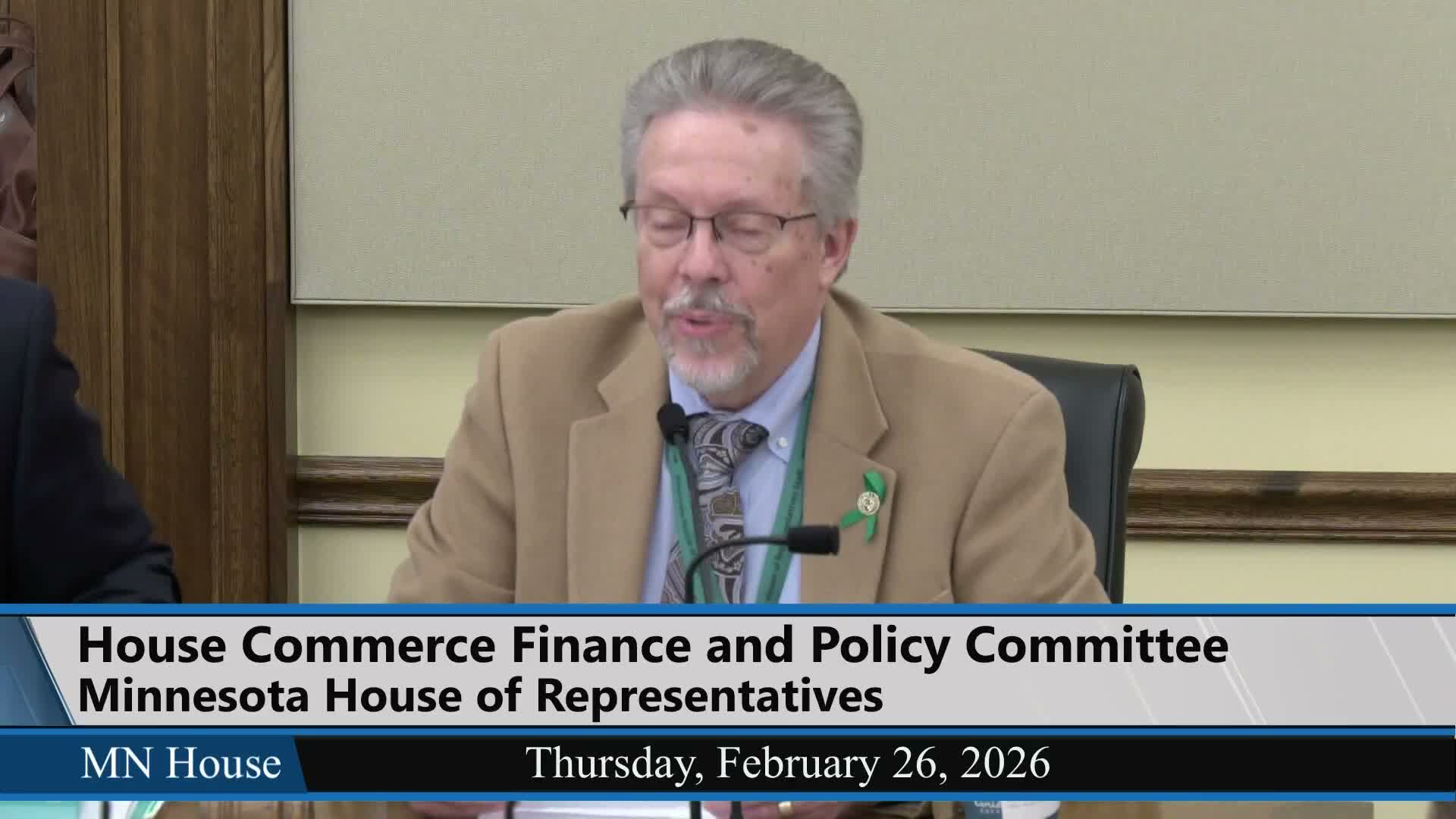
Representative Cagle introduced House File 3642 to prohibit virtual‑currency (crypto) kiosks in Minnesota, saying law enforcement has flagged the machines as a prime target for scammers and that cryptocurrency transactions are often irreversible, leaving victims with little recourse.
Law‑enforcement witnesses told the committee they are seeing recurring and sophisticated schemes. Sgt. Jake Lance of the St. Cloud Police Department described a case in which a 78‑year‑old woman lost $80,000 after being instructed to use a Bitcoin ATM. Detective Lynn Lawrence of the Woodbury Police Department said officers encounter victims who repeatedly make kiosk transactions over months and sometimes give up half their monthly income; she said current safeguards such as on‑screen warnings, daily limits and refund provisions have been circumvented.
Industry testimony came from Larry Lipka, general counsel for CoinFlip, which operates kiosks. Lipka acknowledged fraud exists but argued kiosks are a legitimate, convenient on‑ramp to crypto for cash‑based and unbanked customers, pointed to operator practices such as hold periods for new customers and voluntary refunds, and urged enhanced regulation — including blockchain analytics and customer‑service requirements — rather than a ban.
Jim Glass, an AARP volunteer and former banking regulator, and Sam Smith of the Minnesota Department of Commerce urged stronger statewide action. Smith said the department received 120 complaints over three years tied to kiosk transactions (just under $1 million reported losses), with 70 cases and $540,000 reported in 2025 alone; he also cited an FBI estimate of roughly $240 million in crypto‑kiosk‑related losses nationally during the first half of 2025. Department staff told the committee there are about 350 licensed kiosks operating in Minnesota across roughly 8–10 operators, though unlicensed kiosks may exist.
Committee members pressed for more data and clarification on (1) how kiosks are being exploited to evade new‑customer protections, (2) the mechanics and rates of refunds, (3) the difficulty of tracing funds once converted to cryptocurrency, and (4) cross‑border activity. Industry and agency witnesses disputed on some points: CoinFlip said refund and hold practices protect customers and that banning kiosks would shift scams to other channels, while law enforcement and consumer advocates said many victims fall outside protections and recovery is rare.
After questions and discussion, the committee adopted a DE1 author’s amendment and laid H.F. 3642 over for further work, directing stakeholders and agencies to continue discussions on protections and possible regulatory fixes.
The committee did not vote on final passage. Further hearings and follow‑up information from the Department of Commerce and industry were requested.
Law‑enforcement witnesses told the committee they are seeing recurring and sophisticated schemes. Sgt. Jake Lance of the St. Cloud Police Department described a case in which a 78‑year‑old woman lost $80,000 after being instructed to use a Bitcoin ATM. Detective Lynn Lawrence of the Woodbury Police Department said officers encounter victims who repeatedly make kiosk transactions over months and sometimes give up half their monthly income; she said current safeguards such as on‑screen warnings, daily limits and refund provisions have been circumvented.
Industry testimony came from Larry Lipka, general counsel for CoinFlip, which operates kiosks. Lipka acknowledged fraud exists but argued kiosks are a legitimate, convenient on‑ramp to crypto for cash‑based and unbanked customers, pointed to operator practices such as hold periods for new customers and voluntary refunds, and urged enhanced regulation — including blockchain analytics and customer‑service requirements — rather than a ban.
Jim Glass, an AARP volunteer and former banking regulator, and Sam Smith of the Minnesota Department of Commerce urged stronger statewide action. Smith said the department received 120 complaints over three years tied to kiosk transactions (just under $1 million reported losses), with 70 cases and $540,000 reported in 2025 alone; he also cited an FBI estimate of roughly $240 million in crypto‑kiosk‑related losses nationally during the first half of 2025. Department staff told the committee there are about 350 licensed kiosks operating in Minnesota across roughly 8–10 operators, though unlicensed kiosks may exist.
Committee members pressed for more data and clarification on (1) how kiosks are being exploited to evade new‑customer protections, (2) the mechanics and rates of refunds, (3) the difficulty of tracing funds once converted to cryptocurrency, and (4) cross‑border activity. Industry and agency witnesses disputed on some points: CoinFlip said refund and hold practices protect customers and that banning kiosks would shift scams to other channels, while law enforcement and consumer advocates said many victims fall outside protections and recovery is rare.
After questions and discussion, the committee adopted a DE1 author’s amendment and laid H.F. 3642 over for further work, directing stakeholders and agencies to continue discussions on protections and possible regulatory fixes.
The committee did not vote on final passage. Further hearings and follow‑up information from the Department of Commerce and industry were requested.
View the Full Meeting & All Its Details
This article offers just a summary. Unlock complete video, transcripts, and insights as a Founder Member.
✓
Watch full, unedited meeting videos
✓
Search every word spoken in unlimited transcripts
✓
AI summaries & real-time alerts (all government levels)
✓
Permanent access to expanding government content
30-day money-back guarantee
