Alaska committee hears bill to expand veterans’ sentencing alternatives and encourage treatment
February 26, 2026 | 2026 Legislature Alaska, Alaska
This article was created by AI summarizing key points discussed. AI makes mistakes, so for full details and context, please refer to the video of the full meeting. Please report any errors so we can fix them. Report an error »
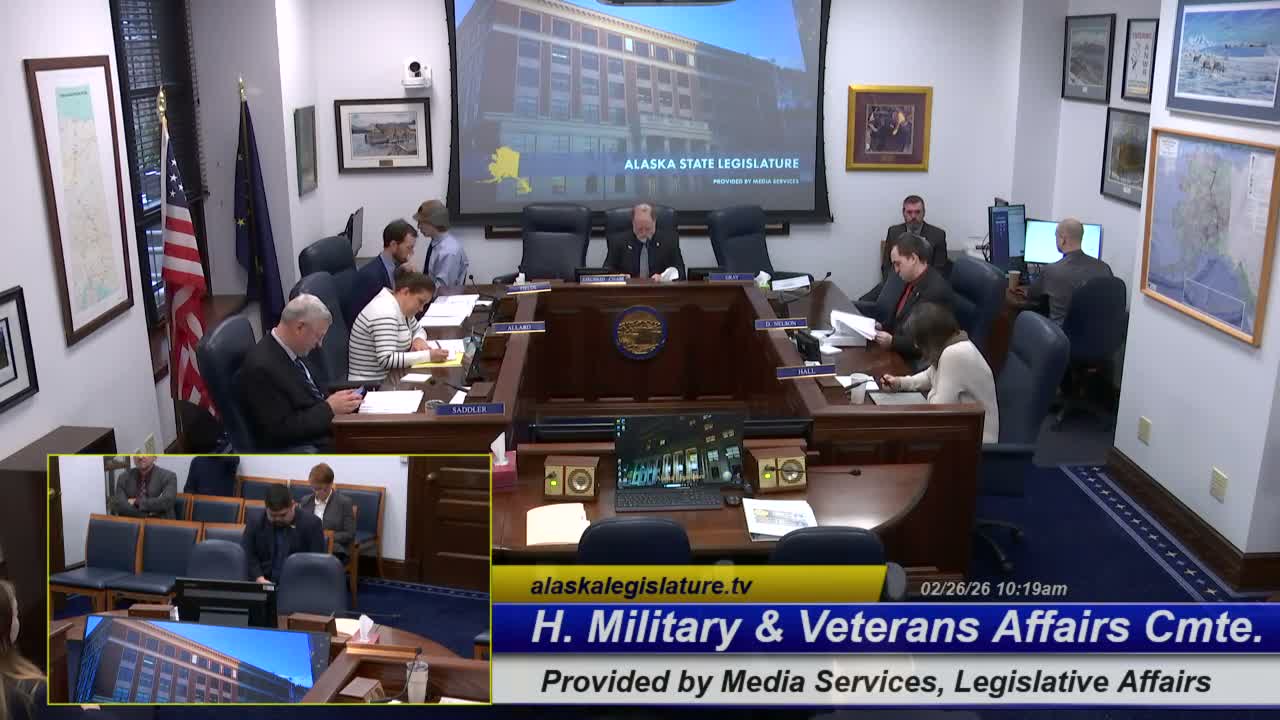
Representative Andrew Stapp, sponsor of House Bill 299, told the House Special Committee on Military and Veterans Affairs on Feb. 26 that the Veterans Justice Act would expand access to therapeutic sentencing for veterans across Alaska and create a pathway for convictions to be set aside or reduced after successful treatment. "I brought this bill forward because I would like to try to kind of figure out how you can kind of thread the needle," Stapp said, describing a personal combat injury that persuaded him the system needs tools to address service‑related trauma.
The bill, as described by Bernard Otto, staff to Representative Stapp, would add language to several Alaska statutes so arresting officers would be directed to determine veteran status (amending AS 12.25 and referencing AS 47.55.900), require judicial officers at initial appearance to inform defendants about the program (AS 12.30.006), and establish a veteran sentencing program under AS 12.55 that focuses on misdemeanor admissions and individualized case plans. Otto said the legislation also would permit courts to set aside, reduce or—where appropriate—dismiss convictions after participants complete an evidence‑based treatment program, and would require the Criminal Justice Data Analysis Commission to track program outcomes. The bill includes indirect amendments to Alaska Rules of Criminal Procedure (Rules 35 and 43) and sets an effective date of July 1, 2027.
Supporters at the hearing said the measure would improve early identification of justice‑involved veterans and expand options in places without formal veterans courts. Phil Hokanson, chair of the Alaska Veterans Advisory Council, testified that HB 299 "strengthens the intake of veterans into the veterans court model" and would help veterans access tailored treatment and mentoring resources rather than incarceration. Brock Hunter of the Veterans Defense Project, which helped draft similar laws in other states, described the bill as "an augment, not a replacement" to existing veterans courts and pointed to Minnesota data showing high completion rates where model legislation was enacted.
Court system counsel and the Department of Law urged caution on structure and implementation. Nancy Mead, general counsel for the Alaska Court System, explained current veterans therapeutic courts in Anchorage (capacity about 35, 30 enrolled) and Fairbanks (capacity about 15, 5–6 enrolled) are resource‑intensive, team‑run programs that rely on Veterans Justice Outreach coordinators and VA treatment capacity. Mead warned that statutory constraints could limit operational flexibility and noted that eligibility in current practice is often tied to VA benefit eligibility and available treatment. "The limiter for therapeutic courts... is those three things: treatment, housing, and employment," Mead said.
Deputy Attorney General Angie Kemp confirmed prosecutors currently exercise substantial discretion over who is admitted to therapeutic programs and described that as a practical safety filter. Kemp said that in Fairbanks about 80% of applicants the prosecutor reviewed were approved for participation; the remaining denials were based on public‑safety concerns, victim objections or other risk factors. Kemp and Mead cautioned that removing prosecutorial input could raise separation‑of‑powers and practical evidence‑access issues for judges.
Committee members pressed on several implementation points: what crimes would qualify (the bill’s mechanics target misdemeanants and generally require a guilty plea to enter the program), how to define "veteran" for program eligibility, whether repeat offenders could be readmitted, how the bill would interact with existing veterans courts, and how Alaska would address gaps in treatment and housing that limit program capacity in rural communities. Representative Stapp and staff said the bill is intended to provide clarity and expand access in jurisdictions without veterans courts, not to displace current programs.
No vote occurred. The committee heard from ALEC representative Zach Federico, who described the model policy and offered to provide written materials, and concluded the first hearing at 11:50 a.m., setting the bill aside for further consideration.
The committee’s next procedural steps were not specified at the hearing; no formal motions or votes on HB 299 were recorded.
Ending: The committee completed the initial hearing on HB 299 after invited testimony and member questions; supporters urged expansion of treatment access, while court and law officials emphasized operational constraints and prosecutorial discretion that would need to be addressed in follow‑up work.
The bill, as described by Bernard Otto, staff to Representative Stapp, would add language to several Alaska statutes so arresting officers would be directed to determine veteran status (amending AS 12.25 and referencing AS 47.55.900), require judicial officers at initial appearance to inform defendants about the program (AS 12.30.006), and establish a veteran sentencing program under AS 12.55 that focuses on misdemeanor admissions and individualized case plans. Otto said the legislation also would permit courts to set aside, reduce or—where appropriate—dismiss convictions after participants complete an evidence‑based treatment program, and would require the Criminal Justice Data Analysis Commission to track program outcomes. The bill includes indirect amendments to Alaska Rules of Criminal Procedure (Rules 35 and 43) and sets an effective date of July 1, 2027.
Supporters at the hearing said the measure would improve early identification of justice‑involved veterans and expand options in places without formal veterans courts. Phil Hokanson, chair of the Alaska Veterans Advisory Council, testified that HB 299 "strengthens the intake of veterans into the veterans court model" and would help veterans access tailored treatment and mentoring resources rather than incarceration. Brock Hunter of the Veterans Defense Project, which helped draft similar laws in other states, described the bill as "an augment, not a replacement" to existing veterans courts and pointed to Minnesota data showing high completion rates where model legislation was enacted.
Court system counsel and the Department of Law urged caution on structure and implementation. Nancy Mead, general counsel for the Alaska Court System, explained current veterans therapeutic courts in Anchorage (capacity about 35, 30 enrolled) and Fairbanks (capacity about 15, 5–6 enrolled) are resource‑intensive, team‑run programs that rely on Veterans Justice Outreach coordinators and VA treatment capacity. Mead warned that statutory constraints could limit operational flexibility and noted that eligibility in current practice is often tied to VA benefit eligibility and available treatment. "The limiter for therapeutic courts... is those three things: treatment, housing, and employment," Mead said.
Deputy Attorney General Angie Kemp confirmed prosecutors currently exercise substantial discretion over who is admitted to therapeutic programs and described that as a practical safety filter. Kemp said that in Fairbanks about 80% of applicants the prosecutor reviewed were approved for participation; the remaining denials were based on public‑safety concerns, victim objections or other risk factors. Kemp and Mead cautioned that removing prosecutorial input could raise separation‑of‑powers and practical evidence‑access issues for judges.
Committee members pressed on several implementation points: what crimes would qualify (the bill’s mechanics target misdemeanants and generally require a guilty plea to enter the program), how to define "veteran" for program eligibility, whether repeat offenders could be readmitted, how the bill would interact with existing veterans courts, and how Alaska would address gaps in treatment and housing that limit program capacity in rural communities. Representative Stapp and staff said the bill is intended to provide clarity and expand access in jurisdictions without veterans courts, not to displace current programs.
No vote occurred. The committee heard from ALEC representative Zach Federico, who described the model policy and offered to provide written materials, and concluded the first hearing at 11:50 a.m., setting the bill aside for further consideration.
The committee’s next procedural steps were not specified at the hearing; no formal motions or votes on HB 299 were recorded.
Ending: The committee completed the initial hearing on HB 299 after invited testimony and member questions; supporters urged expansion of treatment access, while court and law officials emphasized operational constraints and prosecutorial discretion that would need to be addressed in follow‑up work.
Don't Miss a Word: See the Full Meeting!
Go beyond summaries. Unlock every video, transcript, and key insight with a Founder Membership.
✓
Get instant access to full meeting videos
✓
Search and clip any phrase from complete transcripts
✓
Receive AI-powered summaries & custom alerts
✓
Enjoy lifetime, unrestricted access to government data
30-day money-back guarantee
