ANSEP outlines K–PhD pipeline, student outcomes and funding needs to Alaska legislators
February 26, 2026 | 2026 Legislature Alaska, Alaska
This article was created by AI summarizing key points discussed. AI makes mistakes, so for full details and context, please refer to the video of the full meeting. Please report any errors so we can fix them. Report an error »
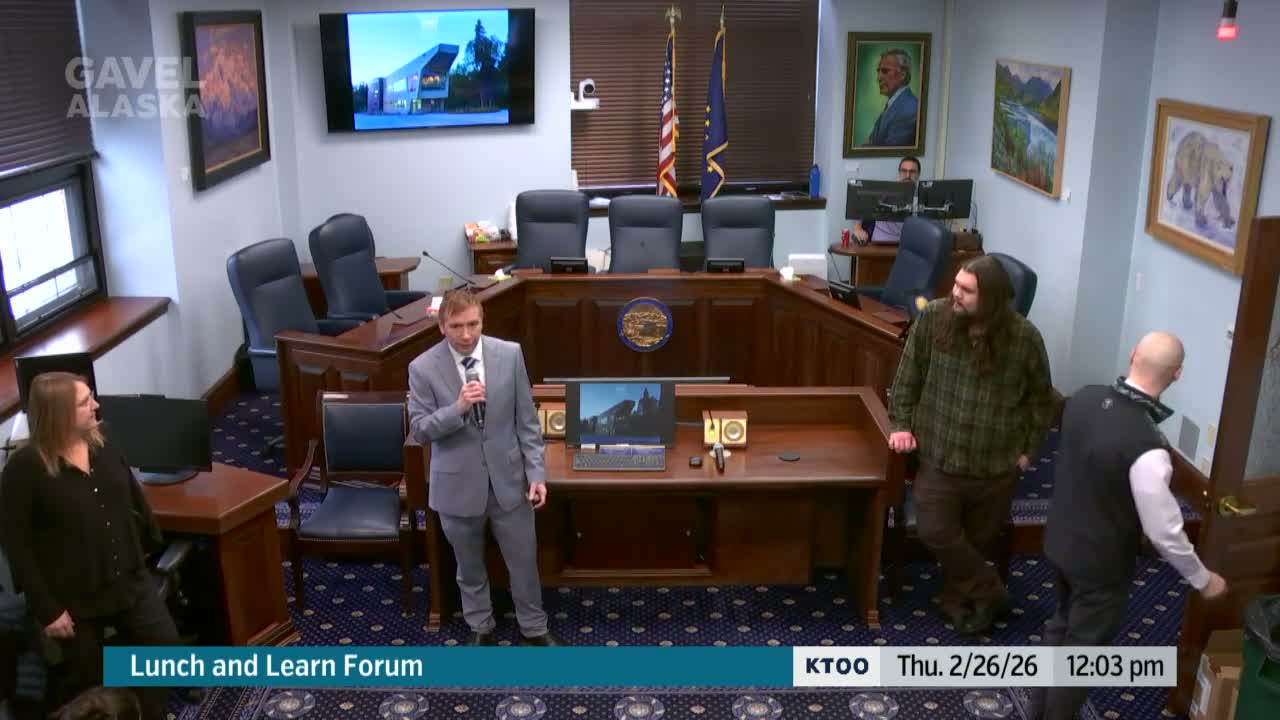
ANSEP representatives told legislators that the Alaska Native Science & Engineering Program (ANSEP) has built a K–PhD pipeline that reaches students in more than 100 communities and produces substantial college credit and workforce outcomes, but that continued funding is needed to sustain its acceleration and dual-enrollment programs.
Matt Calhoun, ANSEP’s executive director, told the 2026 Legislature that ANSEP serves kindergarten through doctoral students, with roughly 1,500 students in the pipeline and about 850 alumni working in Alaska. "We have students from 100 different communities," Calhoun said, describing a mix of campus-based sites and statewide online offerings. He cited an Urban Institute logic model and evaluation that, he said, found "there's no other program like ANSEP in the nation."
Dr. Michelle Yachman F., who described K–5 and middle-school programming, said ANSEP’s middle-school academies focus on hands-on activities and accelerated math, and reported middle-school students completing Algebra I at about three times the national rate. "We have a pilot program that's gonna get us into STEM classrooms, starting this coming year," she said, summarizing efforts to build early-grade exposure to STEM careers.
Beth Spangler, the Herbert P. Schroeder endowed chair at ANSEP, described the high-school and Bridge (freshman-year) programs that provide dual-enrollment University of Alaska (UA) credits and internship pathways. "This past year, our students had about 69 university credits on average," Spangler said, noting that dual-credit coursework and partner-funded paid internships help students move into STEM and business careers without direct cost to families.
The presentation included a student testimony from Ethan Johnson, a 2026 Acceleration Academy senior who said he will graduate from high school with 171 college credits and plans to pursue doctoral research. "ANSEP has been instrumental in providing those opportunities, both financially, but also in giving us the social foundation we need," Johnson said, describing internships with the Alaska Native Tribal Health Consortium and the Alaska Native Medical Center.
Lawmakers asked how they could support the program. Calhoun urged advocacy at all levels and cited multiple funding sources that sustain ANSEP: "we get funding from a lot of different areas — for-profit, nonprofit, universities, some from the state," he said. He specifically told the Legislature that ANSEP is included in the operating budget and that "we do have $5,000,000 through DEED," identifying that state DEED funding as a critical component for supporting acceleration dual-credit high schools.
Speakers also addressed federal funding changes. When asked about the impact of national shifts on DEI-related funding, Calhoun said ANSEP "did lose some federal funding" in 2025 but that the organization "was able to pivot" and cover gaps with nonprofit and private partners. Ethan Johnson added that the cuts "have been felt even by us acceleration students."
Presenters described practical steps to expand access and retention: career explorations now occur in students' home communities (including Anchorage, Mat-Su, Bethel, Kotzebue and Nome), remote math supports such as ALEKS, and partnerships to create internship and degree pathways — including aviation and, in the future, education degrees aimed at returning teachers to rural communities.
The presentation closed with a request that legislators preserve operating support and with an offer of ANSEP materials outlining 30 years of program history and an Urban Institute logic model. No formal vote or action was taken during the session.
The program provided details about applications (ancep.net), site expansion (Nome added August 2025), capacity constraints (wait lists at pre-college levels; example: Matanuska-Susitna Borough funding for 25 slots but 100+ applicants) and student expectations for Bridge-level enrollment (minimum 2.5 GPA, weekly study sessions, internships and professional engagement).
Matt Calhoun, ANSEP’s executive director, told the 2026 Legislature that ANSEP serves kindergarten through doctoral students, with roughly 1,500 students in the pipeline and about 850 alumni working in Alaska. "We have students from 100 different communities," Calhoun said, describing a mix of campus-based sites and statewide online offerings. He cited an Urban Institute logic model and evaluation that, he said, found "there's no other program like ANSEP in the nation."
Dr. Michelle Yachman F., who described K–5 and middle-school programming, said ANSEP’s middle-school academies focus on hands-on activities and accelerated math, and reported middle-school students completing Algebra I at about three times the national rate. "We have a pilot program that's gonna get us into STEM classrooms, starting this coming year," she said, summarizing efforts to build early-grade exposure to STEM careers.
Beth Spangler, the Herbert P. Schroeder endowed chair at ANSEP, described the high-school and Bridge (freshman-year) programs that provide dual-enrollment University of Alaska (UA) credits and internship pathways. "This past year, our students had about 69 university credits on average," Spangler said, noting that dual-credit coursework and partner-funded paid internships help students move into STEM and business careers without direct cost to families.
The presentation included a student testimony from Ethan Johnson, a 2026 Acceleration Academy senior who said he will graduate from high school with 171 college credits and plans to pursue doctoral research. "ANSEP has been instrumental in providing those opportunities, both financially, but also in giving us the social foundation we need," Johnson said, describing internships with the Alaska Native Tribal Health Consortium and the Alaska Native Medical Center.
Lawmakers asked how they could support the program. Calhoun urged advocacy at all levels and cited multiple funding sources that sustain ANSEP: "we get funding from a lot of different areas — for-profit, nonprofit, universities, some from the state," he said. He specifically told the Legislature that ANSEP is included in the operating budget and that "we do have $5,000,000 through DEED," identifying that state DEED funding as a critical component for supporting acceleration dual-credit high schools.
Speakers also addressed federal funding changes. When asked about the impact of national shifts on DEI-related funding, Calhoun said ANSEP "did lose some federal funding" in 2025 but that the organization "was able to pivot" and cover gaps with nonprofit and private partners. Ethan Johnson added that the cuts "have been felt even by us acceleration students."
Presenters described practical steps to expand access and retention: career explorations now occur in students' home communities (including Anchorage, Mat-Su, Bethel, Kotzebue and Nome), remote math supports such as ALEKS, and partnerships to create internship and degree pathways — including aviation and, in the future, education degrees aimed at returning teachers to rural communities.
The presentation closed with a request that legislators preserve operating support and with an offer of ANSEP materials outlining 30 years of program history and an Urban Institute logic model. No formal vote or action was taken during the session.
The program provided details about applications (ancep.net), site expansion (Nome added August 2025), capacity constraints (wait lists at pre-college levels; example: Matanuska-Susitna Borough funding for 25 slots but 100+ applicants) and student expectations for Bridge-level enrollment (minimum 2.5 GPA, weekly study sessions, internships and professional engagement).
Don't Miss a Word: See the Full Meeting!
Go beyond summaries. Unlock every video, transcript, and key insight with a Founder Membership.
✓
Get instant access to full meeting videos
✓
Search and clip any phrase from complete transcripts
✓
Receive AI-powered summaries & custom alerts
✓
Enjoy lifetime, unrestricted access to government data
30-day money-back guarantee
