Alaska experts outline rapid rise of small nuclear projects, urge public outreach
February 26, 2026 | 2026 Legislature Alaska, Alaska
This article was created by AI summarizing key points discussed. AI makes mistakes, so for full details and context, please refer to the video of the full meeting. Please report any errors so we can fix them. Report an error »
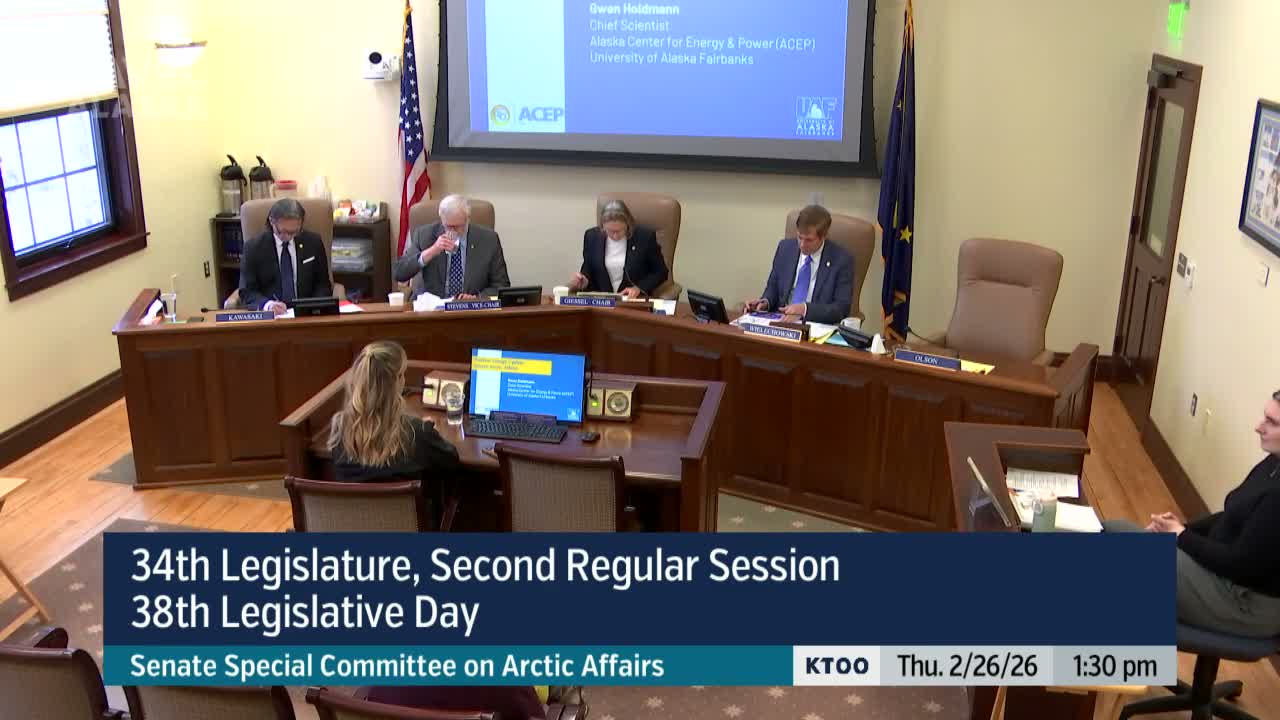
Gwen Holdman, chief scientist at the Alaska Center for Energy and Power at the University of Alaska Fairbanks, told the Senate Arctic Affairs Committee that advanced, smaller nuclear reactors are moving from concept to pilot projects and deserve consideration for Alaska's energy future.
"Twenty percent of the electric power in The United States is produced from nuclear," Holdman said, noting the technology's potential role alongside renewables and existing baseload sources. Her presentation described small modular and microreactor designs as "typically smaller, scalable and modular," often factory-built and transportable to sites closer to demand.
Why it matters: Holdman said those design features could make reactors usable in remote communities or paired with large new loads such as data centers, and they can provide both electricity and thermal energy for applications like district heating. She also emphasized that many advanced designs include passive safety features that reduce—but do not entirely eliminate—the risk of conventional-style meltdowns.
Committee members pressed on safety and timelines. Senator Wilikowski asked bluntly, "Could you have a meltdown?" Holdman responded that many advanced designs have a negative reactivity coefficient so "they really can't meltdown," while acknowledging experts avoid claiming zero risk.
Holdman updated the committee on projects with Alaska links. She said Eielson Air Force Base issued a notice of intent to award to Oklo and is negotiating contracts, but noted that no small microreactor had yet secured Nuclear Regulatory Commission (NRC) licensing and that Oklo's earlier submission was returned for further information. She described Idaho National Lab work and a 75-megawatt reactor under construction at INL, and said the microreactor proposed for Eielson is roughly 5 megawatts.
On schedules, Holdman said Fort Wainwright's reactor is publicly slated to be operational by 2028, a timeline she called "very optimistic." She also described Department of Energy and Department of Defense pilot initiatives (Project Pele and Project Janice) that are accelerating fuel fabrication and mobile/test reactor work.
Cost and public acceptance: On economics, Holdman cautioned that delivered cost per kilowatt-hour for microreactors remains uncertain and will depend heavily on licensing and operating requirements; she said vendors are working to meet market prices but that cheap power from nuclear is unlikely in the near term. Her polling work shows about three-quarters of Alaskans remain unfamiliar with advanced reactors; providing basic information increased self-reported support by roughly 28 percent in before/after polling.
Waste and legal limits: Holdman told the committee that spent nuclear fuel disposal is a federal responsibility and that Alaska state statutes currently prohibit storage of new spent fuel in the state; any fuel moved within Alaska may only be transported for removal from the state.
What comes next: Holdman recommended continued public engagement and careful attention to licensing distinctions (site versus technology) as Alaska assesses potential pilot projects. The committee thanked Holdman and moved on to a resolution item.
"Twenty percent of the electric power in The United States is produced from nuclear," Holdman said, noting the technology's potential role alongside renewables and existing baseload sources. Her presentation described small modular and microreactor designs as "typically smaller, scalable and modular," often factory-built and transportable to sites closer to demand.
Why it matters: Holdman said those design features could make reactors usable in remote communities or paired with large new loads such as data centers, and they can provide both electricity and thermal energy for applications like district heating. She also emphasized that many advanced designs include passive safety features that reduce—but do not entirely eliminate—the risk of conventional-style meltdowns.
Committee members pressed on safety and timelines. Senator Wilikowski asked bluntly, "Could you have a meltdown?" Holdman responded that many advanced designs have a negative reactivity coefficient so "they really can't meltdown," while acknowledging experts avoid claiming zero risk.
Holdman updated the committee on projects with Alaska links. She said Eielson Air Force Base issued a notice of intent to award to Oklo and is negotiating contracts, but noted that no small microreactor had yet secured Nuclear Regulatory Commission (NRC) licensing and that Oklo's earlier submission was returned for further information. She described Idaho National Lab work and a 75-megawatt reactor under construction at INL, and said the microreactor proposed for Eielson is roughly 5 megawatts.
On schedules, Holdman said Fort Wainwright's reactor is publicly slated to be operational by 2028, a timeline she called "very optimistic." She also described Department of Energy and Department of Defense pilot initiatives (Project Pele and Project Janice) that are accelerating fuel fabrication and mobile/test reactor work.
Cost and public acceptance: On economics, Holdman cautioned that delivered cost per kilowatt-hour for microreactors remains uncertain and will depend heavily on licensing and operating requirements; she said vendors are working to meet market prices but that cheap power from nuclear is unlikely in the near term. Her polling work shows about three-quarters of Alaskans remain unfamiliar with advanced reactors; providing basic information increased self-reported support by roughly 28 percent in before/after polling.
Waste and legal limits: Holdman told the committee that spent nuclear fuel disposal is a federal responsibility and that Alaska state statutes currently prohibit storage of new spent fuel in the state; any fuel moved within Alaska may only be transported for removal from the state.
What comes next: Holdman recommended continued public engagement and careful attention to licensing distinctions (site versus technology) as Alaska assesses potential pilot projects. The committee thanked Holdman and moved on to a resolution item.
Don't Miss a Word: See the Full Meeting!
Go beyond summaries. Unlock every video, transcript, and key insight with a Founder Membership.
✓
Get instant access to full meeting videos
✓
Search and clip any phrase from complete transcripts
✓
Receive AI-powered summaries & custom alerts
✓
Enjoy lifetime, unrestricted access to government data
30-day money-back guarantee
