Alaskan advocates urge Senate finance committee to restore and boost funding for domestic‑violence services
February 26, 2026 | 2026 Legislature Alaska, Alaska
This article was created by AI summarizing key points discussed. AI makes mistakes, so for full details and context, please refer to the video of the full meeting. Please report any errors so we can fix them. Report an error »
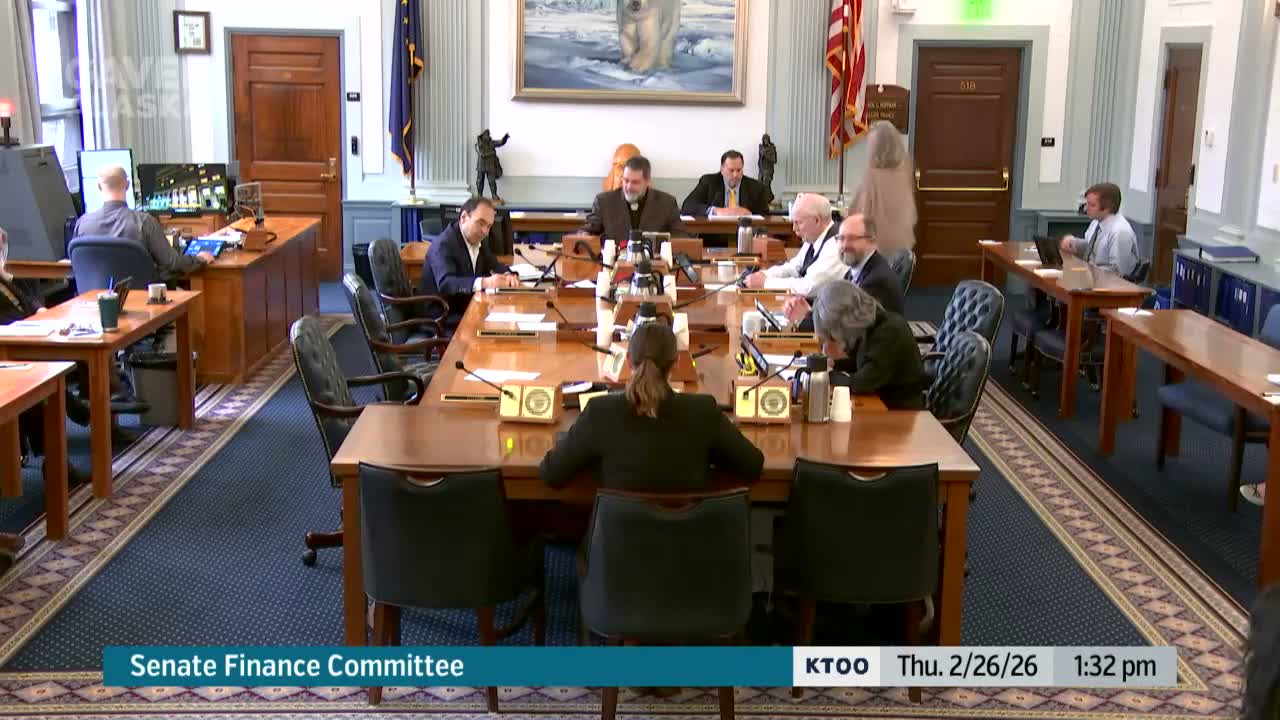
Eileen Arnold, executive director of the Tundra Women’s Coalition in Bethel, and several other advocates told the Alaska Senate Finance Committee on Feb. 26 that state funding for victim services has not kept pace with need.
"We are asking for a $2,000,000 increase to victim services within the Council on Domestic Violence and Sexual Assault and $500,000 for legal services," Arnold said, noting many regional programs have been flat‑funded since 2017. She described a roughly 200% increase in transitional‑housing use since 2017 and said local, tribal‑based providers are uniquely positioned to help survivors navigate benefits and supports.
Leila Johnson, director of Bay Haven DVSA shelter in Hooper Bay, asked the committee to fully fund an additional $2,500,000 to CDVSA, saying cuts to VOCA and reductions in enhanced services reduce safety: "When someone is standing outside in the cold at 2AM, there is no backup plan." Johnson described her shelter as a 24/7 emergency response in a region with no alternative.
Other rural witnesses reiterated those requests. Bertha Solonullik Kowalik (ANDVSA) said sustained funding is needed to retain and train staff who understand local cultures and intergenerational trauma. Cheryl Hummy, a counselor with Arctic Women in Utqiagvik, said her program is one of 37 funded by CDVSA and operates the only shelter on the North Slope Borough—28 beds that fly people in from villages—and urged passage of the $2,000,000 and $500,000 requests to keep doors open.
Advocates framed the funding as operationally essential rather than discretionary: without increases, programs face staff shortages, reduced legal services and fewer options for survivors in remote communities. No committee action or vote occurred during the hearing; testimony was recorded for legislators’ consideration as part of the operating and supplemental budget reviews.
The committee will resume budget public testimony the following day.
"We are asking for a $2,000,000 increase to victim services within the Council on Domestic Violence and Sexual Assault and $500,000 for legal services," Arnold said, noting many regional programs have been flat‑funded since 2017. She described a roughly 200% increase in transitional‑housing use since 2017 and said local, tribal‑based providers are uniquely positioned to help survivors navigate benefits and supports.
Leila Johnson, director of Bay Haven DVSA shelter in Hooper Bay, asked the committee to fully fund an additional $2,500,000 to CDVSA, saying cuts to VOCA and reductions in enhanced services reduce safety: "When someone is standing outside in the cold at 2AM, there is no backup plan." Johnson described her shelter as a 24/7 emergency response in a region with no alternative.
Other rural witnesses reiterated those requests. Bertha Solonullik Kowalik (ANDVSA) said sustained funding is needed to retain and train staff who understand local cultures and intergenerational trauma. Cheryl Hummy, a counselor with Arctic Women in Utqiagvik, said her program is one of 37 funded by CDVSA and operates the only shelter on the North Slope Borough—28 beds that fly people in from villages—and urged passage of the $2,000,000 and $500,000 requests to keep doors open.
Advocates framed the funding as operationally essential rather than discretionary: without increases, programs face staff shortages, reduced legal services and fewer options for survivors in remote communities. No committee action or vote occurred during the hearing; testimony was recorded for legislators’ consideration as part of the operating and supplemental budget reviews.
The committee will resume budget public testimony the following day.
View the Full Meeting & All Its Details
This article offers just a summary. Unlock complete video, transcripts, and insights as a Founder Member.
✓
Watch full, unedited meeting videos
✓
Search every word spoken in unlimited transcripts
✓
AI summaries & real-time alerts (all government levels)
✓
Permanent access to expanding government content
30-day money-back guarantee
