House Bill 26 would require DOTPF to plan statewide public and community transit, expand rural and tribal engagement
February 26, 2026 | 2026 Legislature Alaska, Alaska
This article was created by AI summarizing key points discussed. AI makes mistakes, so for full details and context, please refer to the video of the full meeting. Please report any errors so we can fix them. Report an error »
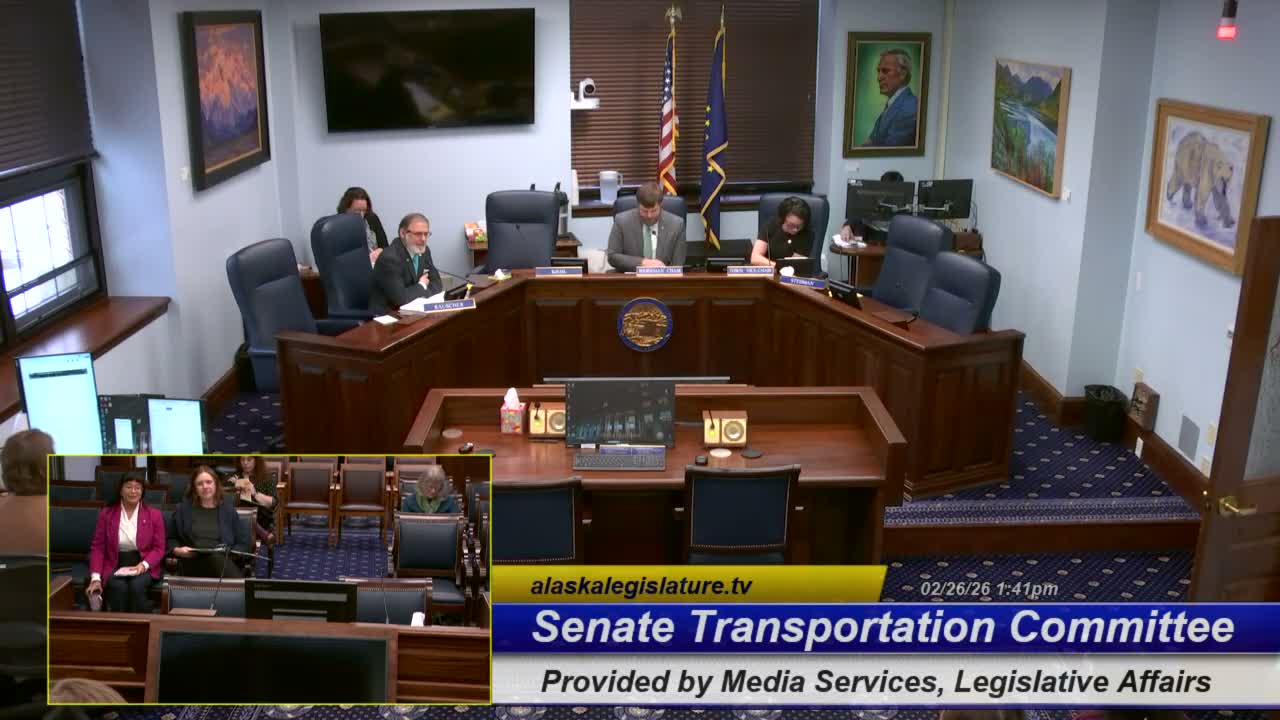
Representative Genevieve Mina (House District 19) presented House Bill 26 to the Senate Transportation Committee as a multi‑part effort to modernize DOTPF’s planning duties: explicitly include public and community transit, extend study of alternative transportation to rural and remote areas, and codify public engagement procedures in statewide transportation plans.
Claire Wernicke, staff to Representative Mina, summarized the bill’s sectional changes: add public, community, and tribal transit programs to DOTPF duties; require coordination with metropolitan planning organizations, local governments, tribal entities, public and community transit operators (including the Alaska Marine Highway System and the Alaska Railroad Corporation); and create a new statutory duty to develop a statewide public and community transit plan.
Committee members focused on tribal inclusion and representation. Senator Rauscher asked whether DOT would have jurisdiction on tribal lands; Mina and staff said the bill emphasizes government‑to‑government engagement and collaboration, not state jurisdiction. Senator Tobin sought specificity on which tribal entities the bill references (tribal governments, nonprofits, federally or state‑recognized tribes). Mina acknowledged the term is broad in statute and agreed to work with Tobin’s office on clarifying language to ensure geographic representation and that tribes living in affected areas have seats at the table.
Invited witnesses urged support. Patrick Reinhart, executive director of the Council on Disabilities and Special Education, said tribal transit programs are increasingly federally funded and often serve whole communities; he stressed that people with disabilities and seniors rely on community transit. Michelle Giroux, executive director of Hope Community Resources and board chair of the Key Coalition of Alaska, described transportation as a top barrier to employment, health care and food access and urged the committee’s support. Millie Ryan, president of the Alaska Mobility Coalition, said statutory recognition would keep community transit on DOTPF’s checklist and help coordinate cost‑effective, sustainable rides across the state.
Sarah Lucey, statewide planning chief for DOTPF (appearing by phone), told the committee DOT already considers multimodal planning and expects to begin the statewide transit effort once a vacant planning chief position is filled. Lucey said the department’s fiscal note was $0 because DOT intends to use existing planning funds for development; she and members noted that implementation of new projects identified in a plan could require additional funding later and that DOT typically passes federal grants to subrecipients rather than operating services directly.
Representative Mina closed by saying she would provide further clarifying language on tribal participation. Chair Bjorkman announced HB 26 would be set aside for future consideration; no final vote was taken at this hearing.
Claire Wernicke, staff to Representative Mina, summarized the bill’s sectional changes: add public, community, and tribal transit programs to DOTPF duties; require coordination with metropolitan planning organizations, local governments, tribal entities, public and community transit operators (including the Alaska Marine Highway System and the Alaska Railroad Corporation); and create a new statutory duty to develop a statewide public and community transit plan.
Committee members focused on tribal inclusion and representation. Senator Rauscher asked whether DOT would have jurisdiction on tribal lands; Mina and staff said the bill emphasizes government‑to‑government engagement and collaboration, not state jurisdiction. Senator Tobin sought specificity on which tribal entities the bill references (tribal governments, nonprofits, federally or state‑recognized tribes). Mina acknowledged the term is broad in statute and agreed to work with Tobin’s office on clarifying language to ensure geographic representation and that tribes living in affected areas have seats at the table.
Invited witnesses urged support. Patrick Reinhart, executive director of the Council on Disabilities and Special Education, said tribal transit programs are increasingly federally funded and often serve whole communities; he stressed that people with disabilities and seniors rely on community transit. Michelle Giroux, executive director of Hope Community Resources and board chair of the Key Coalition of Alaska, described transportation as a top barrier to employment, health care and food access and urged the committee’s support. Millie Ryan, president of the Alaska Mobility Coalition, said statutory recognition would keep community transit on DOTPF’s checklist and help coordinate cost‑effective, sustainable rides across the state.
Sarah Lucey, statewide planning chief for DOTPF (appearing by phone), told the committee DOT already considers multimodal planning and expects to begin the statewide transit effort once a vacant planning chief position is filled. Lucey said the department’s fiscal note was $0 because DOT intends to use existing planning funds for development; she and members noted that implementation of new projects identified in a plan could require additional funding later and that DOT typically passes federal grants to subrecipients rather than operating services directly.
Representative Mina closed by saying she would provide further clarifying language on tribal participation. Chair Bjorkman announced HB 26 would be set aside for future consideration; no final vote was taken at this hearing.
Don't Miss a Word: See the Full Meeting!
Go beyond summaries. Unlock every video, transcript, and key insight with a Founder Membership.
✓
Get instant access to full meeting videos
✓
Search and clip any phrase from complete transcripts
✓
Receive AI-powered summaries & custom alerts
✓
Enjoy lifetime, unrestricted access to government data
30-day money-back guarantee
