Facing Foster Care in Alaska pushes bills and services to ease transition for youth aging out of care
February 26, 2026 | 2026 Legislature Alaska, Alaska
This article was created by AI summarizing key points discussed. AI makes mistakes, so for full details and context, please refer to the video of the full meeting. Please report any errors so we can fix them. Report an error »
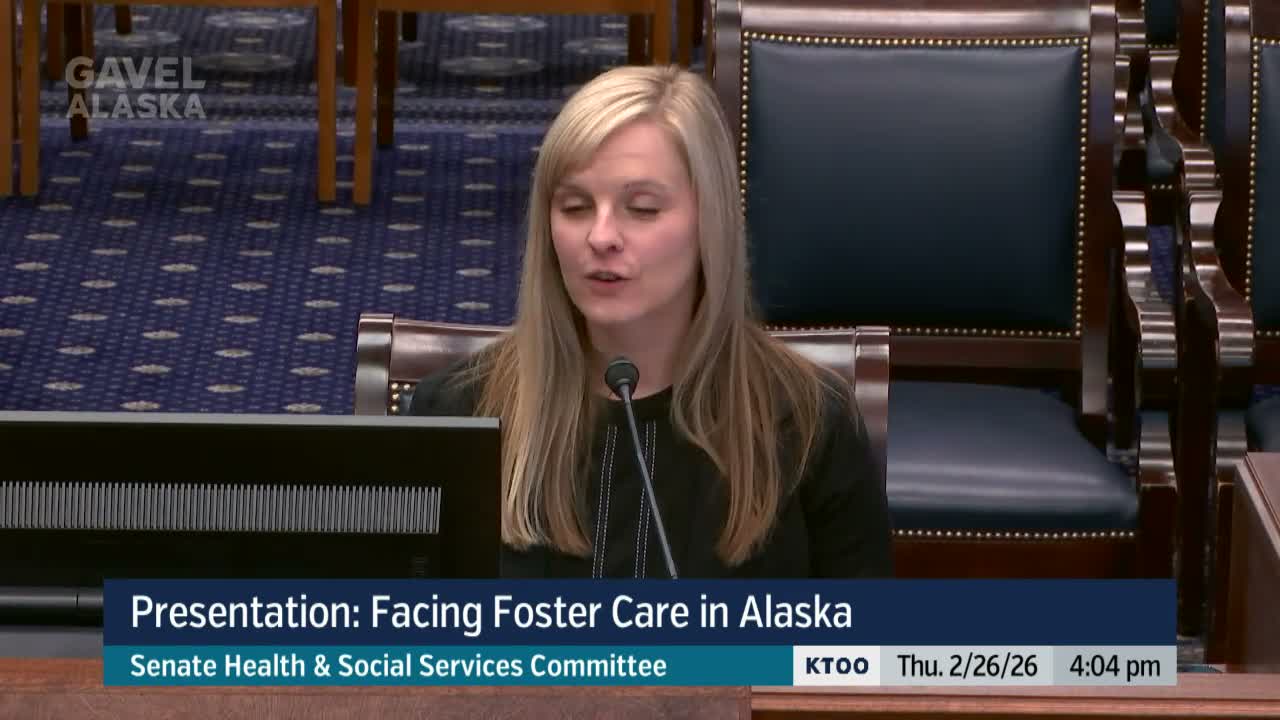
Facing Foster Care in Alaska (FFCA) outlined a multi-part policy agenda to the Senate Health and Social Services Committee on Feb. 26 in Juneau, focusing on legal protections and practical supports for youth transitioning out of foster care.
Amanda Mativier, FFCA executive director, said the group represents roughly 300 current and former foster youth annually and runs statewide youth leadership programs. She described a set of legislative priorities: House Bill 157 to preserve sibling relationships after adoption, model legislation to place Social Security survivor proceeds into a trust for youth, and outreach to expand access to Foster Youth to Independence (FYI) housing vouchers beyond the 12 communities currently served by Alaska Housing Finance Corporation.
On Social Security proceeds, Mativier said the federal Children's Bureau recently notified governors that states should not reimburse themselves from survivor benefits; she said OCS stopped that practice for survivor benefits and now holds those funds for young people, but that disability-benefit collection by the state remains an issue. She said FFCA is working with Representative Carolyn Hall to draft legislation modeled on an Arizona trust approach and estimated the issue affects roughly $2.5 million of OCS budgetary flows.
Youth witnesses recounted obstacles that tie to these proposals. Landon Ryan, a senior at Robert Service High School, told senators HB 157 matters because he lost sibling contact after an adoptive placement became permanent and later led to separation. Deco Harvey, a University of Alaska Anchorage student, described the loss of an OCS higher-education coordinator position that had assisted students with FAFSA, housing and emergency contacts; he said the coordinator’s removal caused at least one peer to drop out and urged the position be restored. Madison Brewer, who is in extended foster care, said many youth living in dorms or independent settings must pay their own costs and that FFCA recently filed a lawsuit asking OCS to cover cost-of-care for youth in non-foster-home placements.
Mativier also highlighted data from the National Youth in Transition Database showing about 45% of foster youth in Alaska reported homelessness by age 21, and noted federal FYI vouchers allow youth to pay up to 30% of income for three years with a potential extension for education; she said rural youth are effectively excluded when vouchers are limited to 12 communities. FFCA said it received support from the Alaska Mental Health Trust Authority to pilot a peer-navigator model and plans full statewide rollout by 2027.
Committee members asked clarifying questions about federal rules governing Social Security payees, the status of federal disability-benefit practices and staffing implications of reinstating positions or shifting funds. No committee vote or formal action occurred on these policy items at the Feb. 26 session.
Quotes in this article are taken from committee testimony and attributed to speakers who appear by name in the hearing record.
Amanda Mativier, FFCA executive director, said the group represents roughly 300 current and former foster youth annually and runs statewide youth leadership programs. She described a set of legislative priorities: House Bill 157 to preserve sibling relationships after adoption, model legislation to place Social Security survivor proceeds into a trust for youth, and outreach to expand access to Foster Youth to Independence (FYI) housing vouchers beyond the 12 communities currently served by Alaska Housing Finance Corporation.
On Social Security proceeds, Mativier said the federal Children's Bureau recently notified governors that states should not reimburse themselves from survivor benefits; she said OCS stopped that practice for survivor benefits and now holds those funds for young people, but that disability-benefit collection by the state remains an issue. She said FFCA is working with Representative Carolyn Hall to draft legislation modeled on an Arizona trust approach and estimated the issue affects roughly $2.5 million of OCS budgetary flows.
Youth witnesses recounted obstacles that tie to these proposals. Landon Ryan, a senior at Robert Service High School, told senators HB 157 matters because he lost sibling contact after an adoptive placement became permanent and later led to separation. Deco Harvey, a University of Alaska Anchorage student, described the loss of an OCS higher-education coordinator position that had assisted students with FAFSA, housing and emergency contacts; he said the coordinator’s removal caused at least one peer to drop out and urged the position be restored. Madison Brewer, who is in extended foster care, said many youth living in dorms or independent settings must pay their own costs and that FFCA recently filed a lawsuit asking OCS to cover cost-of-care for youth in non-foster-home placements.
Mativier also highlighted data from the National Youth in Transition Database showing about 45% of foster youth in Alaska reported homelessness by age 21, and noted federal FYI vouchers allow youth to pay up to 30% of income for three years with a potential extension for education; she said rural youth are effectively excluded when vouchers are limited to 12 communities. FFCA said it received support from the Alaska Mental Health Trust Authority to pilot a peer-navigator model and plans full statewide rollout by 2027.
Committee members asked clarifying questions about federal rules governing Social Security payees, the status of federal disability-benefit practices and staffing implications of reinstating positions or shifting funds. No committee vote or formal action occurred on these policy items at the Feb. 26 session.
Quotes in this article are taken from committee testimony and attributed to speakers who appear by name in the hearing record.
Don't Miss a Word: See the Full Meeting!
Go beyond summaries. Unlock every video, transcript, and key insight with a Founder Membership.
✓
Get instant access to full meeting videos
✓
Search and clip any phrase from complete transcripts
✓
Receive AI-powered summaries & custom alerts
✓
Enjoy lifetime, unrestricted access to government data
30-day money-back guarantee
