WeGo, city and federal partners open Dr. Ernest 'Rip' Patton Jr. North Nashville Transit Center
August 30, 2024 | Misc. Metro Meetings and Events, Nashville, Davidson County, Tennessee
This article was created by AI summarizing key points discussed. AI makes mistakes, so for full details and context, please refer to the video of the full meeting. Please report any errors so we can fix them. Report an error »
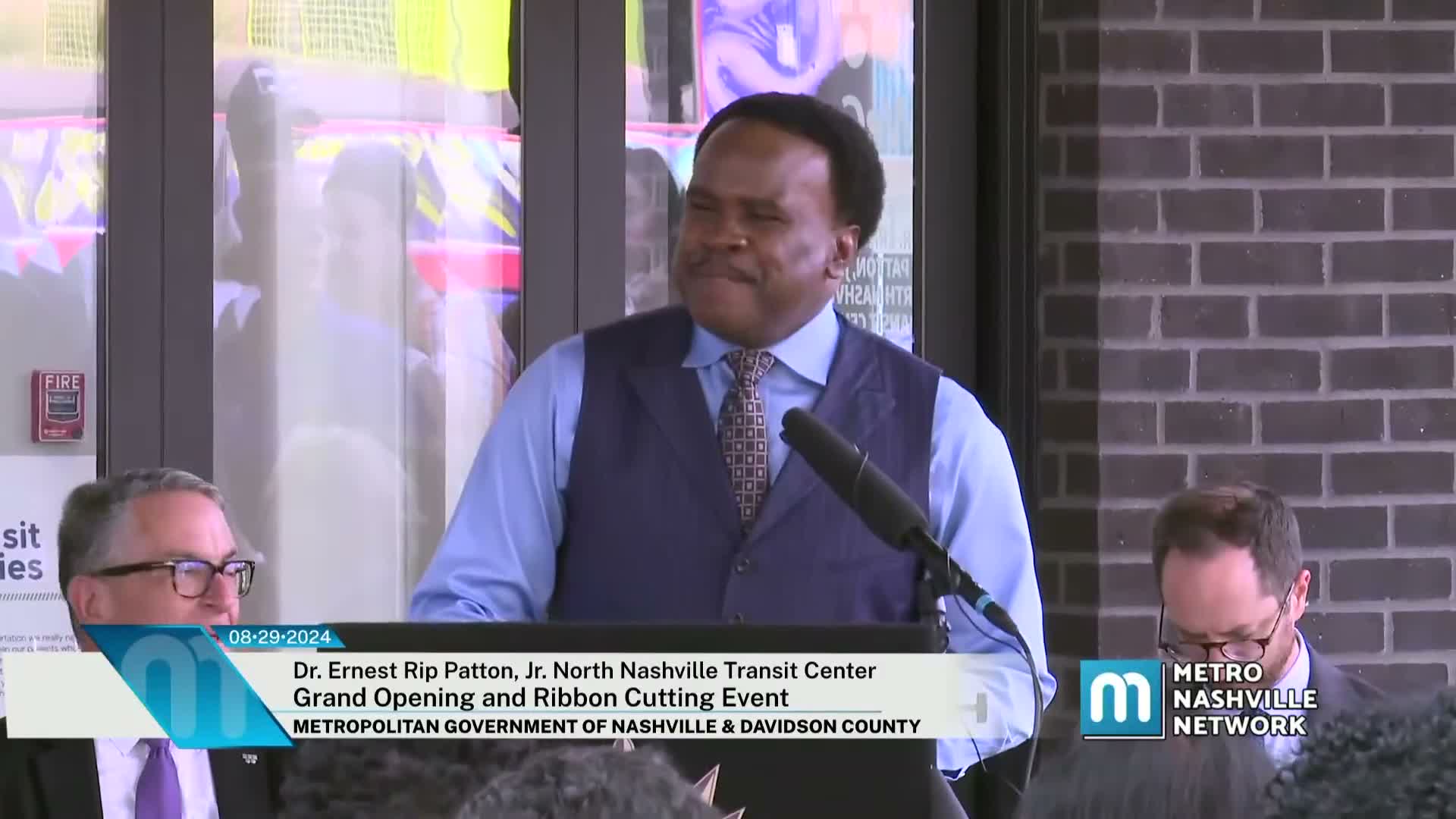
WeGo Public Transit and Metro Nashville officials on Aug. 29 unveiled the Dr. Ernest 'Rip' Patton Jr. North Nashville Transit Center, a $16,900,000 facility designed to expand cross‑town bus connections, add rider amenities and honor local civil‑rights history.
"More routes, more frequent service, better connections, more amenities for our riders, and maybe most important, more dignity," said Steve Bland, CEO of WeGo Public Transit, during remarks at the ribbon‑cutting ceremony. Bland also said the seven routes that intersect at the new center saw a 36% increase in ridership year over year before the building opened.
Mayor Freddie O'Connell framed the new center as part of a larger shift in the city's network away from a downtown‑centric hub‑and‑spoke system toward point‑to‑point connections across neighborhoods. He said state contributions covered roughly one‑third of the project's cost and federal support paid for "nearly half" of the $16.9 million, with the Federal Transit Administration providing $7,800,000 for the site.
The center includes an air‑conditioned waiting area, clean restrooms, free Wi‑Fi, ticket vending machines, digital real‑time arrival information, bike racks, paratransit access, 24/7 security staff and multiple bus bays. "Within a 30‑minute travel window, Rip Patton riders now have access to 2 universities, 2 high schools, 4 middle schools, and 6 medical centers," O'Connell said, adding that the location connects riders to more than 64,000 jobs.
State transportation officials emphasized partnership and local contracting goals. Butch Ealy, deputy governor and commissioner of the Tennessee Department of Transportation, said the project is one of several TDOT has supported and highlighted that TDOT and the project team targeted small‑business and diversity inclusion goals, achieving roughly 40% participation in small‑business/diversity contracting on this site.
Federal Transit Administration Region 4 Administrator Dr. Yvette Taylor praised the project as part of broader federal investment in transit, saying the Bipartisan Infrastructure Law and recent discretionary awards supported MTA's expansion. Taylor noted more than $7.8 million in federal funds for the North Nashville Transit Center and described additional recent federal support for local transit projects.
Project leaders said the center also delivered on local equity goals: Bland said the project exceeded the agency’s disadvantaged business enterprise goal with "over 30% of the contracted value" awarded to DBEs. City and regional partners were credited with funding pedestrian and bicycle improvements near the site.
Michael Patton, son of Dr. Ernest "Rip" Patton Jr., spoke about his father's civil‑rights work and the significance of naming the facility for him. "This is the day in history when the pendulum swings towards liberty," Patton said, noting the ceremony date as Aug. 29, 2024.
Officials invited attendees to tour the waiting room and plaza art—featuring a digital installation by Lee Zander Bryant and plaza artwork by Woke 3—and said artists and displays highlighting North Nashville history will be available for viewing and purchase after the ribbon cutting. Event organizers directed seated speakers to two photo areas before the public walkthrough.
The mayor said the opening also previews the city's transportation agenda, including a proposed "Choose How You Move" program and a Transportation Improvement Program that would accelerate construction of similar centers; O'Connell said the ballot decision on the Choose How You Move proposal is scheduled for Nov. 5. City officials said an economic impact study led by the Greater Nashville Regional Council is expected in the coming months to guide growth around the center.
The ribbon cutting marked the facility's formal opening; there were no motions, votes or regulatory actions taken at the event.
"More routes, more frequent service, better connections, more amenities for our riders, and maybe most important, more dignity," said Steve Bland, CEO of WeGo Public Transit, during remarks at the ribbon‑cutting ceremony. Bland also said the seven routes that intersect at the new center saw a 36% increase in ridership year over year before the building opened.
Mayor Freddie O'Connell framed the new center as part of a larger shift in the city's network away from a downtown‑centric hub‑and‑spoke system toward point‑to‑point connections across neighborhoods. He said state contributions covered roughly one‑third of the project's cost and federal support paid for "nearly half" of the $16.9 million, with the Federal Transit Administration providing $7,800,000 for the site.
The center includes an air‑conditioned waiting area, clean restrooms, free Wi‑Fi, ticket vending machines, digital real‑time arrival information, bike racks, paratransit access, 24/7 security staff and multiple bus bays. "Within a 30‑minute travel window, Rip Patton riders now have access to 2 universities, 2 high schools, 4 middle schools, and 6 medical centers," O'Connell said, adding that the location connects riders to more than 64,000 jobs.
State transportation officials emphasized partnership and local contracting goals. Butch Ealy, deputy governor and commissioner of the Tennessee Department of Transportation, said the project is one of several TDOT has supported and highlighted that TDOT and the project team targeted small‑business and diversity inclusion goals, achieving roughly 40% participation in small‑business/diversity contracting on this site.
Federal Transit Administration Region 4 Administrator Dr. Yvette Taylor praised the project as part of broader federal investment in transit, saying the Bipartisan Infrastructure Law and recent discretionary awards supported MTA's expansion. Taylor noted more than $7.8 million in federal funds for the North Nashville Transit Center and described additional recent federal support for local transit projects.
Project leaders said the center also delivered on local equity goals: Bland said the project exceeded the agency’s disadvantaged business enterprise goal with "over 30% of the contracted value" awarded to DBEs. City and regional partners were credited with funding pedestrian and bicycle improvements near the site.
Michael Patton, son of Dr. Ernest "Rip" Patton Jr., spoke about his father's civil‑rights work and the significance of naming the facility for him. "This is the day in history when the pendulum swings towards liberty," Patton said, noting the ceremony date as Aug. 29, 2024.
Officials invited attendees to tour the waiting room and plaza art—featuring a digital installation by Lee Zander Bryant and plaza artwork by Woke 3—and said artists and displays highlighting North Nashville history will be available for viewing and purchase after the ribbon cutting. Event organizers directed seated speakers to two photo areas before the public walkthrough.
The mayor said the opening also previews the city's transportation agenda, including a proposed "Choose How You Move" program and a Transportation Improvement Program that would accelerate construction of similar centers; O'Connell said the ballot decision on the Choose How You Move proposal is scheduled for Nov. 5. City officials said an economic impact study led by the Greater Nashville Regional Council is expected in the coming months to guide growth around the center.
The ribbon cutting marked the facility's formal opening; there were no motions, votes or regulatory actions taken at the event.
View the Full Meeting & All Its Details
This article offers just a summary. Unlock complete video, transcripts, and insights as a Founder Member.
✓
Watch full, unedited meeting videos
✓
Search every word spoken in unlimited transcripts
✓
AI summaries & real-time alerts (all government levels)
✓
Permanent access to expanding government content
30-day money-back guarantee
