Committee backs pilot to require independent evaluation of selected grant programs, approves $9M in appropriations
February 26, 2026 | 2026 Utah Legislature, Utah Legislature, Utah Legislative Branch, Utah
This article was created by AI summarizing key points discussed. AI makes mistakes, so for full details and context, please refer to the video of the full meeting. Please report any errors so we can fix them. Report an error »
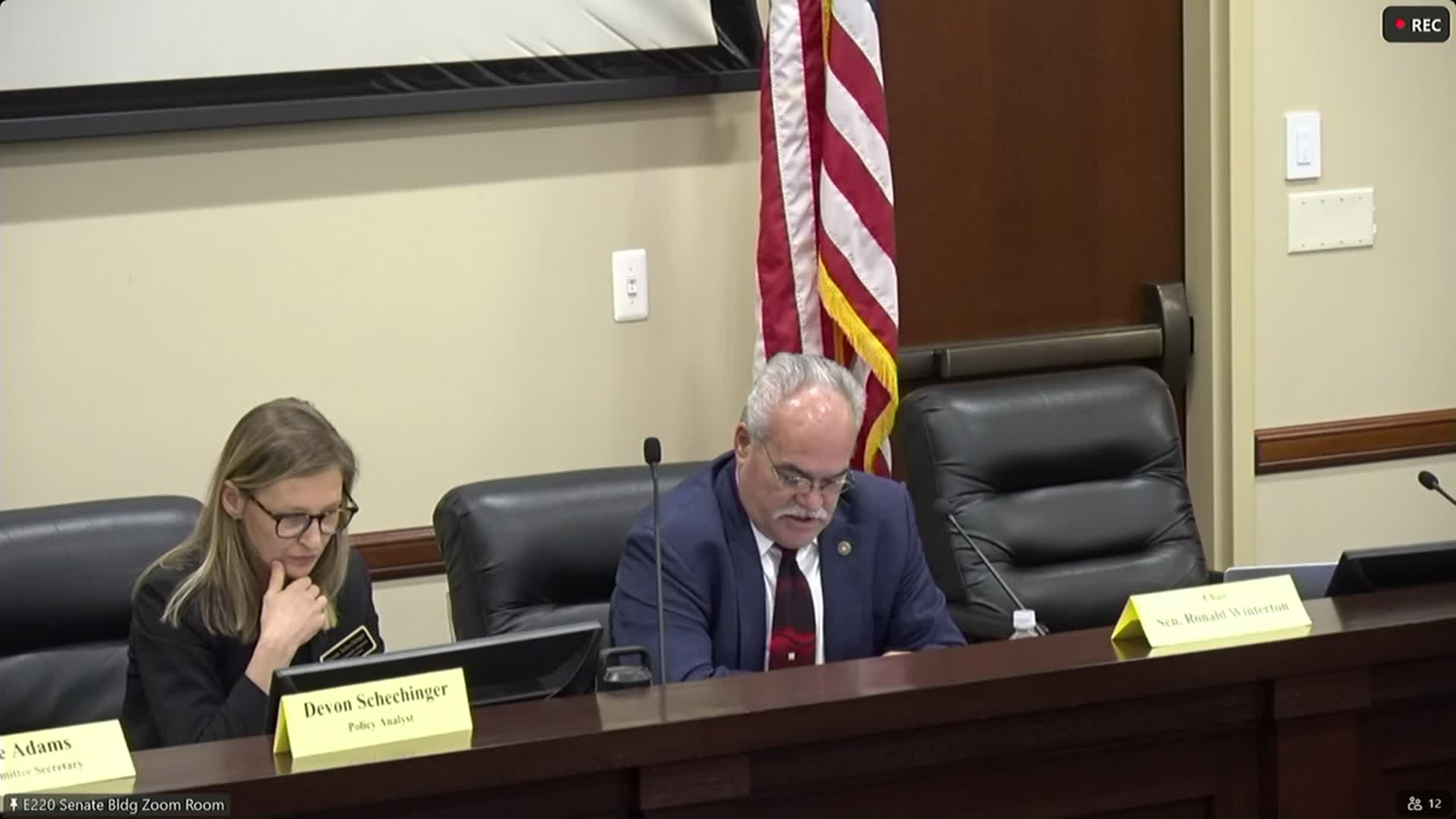
SALT LAKE CITY — The Senate Government Operations and Political Subdivisions Standing Committee on Friday favorably recommended a first substitute for Senate Bill 324, a pilot program that would require clearer outcome definitions, independent evaluation and legislative-auditor oversight for certain state grants.
The bill’s sponsor described the measure as an “adaptive framework” that would require, before awards are made, applicants to define intended outcomes, specify measurement approaches and describe evaluation methodologies. "The entity implementing the project does not score its own performance," the sponsor said, explaining that independent evaluation is the bill’s "most key portion." The substitute also assigns oversight to the Office of the Legislative Auditor General to establish standards and review methodology rigor.
The substitute includes two appropriations the sponsor said would be used as test cases: $4.5 million to the Utah State Board of Education to administer grants for up to two local education agencies modeled on strategies implemented in the Houston Independent School District starting in 2023, and $4.5 million to the Utah Board of Higher Education for grants aimed at measuring upward mobility through digital data inventories. The sponsor said the pilot is targeted and would not automatically apply to every state grant program.
In public comment, Nate Talley, deputy commissioner and CFO for the Utah System of Higher Education, told the committee the University of Utah’s Kem C. Gardner Policy Institute has been collaborating with researchers such as Dr. Raj Chetty and others to develop new ways to measure program effectiveness, and supported the appropriation to scale those methods in state programs. Michael Parker of the City Strong Foundation also urged backing the bill as a tool to help the state and potential private partners ask tougher, outcome-oriented questions.
Senator Vickers moved to delete the title and body and replace SB324 with the first substitute; the committee then voted to favorably recommend the substitute. The chair recorded the motion as favorably recommended and members noted bipartisan support during discussion.
Next steps: The bill will continue to the House (or the next legislative stage) per the sponsor’s timeline. The sponsor said the committee process is time sensitive and asked colleagues to consider placing the bill on consent in the House to expedite review.
The bill’s sponsor described the measure as an “adaptive framework” that would require, before awards are made, applicants to define intended outcomes, specify measurement approaches and describe evaluation methodologies. "The entity implementing the project does not score its own performance," the sponsor said, explaining that independent evaluation is the bill’s "most key portion." The substitute also assigns oversight to the Office of the Legislative Auditor General to establish standards and review methodology rigor.
The substitute includes two appropriations the sponsor said would be used as test cases: $4.5 million to the Utah State Board of Education to administer grants for up to two local education agencies modeled on strategies implemented in the Houston Independent School District starting in 2023, and $4.5 million to the Utah Board of Higher Education for grants aimed at measuring upward mobility through digital data inventories. The sponsor said the pilot is targeted and would not automatically apply to every state grant program.
In public comment, Nate Talley, deputy commissioner and CFO for the Utah System of Higher Education, told the committee the University of Utah’s Kem C. Gardner Policy Institute has been collaborating with researchers such as Dr. Raj Chetty and others to develop new ways to measure program effectiveness, and supported the appropriation to scale those methods in state programs. Michael Parker of the City Strong Foundation also urged backing the bill as a tool to help the state and potential private partners ask tougher, outcome-oriented questions.
Senator Vickers moved to delete the title and body and replace SB324 with the first substitute; the committee then voted to favorably recommend the substitute. The chair recorded the motion as favorably recommended and members noted bipartisan support during discussion.
Next steps: The bill will continue to the House (or the next legislative stage) per the sponsor’s timeline. The sponsor said the committee process is time sensitive and asked colleagues to consider placing the bill on consent in the House to expedite review.
View the Full Meeting & All Its Details
This article offers just a summary. Unlock complete video, transcripts, and insights as a Founder Member.
✓
Watch full, unedited meeting videos
✓
Search every word spoken in unlimited transcripts
✓
AI summaries & real-time alerts (all government levels)
✓
Permanent access to expanding government content
30-day money-back guarantee
