Senate committee advances bill limiting outdoor syringe exchanges and creating new drug-court tools
February 26, 2026 | 2026 Utah Legislature, Utah Legislature, Utah Legislative Branch, Utah
This article was created by AI summarizing key points discussed. AI makes mistakes, so for full details and context, please refer to the video of the full meeting. Please report any errors so we can fix them. Report an error »
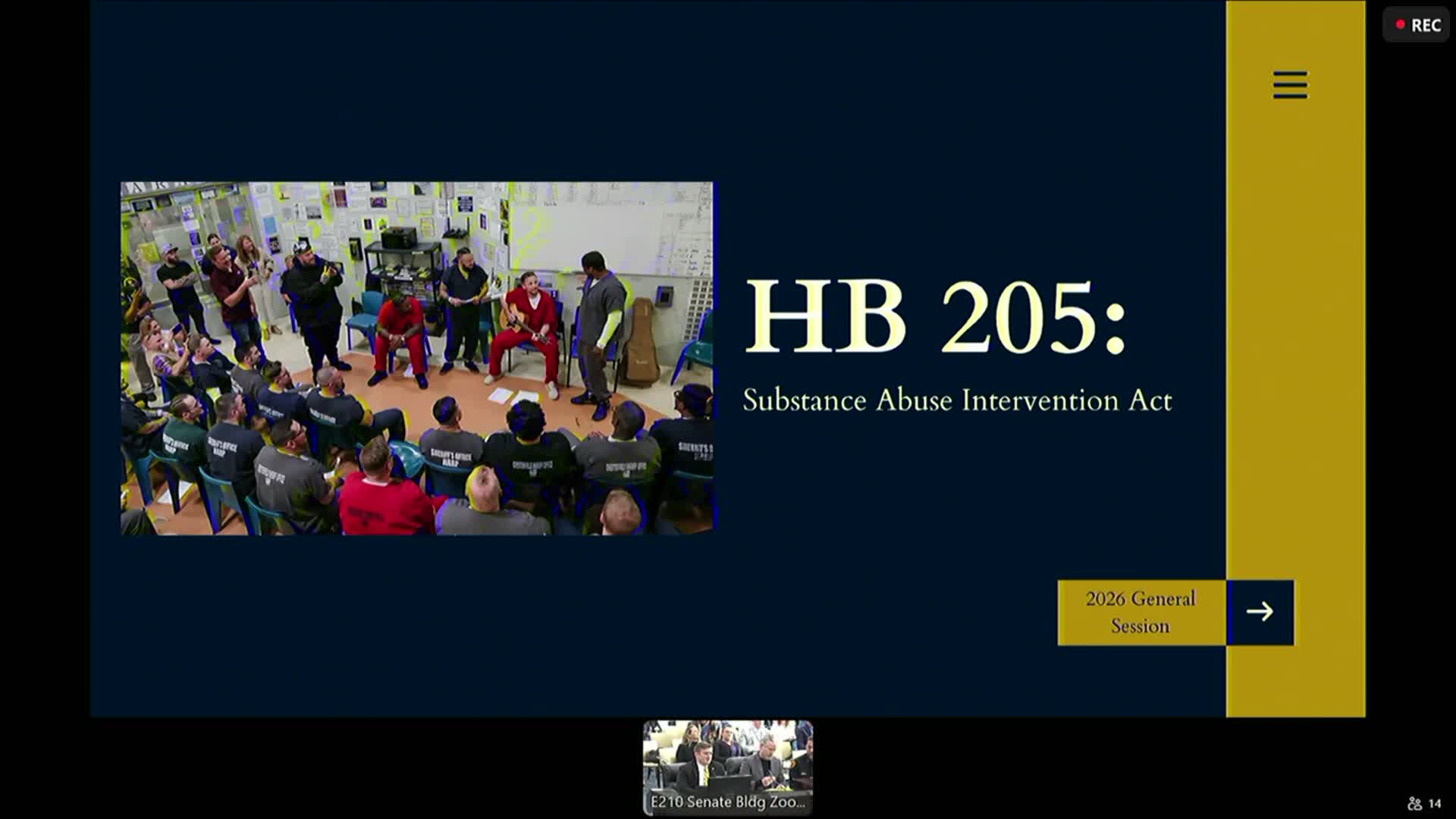
Salt Lake City — The Senate Judiciary, Law Enforcement and Criminal Justice Committee on Tuesday favorably recommended House Bill 205, a substitute that combines restrictions on some needle-exchange activity with new judicial and programmatic tools aimed at reducing open-air drug markets.
Representative Ray Clancy, the sponsor, told committee members the bill clarifies what syringe-exchange programs may do on public property, creates a civil "stay out of drug area" (SOTA) order judges can use to keep known distributors away from identified hotspots, authorizes justice-court "step courts" modeled on swift, certain and fair programs, and authorizes voluntary jail recovery pods. "We're trying to make sure we're all rowing in the same direction," Clancy said.
The bill would prohibit exchanges from operating on parks and other government-owned public spaces without the consent of the relevant government entity; it also clarifies that syringe-exchange operations do not include distribution of pipes, tinfoil or other smoking paraphernalia. Supporters said those limits preserve the original 2016 intent of needle-exchange law, which focused on reducing bloodborne disease transmission.
Salt Lake City Police Department representatives testified that the measures give police and prosecutors additional tools to combat open-air drug markets in parks. "These tools would really give us additional avenues to help keep those parks clear," Deputy Chief Bill Manzanaras said.
Harm-reduction providers strongly disputed parts of the bill. Mindy Vincent, executive director of the Utah Harm Reduction Coalition, said an "all public places" prohibition would ban the street outreach that serves many unhoused people and removes life-saving services such as on-site naloxone and HIV/hepatitis testing. "Passing this bill as it is will eliminate our ability to serve the vast majority of the homeless population," she said.
Salt Lake Harm Reduction Project's executive director Mackenzie Bray told the committee outreach teams sometimes meet clients briefly on sidewalks or in parking lots that are not private property; the bill’s current language would require written permission from multiple government entities for such encounters, she said. "That would banish us basically from almost all street outreach," Bray said.
Policy advocates and service providers urged amendments to narrow the public-property restriction and to allow smoking-supply distribution in limited circumstances to reduce injection-related wounds and overdoses. Representative Clancy said he worked through many stakeholder concerns in the House and framed the measure as a compromise that is narrower than extreme municipal models such as San Francisco’s ban on outdoor harm-reduction entirely.
The bill includes funding and programmatic options: the step-court authority would let justice courts offer specialty programs where appropriate, and the proposed SOTA orders would be civil tools (not a change to bail or substantive narcotics penalties) designed to prevent reoffending at identified public sites. Clancy said funding could include private donations and requested appropriations; he told members the fiscal analyst saw $250,000 as a reasonable initial target for the clearance-rate project referenced elsewhere in committee discussion.
Supporters of the bill included the Salt Lake City Police Department and some criminal-justice reform groups; opponents included the Utah Harm Reduction Coalition and other outreach providers who said the measure would reduce lifesaving contact with vulnerable people. After extended public testimony and several committee questions about rural and operational impacts, the committee voted to favorably recommend the substitute on a roll call (4-0 at the time of recorded vote). The sponsor said he would continue stakeholder conversations as the bill moves to the Senate floor.
The committee's action sends HB 205 to the full Senate for further debate and possible amendment.
Representative Ray Clancy, the sponsor, told committee members the bill clarifies what syringe-exchange programs may do on public property, creates a civil "stay out of drug area" (SOTA) order judges can use to keep known distributors away from identified hotspots, authorizes justice-court "step courts" modeled on swift, certain and fair programs, and authorizes voluntary jail recovery pods. "We're trying to make sure we're all rowing in the same direction," Clancy said.
The bill would prohibit exchanges from operating on parks and other government-owned public spaces without the consent of the relevant government entity; it also clarifies that syringe-exchange operations do not include distribution of pipes, tinfoil or other smoking paraphernalia. Supporters said those limits preserve the original 2016 intent of needle-exchange law, which focused on reducing bloodborne disease transmission.
Salt Lake City Police Department representatives testified that the measures give police and prosecutors additional tools to combat open-air drug markets in parks. "These tools would really give us additional avenues to help keep those parks clear," Deputy Chief Bill Manzanaras said.
Harm-reduction providers strongly disputed parts of the bill. Mindy Vincent, executive director of the Utah Harm Reduction Coalition, said an "all public places" prohibition would ban the street outreach that serves many unhoused people and removes life-saving services such as on-site naloxone and HIV/hepatitis testing. "Passing this bill as it is will eliminate our ability to serve the vast majority of the homeless population," she said.
Salt Lake Harm Reduction Project's executive director Mackenzie Bray told the committee outreach teams sometimes meet clients briefly on sidewalks or in parking lots that are not private property; the bill’s current language would require written permission from multiple government entities for such encounters, she said. "That would banish us basically from almost all street outreach," Bray said.
Policy advocates and service providers urged amendments to narrow the public-property restriction and to allow smoking-supply distribution in limited circumstances to reduce injection-related wounds and overdoses. Representative Clancy said he worked through many stakeholder concerns in the House and framed the measure as a compromise that is narrower than extreme municipal models such as San Francisco’s ban on outdoor harm-reduction entirely.
The bill includes funding and programmatic options: the step-court authority would let justice courts offer specialty programs where appropriate, and the proposed SOTA orders would be civil tools (not a change to bail or substantive narcotics penalties) designed to prevent reoffending at identified public sites. Clancy said funding could include private donations and requested appropriations; he told members the fiscal analyst saw $250,000 as a reasonable initial target for the clearance-rate project referenced elsewhere in committee discussion.
Supporters of the bill included the Salt Lake City Police Department and some criminal-justice reform groups; opponents included the Utah Harm Reduction Coalition and other outreach providers who said the measure would reduce lifesaving contact with vulnerable people. After extended public testimony and several committee questions about rural and operational impacts, the committee voted to favorably recommend the substitute on a roll call (4-0 at the time of recorded vote). The sponsor said he would continue stakeholder conversations as the bill moves to the Senate floor.
The committee's action sends HB 205 to the full Senate for further debate and possible amendment.
View the Full Meeting & All Its Details
This article offers just a summary. Unlock complete video, transcripts, and insights as a Founder Member.
✓
Watch full, unedited meeting videos
✓
Search every word spoken in unlimited transcripts
✓
AI summaries & real-time alerts (all government levels)
✓
Permanent access to expanding government content
30-day money-back guarantee
