Lafayette unveils $3.8 million repaving plan for 28 streets; residents press for bike and drainage fixes
February 26, 2026 | Lafayette, Contra Costa County, California
This article was created by AI summarizing key points discussed. AI makes mistakes, so for full details and context, please refer to the video of the full meeting. Please report any errors so we can fix them. Report an error »
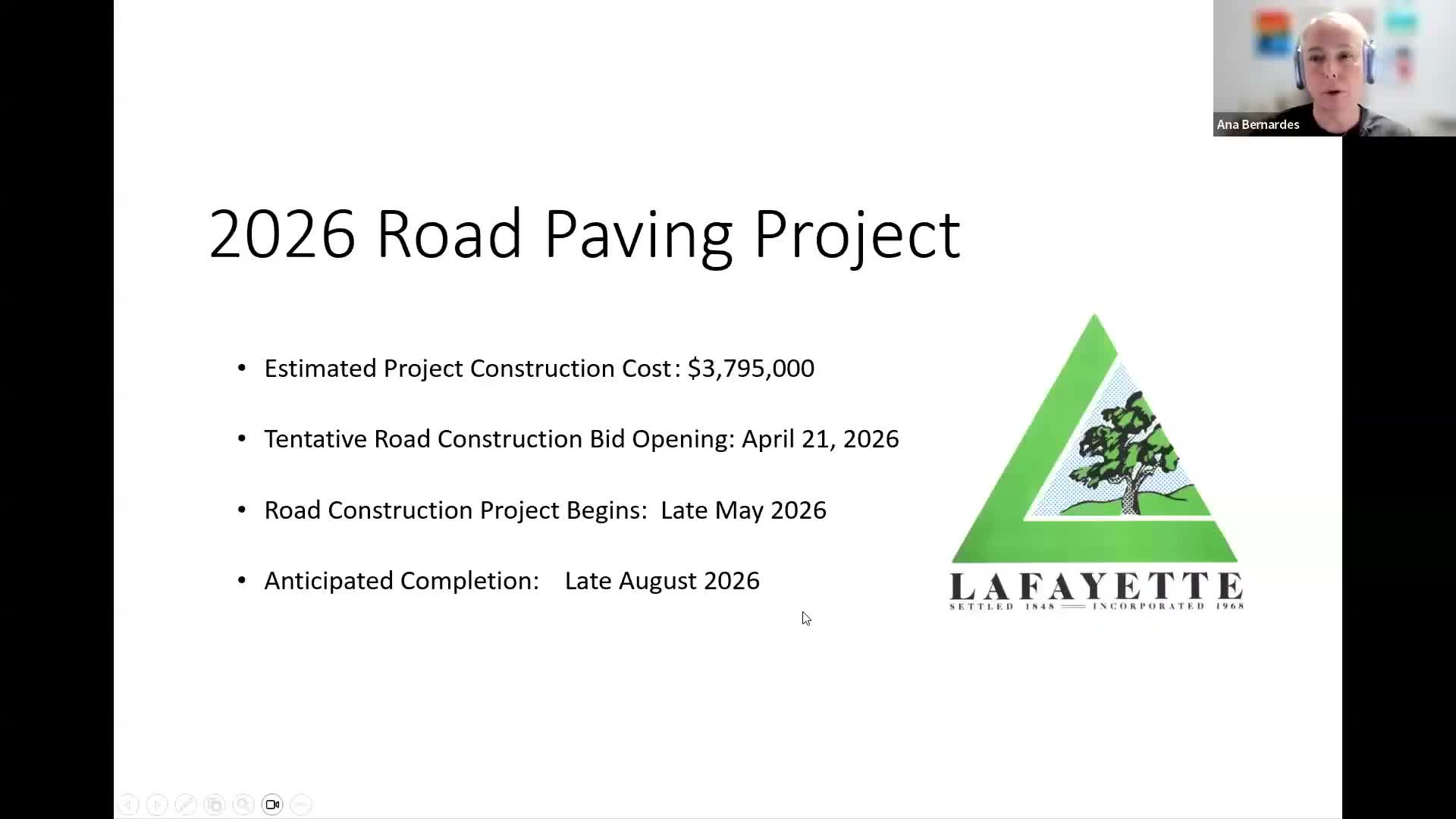
Anna Bernardes, the City of Lafayette’s senior engineer, presented the city’s 2026 paving program on Monday and said the $3,800,000 project will resurface 28 streets beginning in late May and wrapping up in late August.
The meeting, held as a public presentation, walked residents through the construction sequence — grind and remove existing striping, crack-seal, perform base repairs (dig-outs), apply a tack coat and finish with a hot-mix asphalt overlay. "Most of the streets on this project will receive an inch and a half of hot asphalt overlay," Bernardes said, adding that in some locations inlay work of up to 3–3.5 inches will be used where pavement is more severely damaged.
Why it matters: repaving now is intended as preventative maintenance. Bernardes said the city uses a pavement condition index (PCI) and consultant surveys to select streets and that focusing on residential streets helps avoid costlier full reconstruction later.
Bernardes outlined homeowner responsibilities and a May 15 deadline for frontage repairs done by private contractors. "Property owners hiring their own contractor to do these repairs are required to acquire an encroachment permit and complete the work by May 15," she said, and noted the city will waive the usual permit fee if the work is completed before that date. She also advised homeowners to inspect sewer laterals and obtain any required permits from the Central Contra Costa Sanitary District.
Work specifics and neighborhood impacts
The presentation detailed common treatments: 6-foot wedge grinding adjacent to concrete or paver driveways, 4-foot 'conformed paving' over asphalt driveways to match finished elevations, replacement of asphalt berms, repairs to curb, gutter and sidewalk where severely damaged, and construction of ADA-compliant curb ramps where missing. Bernardes said utility-adjustment work may be performed by the utility providers or under a city contract reimbursed by utilities.
Release Station Road is the only arterial in the program; because of settlement and erosion the city plans a 3-inch cold-planing and 3-inch inlay rather than a thin overlay on that segment.
Traffic control and schedule
Bernardes said typical contractor hours will be Monday–Friday, 8 a.m.–5 p.m., with lane-closure restrictions during the school year to 9 a.m.–2 p.m. to reduce impacts on school traffic. Where work is occurring, traffic will generally be reduced to one lane with two-way traffic control or a detour. Contractors are expected to post no-parking signs at least 48 hours before work. The city will post weekly Friday updates on the project website with the coming week’s schedule and affected streets.
Resident concerns: Brook Street, bike connections and drainage
Residents used the public-comment portion to press the city on safety and local drainage. Brian, a resident, asked whether the repaving could include a better sidewalk or a multiuse path to help children travel safely between LES and Brook Street Park. "I was just wondering if there's plans or if there's something we can do to make sure the repaving takes a better sidewalk or a multiuse path," he said.
Bernardes said Lafayette has applied for a grant to revise its bike master plan, which would be the forum for studying bike lanes, bulb-outs or other road reconfigurations. "At this project, we’re just resurfacing the road," she said, adding that restriping or signage changes are possible but full reconfiguration would require a separate study, funding and environmental review.
Betsy, another Brook Street resident and parent, described inconsistent pedestrian space along Brook Street and said bike-boulevard designation has not translated into a safe route for children. Bernardes replied that sidewalk repairs and new curb ramps included in the project will improve walkability and that any larger reconfiguration would come from the forthcoming master-plan process and require additional funding.
A resident on Los Arrabes reported persistent runoff during heavy rains that has caused mud to wash into a backyard pool and asked whether the project could address the lack of v-ditch or berm protection. Bernardes asked the resident to email the address and said staff will revisit the site to evaluate options such as placing a berm or performing localized drainage work.
Next steps and contact information
Bernardes encouraged residents with questions or concerns to email or call her (contact details on the city website and in the mailed notice) and reiterated that the city posts Friday updates identifying which streets will be worked on and the expected traffic impacts. Owners may either hire contractors to perform required frontage repairs or request the city include repairs in the construction contract and reimburse the city for associated costs.
The city will proceed with the resurfacing schedule unless PG&E or other utility work requires postponement of a particular street; Bernardes noted PG&E is designing a gas-main replacement that may affect the Brook Street timeline. Residents with site-specific drainage or driveway concerns were asked to follow up directly with Bernardes so staff can inspect and advise on permits and options.
The meeting, held as a public presentation, walked residents through the construction sequence — grind and remove existing striping, crack-seal, perform base repairs (dig-outs), apply a tack coat and finish with a hot-mix asphalt overlay. "Most of the streets on this project will receive an inch and a half of hot asphalt overlay," Bernardes said, adding that in some locations inlay work of up to 3–3.5 inches will be used where pavement is more severely damaged.
Why it matters: repaving now is intended as preventative maintenance. Bernardes said the city uses a pavement condition index (PCI) and consultant surveys to select streets and that focusing on residential streets helps avoid costlier full reconstruction later.
Bernardes outlined homeowner responsibilities and a May 15 deadline for frontage repairs done by private contractors. "Property owners hiring their own contractor to do these repairs are required to acquire an encroachment permit and complete the work by May 15," she said, and noted the city will waive the usual permit fee if the work is completed before that date. She also advised homeowners to inspect sewer laterals and obtain any required permits from the Central Contra Costa Sanitary District.
Work specifics and neighborhood impacts
The presentation detailed common treatments: 6-foot wedge grinding adjacent to concrete or paver driveways, 4-foot 'conformed paving' over asphalt driveways to match finished elevations, replacement of asphalt berms, repairs to curb, gutter and sidewalk where severely damaged, and construction of ADA-compliant curb ramps where missing. Bernardes said utility-adjustment work may be performed by the utility providers or under a city contract reimbursed by utilities.
Release Station Road is the only arterial in the program; because of settlement and erosion the city plans a 3-inch cold-planing and 3-inch inlay rather than a thin overlay on that segment.
Traffic control and schedule
Bernardes said typical contractor hours will be Monday–Friday, 8 a.m.–5 p.m., with lane-closure restrictions during the school year to 9 a.m.–2 p.m. to reduce impacts on school traffic. Where work is occurring, traffic will generally be reduced to one lane with two-way traffic control or a detour. Contractors are expected to post no-parking signs at least 48 hours before work. The city will post weekly Friday updates on the project website with the coming week’s schedule and affected streets.
Resident concerns: Brook Street, bike connections and drainage
Residents used the public-comment portion to press the city on safety and local drainage. Brian, a resident, asked whether the repaving could include a better sidewalk or a multiuse path to help children travel safely between LES and Brook Street Park. "I was just wondering if there's plans or if there's something we can do to make sure the repaving takes a better sidewalk or a multiuse path," he said.
Bernardes said Lafayette has applied for a grant to revise its bike master plan, which would be the forum for studying bike lanes, bulb-outs or other road reconfigurations. "At this project, we’re just resurfacing the road," she said, adding that restriping or signage changes are possible but full reconfiguration would require a separate study, funding and environmental review.
Betsy, another Brook Street resident and parent, described inconsistent pedestrian space along Brook Street and said bike-boulevard designation has not translated into a safe route for children. Bernardes replied that sidewalk repairs and new curb ramps included in the project will improve walkability and that any larger reconfiguration would come from the forthcoming master-plan process and require additional funding.
A resident on Los Arrabes reported persistent runoff during heavy rains that has caused mud to wash into a backyard pool and asked whether the project could address the lack of v-ditch or berm protection. Bernardes asked the resident to email the address and said staff will revisit the site to evaluate options such as placing a berm or performing localized drainage work.
Next steps and contact information
Bernardes encouraged residents with questions or concerns to email or call her (contact details on the city website and in the mailed notice) and reiterated that the city posts Friday updates identifying which streets will be worked on and the expected traffic impacts. Owners may either hire contractors to perform required frontage repairs or request the city include repairs in the construction contract and reimburse the city for associated costs.
The city will proceed with the resurfacing schedule unless PG&E or other utility work requires postponement of a particular street; Bernardes noted PG&E is designing a gas-main replacement that may affect the Brook Street timeline. Residents with site-specific drainage or driveway concerns were asked to follow up directly with Bernardes so staff can inspect and advise on permits and options.
Don't Miss a Word: See the Full Meeting!
Go beyond summaries. Unlock every video, transcript, and key insight with a Founder Membership.
✓
Get instant access to full meeting videos
✓
Search and clip any phrase from complete transcripts
✓
Receive AI-powered summaries & custom alerts
✓
Enjoy lifetime, unrestricted access to government data
30-day money-back guarantee
