Charter Review Commission approves Step 4 to schedule second readings after debate over process and majority threshold
February 26, 2026 | Clark County, Washington
This article was created by AI summarizing key points discussed. AI makes mistakes, so for full details and context, please refer to the video of the full meeting. Please report any errors so we can fix them. Report an error »
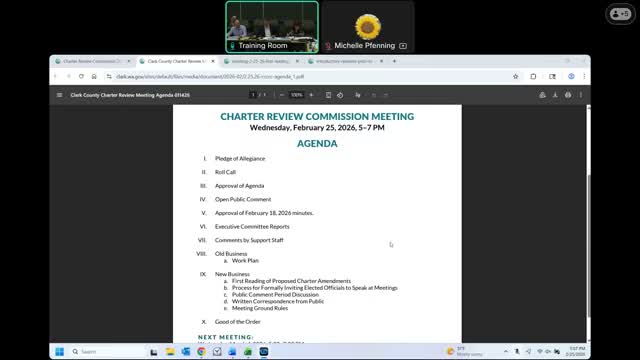
On Feb. 25, 2026, the Clark County Charter Review Commission voted 10–5 to approve Step 4 of its work plan, a procedural rule that allows commissioners to schedule second readings for proposed charter amendments.
The vote followed a lengthy discussion and a failed attempt to adopt the entire work plan at once. Commissioner Jay offered an amendment to approve the whole plan (merging steps 6 and 7), arguing the commission should "keep moving this process forward." That secondary motion failed on a roll-call vote. Chair Erickson then called the roll on the main motion to adopt Step 4, which carried by a 10–5 margin.
Opponents said approving the full plan before the work plan subcommittee completed technical work would be premature. Commissioner Landesberg asked whether an amendment that fails on a first reading could be reintroduced, and Commissioner Holmgren said it “seems early to set the standard at a majority vote” because sponsors may not yet have language to present for committee review. Supporters, including Commissioner Benton, said adopting the next step would prevent delays and allow the commission to move proposals into committee or to scheduled second readings.
Legal and procedural clarity was a recurring theme. Commissioners stressed the subcommittee’s role is administrative—process, timelines and outreach—and not to evaluate amendment content. Chair Erickson and staff clarified that the subcommittee will aim to comply with the Open Public Meetings Act and that approved items meeting the five-vote minimum will be asked to present at the next meeting for a scheduled second reading.
What’s next: With Step 4 approved, items that earn the minimum affirmative votes in a first reading can be calendared for a second reading; sponsors will be asked whether they are prepared to present at the next meeting. The commission also scheduled an additional meeting on March 31 to provide more calendar capacity.
The vote followed a lengthy discussion and a failed attempt to adopt the entire work plan at once. Commissioner Jay offered an amendment to approve the whole plan (merging steps 6 and 7), arguing the commission should "keep moving this process forward." That secondary motion failed on a roll-call vote. Chair Erickson then called the roll on the main motion to adopt Step 4, which carried by a 10–5 margin.
Opponents said approving the full plan before the work plan subcommittee completed technical work would be premature. Commissioner Landesberg asked whether an amendment that fails on a first reading could be reintroduced, and Commissioner Holmgren said it “seems early to set the standard at a majority vote” because sponsors may not yet have language to present for committee review. Supporters, including Commissioner Benton, said adopting the next step would prevent delays and allow the commission to move proposals into committee or to scheduled second readings.
Legal and procedural clarity was a recurring theme. Commissioners stressed the subcommittee’s role is administrative—process, timelines and outreach—and not to evaluate amendment content. Chair Erickson and staff clarified that the subcommittee will aim to comply with the Open Public Meetings Act and that approved items meeting the five-vote minimum will be asked to present at the next meeting for a scheduled second reading.
What’s next: With Step 4 approved, items that earn the minimum affirmative votes in a first reading can be calendared for a second reading; sponsors will be asked whether they are prepared to present at the next meeting. The commission also scheduled an additional meeting on March 31 to provide more calendar capacity.
View the Full Meeting & All Its Details
This article offers just a summary. Unlock complete video, transcripts, and insights as a Founder Member.
✓
Watch full, unedited meeting videos
✓
Search every word spoken in unlimited transcripts
✓
AI summaries & real-time alerts (all government levels)
✓
Permanent access to expanding government content
30-day money-back guarantee
