House committee backs bill to make short fetal‑development video available in Utah schools after heated debate
February 26, 2026 | 2026 Utah Legislature, Utah Legislature, Utah Legislative Branch, Utah
This article was created by AI summarizing key points discussed. AI makes mistakes, so for full details and context, please refer to the video of the full meeting. Please report any errors so we can fix them. Report an error »
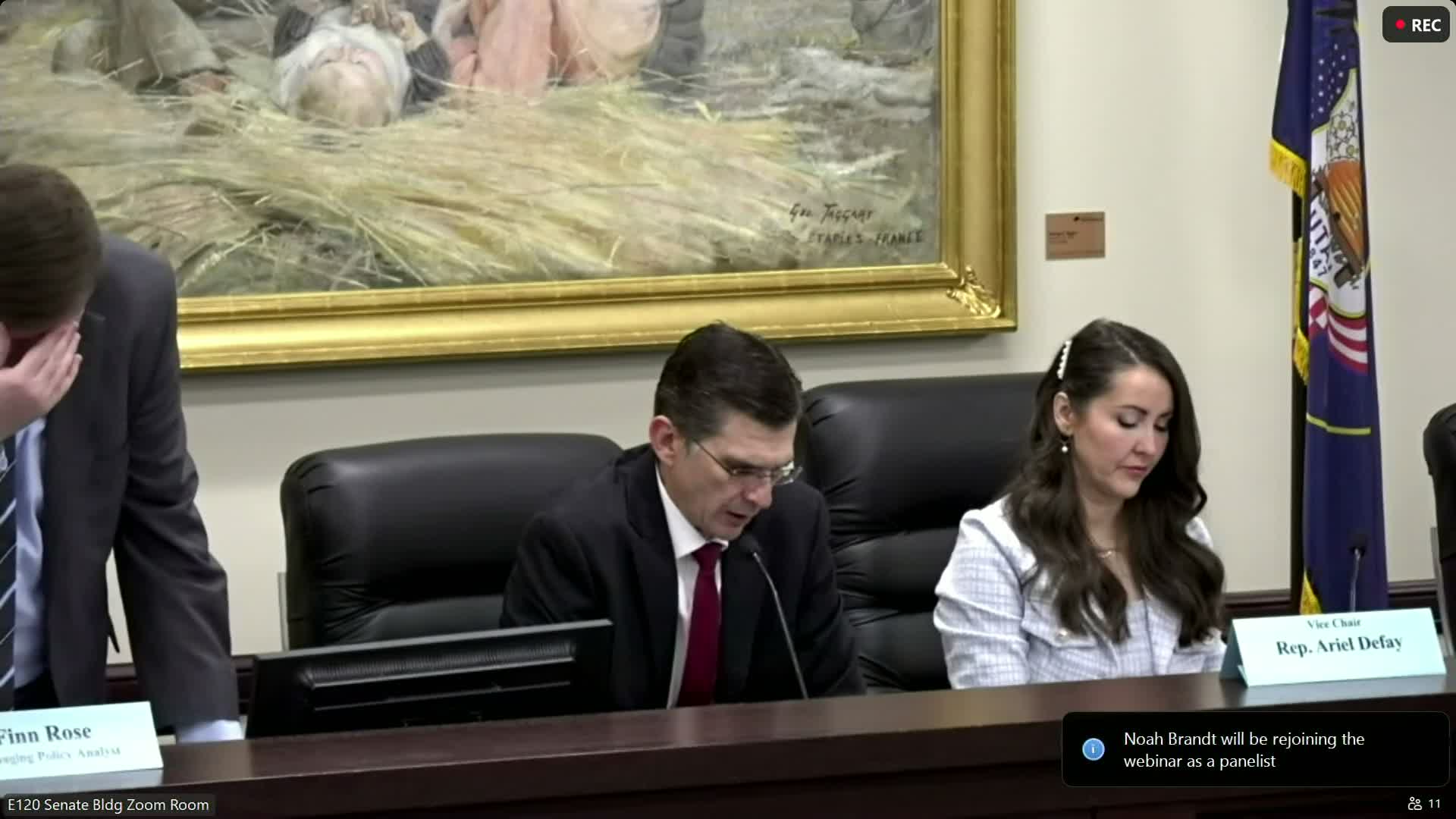
The House Education Standing Committee voted 6–5 on Feb. 26 to recommend favorably House Bill 315, a measure that would require local education agencies to provide a short, high‑definition fetal‑development video as an available instructional resource in specified classes, including fifth‑ and sixth‑grade maturation, health, child‑development and biology courses.
Representative Jill Peck, the bill sponsor, said the measure fills what she described as a gap in students’ education about how babies develop. “It’s a part of human education that we should know,” she told the committee, noting the video would be donated with a perpetual, unbranded license and would not require renewal.
The bill drew sharply divided testimony during a one‑hour committee hearing. Noah Brandt, vice president of communications for the nonprofit Live Action, described the “Baby Olivia” animation as “a medically accurate animated glimpse of human life in the womb” and explained the video uses conceptual age (time since conception) rather than gestational age (time since last menstrual period) to describe developmental milestones. Brandt listed several physicians who contributed to the project and offered to arrange medical experts to brief the committee.
Opponents — including a Planned Parenthood educator and a Salt Lake Valley family physician — argued the video is misleading and not vetted by the local curriculum processes. “Showing these fake ultrasound videos that leading medical experts describe as misleading not only fails to teach students accurate information, it also makes them lose trust,” Bridal Brenneman of Planned Parenthood Association of Utah told the committee.
State Superintendent Molly Hart told the panel that Utah’s existing standards already include conception, fetal development and birth in middle and high school standards and warned the proposal would mark “a major departure” from local vetting. “These standards do not mandate a specific instructional format,” Hart said, and she added that USBE had vetting criteria by which the video did not meet the board’s standards.
Several committee members pressed the sponsor on whether the bill requires use of one particular video. Representative McPherson asked whether LEAs could use other videos that meet the bill’s standards; Representative Peck replied the bill is not highly prescriptive about brand but does specify characteristics for an organizationally provided, three‑minute video.
Public commenters were split. Mary Anne Christensen, executive director of Utah Legislative Watch, urged support, saying the resource increases appreciation for fetal development. Julie Jackson, speaking as an individual and a Granite School Board member, opposed the bill as overly prescriptive to LEAs and cautioned against mandating a single resource.
After debate on process and whether the bill should be studied further, the committee adopted a first substitute and an amendment and then voted to recommend the substitute as amended. The committee clerk recorded a roll‑call vote of 6–5 in favor of the recommendation.
The bill will move forward with the committee’s favorable recommendation; the next procedural steps were not detailed in the hearing record.
Representative Jill Peck, the bill sponsor, said the measure fills what she described as a gap in students’ education about how babies develop. “It’s a part of human education that we should know,” she told the committee, noting the video would be donated with a perpetual, unbranded license and would not require renewal.
The bill drew sharply divided testimony during a one‑hour committee hearing. Noah Brandt, vice president of communications for the nonprofit Live Action, described the “Baby Olivia” animation as “a medically accurate animated glimpse of human life in the womb” and explained the video uses conceptual age (time since conception) rather than gestational age (time since last menstrual period) to describe developmental milestones. Brandt listed several physicians who contributed to the project and offered to arrange medical experts to brief the committee.
Opponents — including a Planned Parenthood educator and a Salt Lake Valley family physician — argued the video is misleading and not vetted by the local curriculum processes. “Showing these fake ultrasound videos that leading medical experts describe as misleading not only fails to teach students accurate information, it also makes them lose trust,” Bridal Brenneman of Planned Parenthood Association of Utah told the committee.
State Superintendent Molly Hart told the panel that Utah’s existing standards already include conception, fetal development and birth in middle and high school standards and warned the proposal would mark “a major departure” from local vetting. “These standards do not mandate a specific instructional format,” Hart said, and she added that USBE had vetting criteria by which the video did not meet the board’s standards.
Several committee members pressed the sponsor on whether the bill requires use of one particular video. Representative McPherson asked whether LEAs could use other videos that meet the bill’s standards; Representative Peck replied the bill is not highly prescriptive about brand but does specify characteristics for an organizationally provided, three‑minute video.
Public commenters were split. Mary Anne Christensen, executive director of Utah Legislative Watch, urged support, saying the resource increases appreciation for fetal development. Julie Jackson, speaking as an individual and a Granite School Board member, opposed the bill as overly prescriptive to LEAs and cautioned against mandating a single resource.
After debate on process and whether the bill should be studied further, the committee adopted a first substitute and an amendment and then voted to recommend the substitute as amended. The committee clerk recorded a roll‑call vote of 6–5 in favor of the recommendation.
The bill will move forward with the committee’s favorable recommendation; the next procedural steps were not detailed in the hearing record.
Don't Miss a Word: See the Full Meeting!
Go beyond summaries. Unlock every video, transcript, and key insight with a Founder Membership.
✓
Get instant access to full meeting videos
✓
Search and clip any phrase from complete transcripts
✓
Receive AI-powered summaries & custom alerts
✓
Enjoy lifetime, unrestricted access to government data
30-day money-back guarantee
