Locust Valley leaders recommend $2.5M transfer to fund phased classroom door and lock upgrades
February 26, 2026 | LOCUST VALLEY CENTRAL SCHOOL DISTRICT, School Districts, New York
This article was created by AI summarizing key points discussed. AI makes mistakes, so for full details and context, please refer to the video of the full meeting. Please report any errors so we can fix them. Report an error »
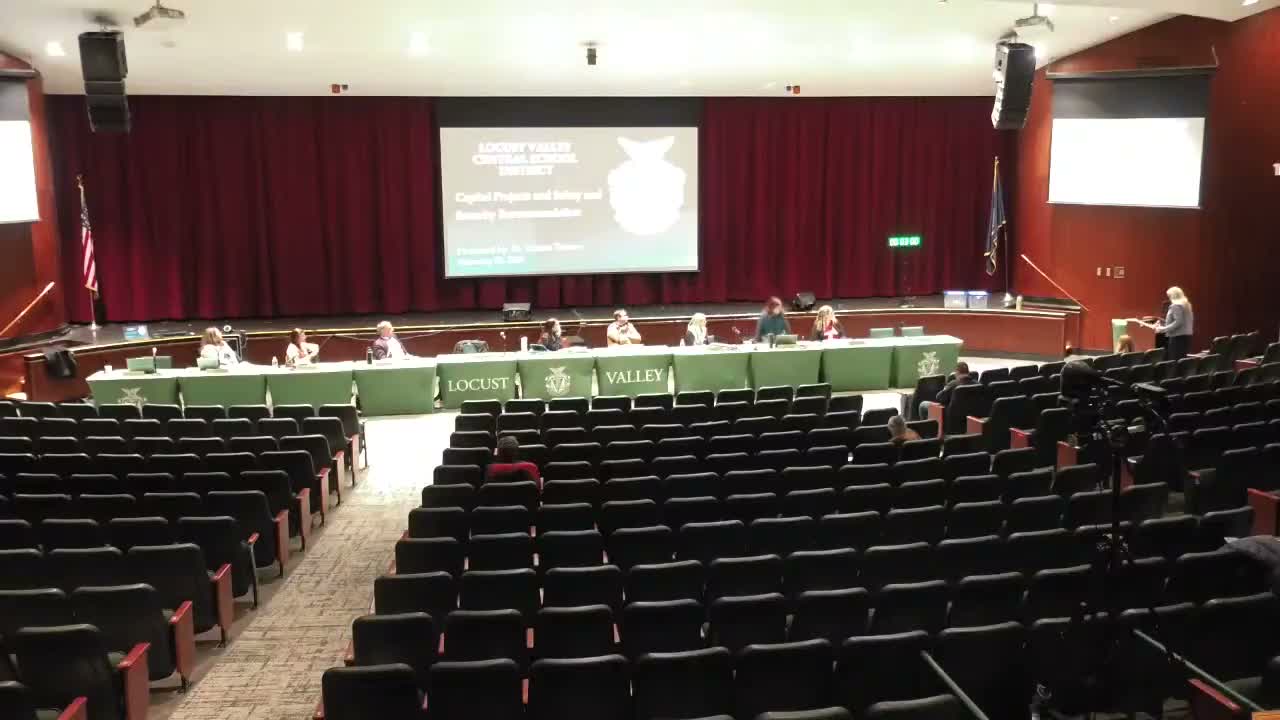
A district official recommended that the Locust Valley Central School District execute a $2,500,000 transfer to capital to pay for a multi‑phase installation of new classroom doors and electronic locks aimed at creating immediate life‑safety 'safe zones.' The proposal prioritizes elementary schools in Phase 1, moves into the middle and high schools in Phase 2A and schedules magnetic door holds in a later Phase 2B.
The recommendation was presented as part of the district’s 2026–27 capital and budget review. The presentation framed the change as part of a broader shift away from long‑term borrowing toward pay‑as‑you‑go capital transfers and reserve withdrawals. The speaker noted the district has reduced annual bond debt from roughly $2.6 million in 2012 to about $356,000 today and said that, despite that change, annual total investment in facilities has remained near previous levels.
“The absolute priority is outfitting our doors. Automatic locking and swipe card access will address this immediate threat,” the speaker said, arguing automatic locks reduce the chance that staff will ‘fumble with keys’ in a crisis. The presentation included specific cost figures shown in the slide deck: $1,550,000 and $950,000, which together were presented as the basis for the $2,500,000 recommendation.
The plan calls for Phase 1 and Phase 2A to be completed during the 2026–27 school year, with Phase 2B (magnetic door holds and any remaining door work) planned for the next budget cycle. Presenters said installation of a lock takes about 15–20 minutes once crews are familiar with procedures, and the district plans to accomplish as much of the elementary work as possible during the summer to avoid classroom disruption.
Board members asked operational questions about day‑to‑day routines under the locked‑door protocol—how students would leave for the bathroom, how visitors would be received, and whether bathroom doors were included. Presenters said bathroom doors would be re‑outfitted where needed and explained that secondary schools already use a swipe system for bathroom entry; in elementary schools classroom door leaders or staff would manage brief exits. The district also noted police override cards exist for first responders and emphasized that panic buttons and the Verkada system would centrally release doors when appropriate.
No formal vote to execute the transfer was recorded in the public session; the board engaged in questions and discussion. The presentation concluded with the district urging that immediate resources be focused on electronic locks as a life‑safety priority and that magnetic holds be budgeted in a later cycle.
The recommendation was presented as part of the district’s 2026–27 capital and budget review. The presentation framed the change as part of a broader shift away from long‑term borrowing toward pay‑as‑you‑go capital transfers and reserve withdrawals. The speaker noted the district has reduced annual bond debt from roughly $2.6 million in 2012 to about $356,000 today and said that, despite that change, annual total investment in facilities has remained near previous levels.
“The absolute priority is outfitting our doors. Automatic locking and swipe card access will address this immediate threat,” the speaker said, arguing automatic locks reduce the chance that staff will ‘fumble with keys’ in a crisis. The presentation included specific cost figures shown in the slide deck: $1,550,000 and $950,000, which together were presented as the basis for the $2,500,000 recommendation.
The plan calls for Phase 1 and Phase 2A to be completed during the 2026–27 school year, with Phase 2B (magnetic door holds and any remaining door work) planned for the next budget cycle. Presenters said installation of a lock takes about 15–20 minutes once crews are familiar with procedures, and the district plans to accomplish as much of the elementary work as possible during the summer to avoid classroom disruption.
Board members asked operational questions about day‑to‑day routines under the locked‑door protocol—how students would leave for the bathroom, how visitors would be received, and whether bathroom doors were included. Presenters said bathroom doors would be re‑outfitted where needed and explained that secondary schools already use a swipe system for bathroom entry; in elementary schools classroom door leaders or staff would manage brief exits. The district also noted police override cards exist for first responders and emphasized that panic buttons and the Verkada system would centrally release doors when appropriate.
No formal vote to execute the transfer was recorded in the public session; the board engaged in questions and discussion. The presentation concluded with the district urging that immediate resources be focused on electronic locks as a life‑safety priority and that magnetic holds be budgeted in a later cycle.
View the Full Meeting & All Its Details
This article offers just a summary. Unlock complete video, transcripts, and insights as a Founder Member.
✓
Watch full, unedited meeting videos
✓
Search every word spoken in unlimited transcripts
✓
AI summaries & real-time alerts (all government levels)
✓
Permanent access to expanding government content
30-day money-back guarantee
