Congressional Hispanic Caucus urges USCCR probe of Supreme Court shadow‑docket order affecting Latino communities
September 20, 2025 | U.S. Commission on Civil Rights, Independent Federal Agency, Executive, Federal
This article was created by AI summarizing key points discussed. AI makes mistakes, so for full details and context, please refer to the video of the full meeting. Please report any errors so we can fix them. Report an error »
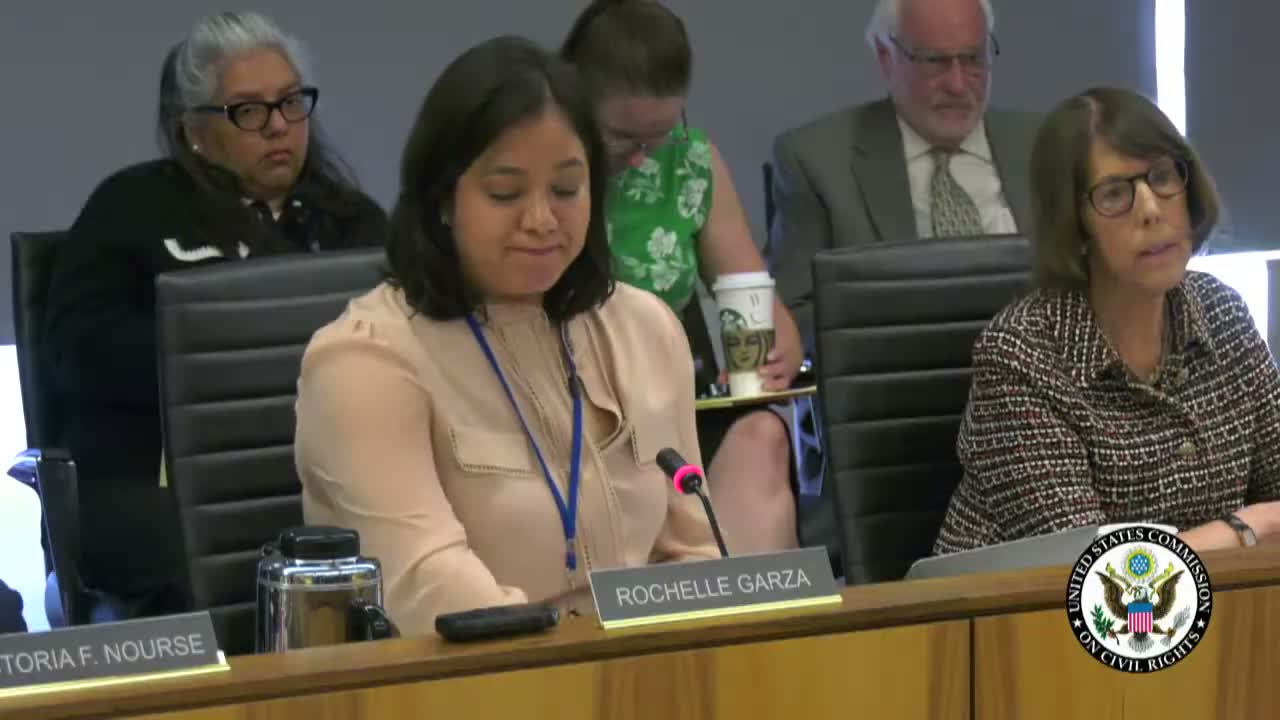
Monica Garay, introduced at the meeting as the executive director of the Congressional Hispanic Caucus, asked the U.S. Commission on Civil Rights to investigate the civil‑rights consequences of the Supreme Court’s recent shadow‑docket order in Noam v. Vasquez Perdomo. Garay said she had a letter from caucus members she wanted to submit for the record and asked the commission to gather testimony from affected Latino communities, civil‑rights organizations and local officials and to issue a report with recommendations for Congress and federal agencies.
Garay described the Fourth Amendment as ‘‘a bedrock guarantee’’ and said the caucus views the order as eroding protections for Latino communities, warning it ‘‘green lights racial profiling’’ and citing local reports—she said in Los Angeles County community members described an uptick in vehicle stops targeting Latino drivers. She said families report curtailing activities such as attending church, school or medical appointments out of fear.
Commissioners asked about the case’s procedural posture. A presenter explained the Supreme Court’s action was an emergency stay issued on the shadow docket—the court granted a stay of a district‑court temporary restraining order; a preliminary injunction hearing in the district court was scheduled for Sept. 24, and the litigation will continue.
During follow‑up, a caucus representative also urged the commission to consider language‑access protections, noting Title III (U.S. Department of Education programs for English‑language learners) as essential to safeguarding services and economic stability for limited‑English‑proficient Latinos.
The commission took the request under advisement; commissioners said they would consider next steps and how to incorporate the caucus’s evidence into potential investigations.
Garay described the Fourth Amendment as ‘‘a bedrock guarantee’’ and said the caucus views the order as eroding protections for Latino communities, warning it ‘‘green lights racial profiling’’ and citing local reports—she said in Los Angeles County community members described an uptick in vehicle stops targeting Latino drivers. She said families report curtailing activities such as attending church, school or medical appointments out of fear.
Commissioners asked about the case’s procedural posture. A presenter explained the Supreme Court’s action was an emergency stay issued on the shadow docket—the court granted a stay of a district‑court temporary restraining order; a preliminary injunction hearing in the district court was scheduled for Sept. 24, and the litigation will continue.
During follow‑up, a caucus representative also urged the commission to consider language‑access protections, noting Title III (U.S. Department of Education programs for English‑language learners) as essential to safeguarding services and economic stability for limited‑English‑proficient Latinos.
The commission took the request under advisement; commissioners said they would consider next steps and how to incorporate the caucus’s evidence into potential investigations.
View the Full Meeting & All Its Details
This article offers just a summary. Unlock complete video, transcripts, and insights as a Founder Member.
✓
Watch full, unedited meeting videos
✓
Search every word spoken in unlimited transcripts
✓
AI summaries & real-time alerts (all government levels)
✓
Permanent access to expanding government content
30-day money-back guarantee
