Charter panel debates whether New Canaan Planning & Zoning should be elected or appointed
February 26, 2026 | New Canaan, Fairfield, Connecticut
This article was created by AI summarizing key points discussed. AI makes mistakes, so for full details and context, please refer to the video of the full meeting. Please report any errors so we can fix them. Report an error »
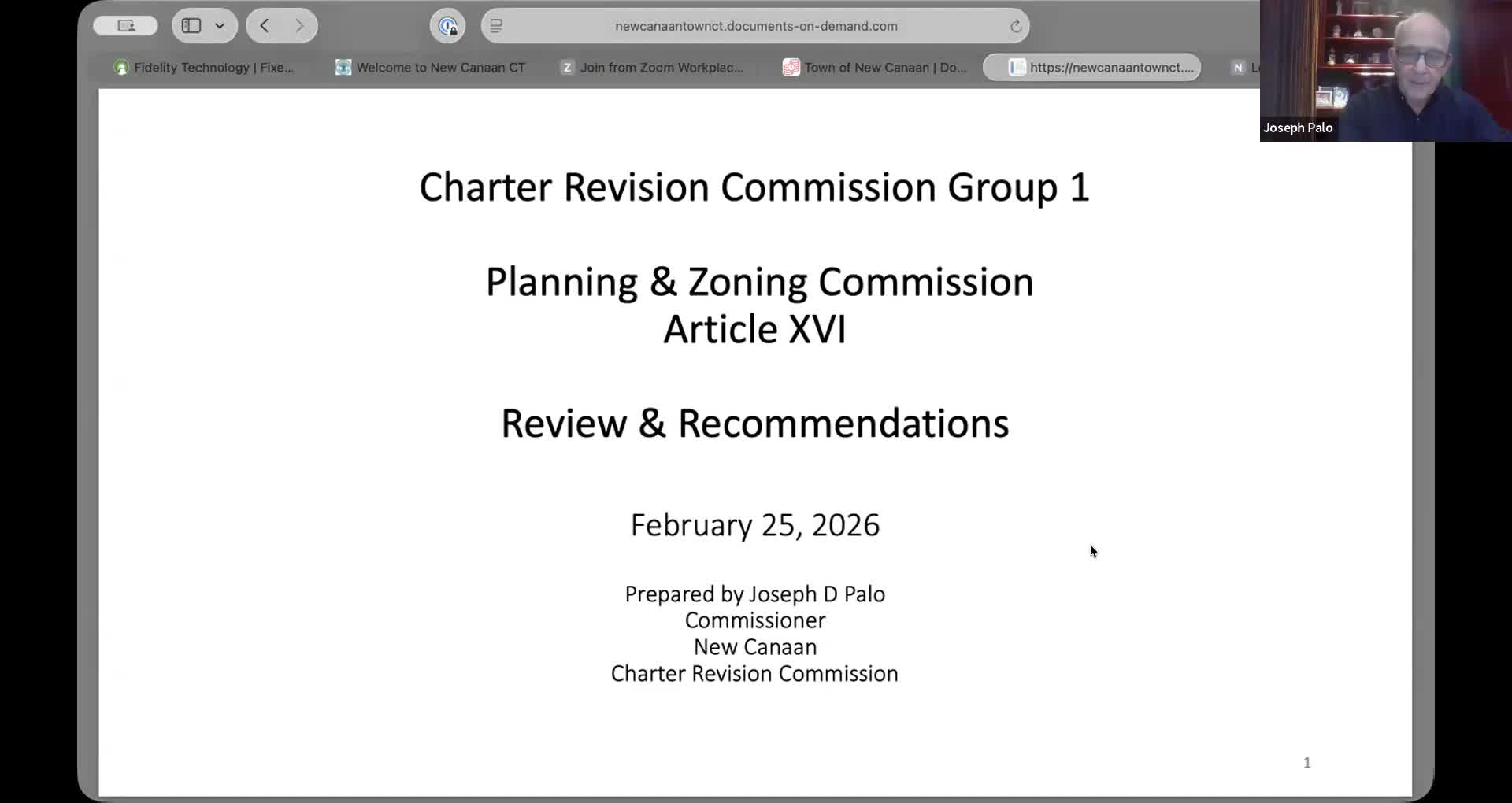
Joe Paulo, chairing the special meeting of Charter Revision Commission Group 1 on Feb. 25, presented a data-driven case for putting the question of whether the town’s Planning and Zoning Commission (P&Z) should remain appointed or become elected before the full commission and, potentially, the voters.
Paulo told the group the materials he compiled include a January 16 letter from P&Z, survey responses, and comparative data from neighboring Fairfield County towns. He said New Canaan has about 15,000 residents, roughly $10 billion on the grand list, and 36 land‑use decisionmakers across multiple appointed bodies — facts he said support giving residents stronger recourse over land‑use outcomes.
The presentation summarized P&Z’s four main points in favor of the appointed model — a curated balance of professional expertise, insulation from narrow voting blocs, perceived neutrality and legal defensibility — then challenged those claims with comparative metrics. Paulo cited work by Commissioner Holmes comparing the types of professional expertise on commissions in Darien, Ridgefield, Westport and Wilton, noting New Canaan met about 50% of the six‑profession benchmark while some elected commissions scored 70% or higher.
Paulo also highlighted language in the town’s Plan of Conservation and Development (POCD) on renewable energy and showed sample imagery of a 340‑foot turbine to illustrate potential land‑use consequences if standards became mandatory. Several commissioners objected to the graphic as unrealistic and urged removing dramatic imagery before public distribution.
A contentious element of the presentation was an extrapolation applying the 38% of 69 survey respondents who favored change to the full voter roll. Multiple commissioners called that statistical projection invalid; Paulo agreed to remove the extrapolation and to label the packet as his individual work rather than the group’s collective recommendation.
Commissioners did not reach a final recommendation on electing versus appointing P&Z. Instead, they agreed on two procedural next steps: (1) edit the presentation to remove tendentious claims and problematic graphics and circulate it as Paulo’s contribution to the record, and (2) explore drafting targeted charter language that would increase accountability without full election — for example, mirroring Board of Finance practice by requiring town council confirmation of selectmen nominations to P&Z. Commissioner Chris volunteered to draft redline language for review.
The group agreed to elevate the topic to the full Charter Revision Commission for broader discussion. The meeting ended without a substantive vote on changing Article 16 of the charter.
Votes and formal actions taken at the meeting were limited to approval of Feb. 18 minutes and adjournment; there were no votes taken to change charter language or to recommend election of P&Z.
Paulo told the group the materials he compiled include a January 16 letter from P&Z, survey responses, and comparative data from neighboring Fairfield County towns. He said New Canaan has about 15,000 residents, roughly $10 billion on the grand list, and 36 land‑use decisionmakers across multiple appointed bodies — facts he said support giving residents stronger recourse over land‑use outcomes.
The presentation summarized P&Z’s four main points in favor of the appointed model — a curated balance of professional expertise, insulation from narrow voting blocs, perceived neutrality and legal defensibility — then challenged those claims with comparative metrics. Paulo cited work by Commissioner Holmes comparing the types of professional expertise on commissions in Darien, Ridgefield, Westport and Wilton, noting New Canaan met about 50% of the six‑profession benchmark while some elected commissions scored 70% or higher.
Paulo also highlighted language in the town’s Plan of Conservation and Development (POCD) on renewable energy and showed sample imagery of a 340‑foot turbine to illustrate potential land‑use consequences if standards became mandatory. Several commissioners objected to the graphic as unrealistic and urged removing dramatic imagery before public distribution.
A contentious element of the presentation was an extrapolation applying the 38% of 69 survey respondents who favored change to the full voter roll. Multiple commissioners called that statistical projection invalid; Paulo agreed to remove the extrapolation and to label the packet as his individual work rather than the group’s collective recommendation.
Commissioners did not reach a final recommendation on electing versus appointing P&Z. Instead, they agreed on two procedural next steps: (1) edit the presentation to remove tendentious claims and problematic graphics and circulate it as Paulo’s contribution to the record, and (2) explore drafting targeted charter language that would increase accountability without full election — for example, mirroring Board of Finance practice by requiring town council confirmation of selectmen nominations to P&Z. Commissioner Chris volunteered to draft redline language for review.
The group agreed to elevate the topic to the full Charter Revision Commission for broader discussion. The meeting ended without a substantive vote on changing Article 16 of the charter.
Votes and formal actions taken at the meeting were limited to approval of Feb. 18 minutes and adjournment; there were no votes taken to change charter language or to recommend election of P&Z.
Don't Miss a Word: See the Full Meeting!
Go beyond summaries. Unlock every video, transcript, and key insight with a Founder Membership.
✓
Get instant access to full meeting videos
✓
Search and clip any phrase from complete transcripts
✓
Receive AI-powered summaries & custom alerts
✓
Enjoy lifetime, unrestricted access to government data
30-day money-back guarantee
