Grand Island workshop debates setbacks, safety and site-specific review in proposed battery storage law
February 26, 2026 | Grand Island, Erie County, New York
This article was created by AI summarizing key points discussed. AI makes mistakes, so for full details and context, please refer to the video of the full meeting. Please report any errors so we can fix them. Report an error »
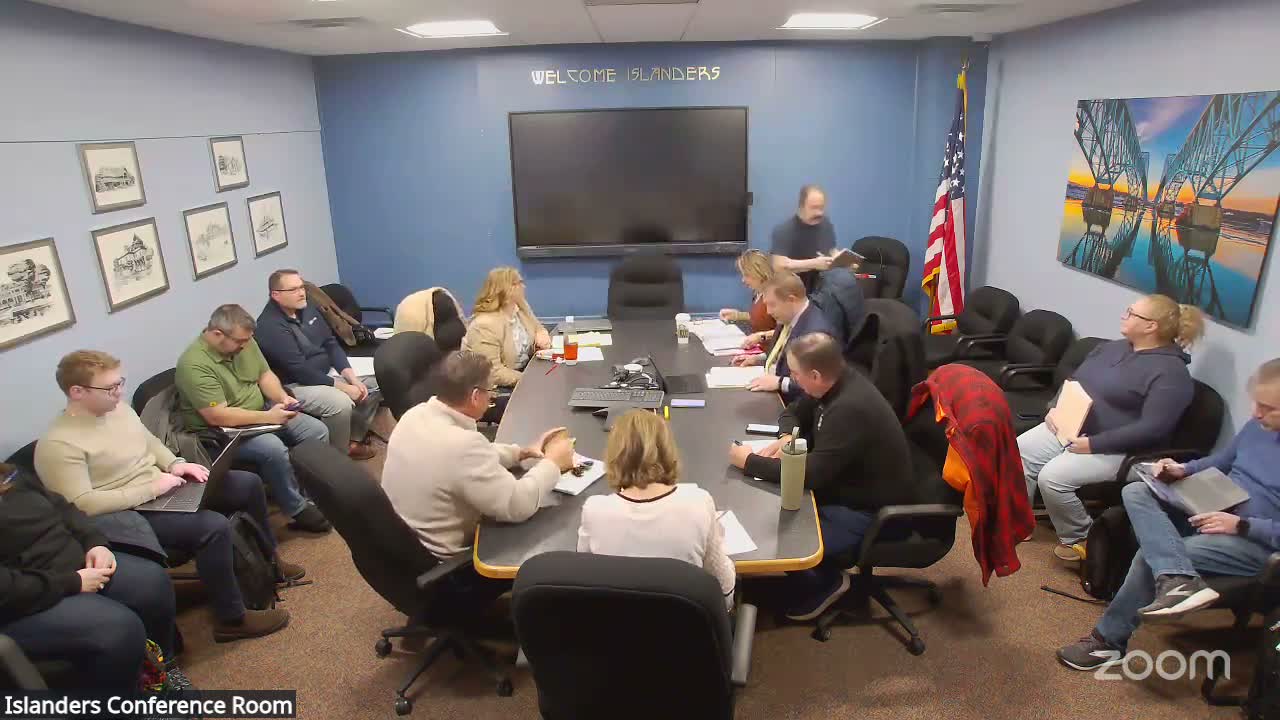
At a Grand Island workshop, participants spent the session debating setback distances and safety requirements in a draft battery storage law, with planning and safety advocates urging broad buffers and developers pressing for more modest, site-specific rules.
Bridget, a staff member who prepared the draft, framed the issue as the ordinance’s key controversy: advisory groups favor setbacks between about 300 and 1,000 feet while developer representatives argued for 100–150 feet. She said the meeting was convened to “drill down on some of the big picture items” that would help move the law forward.
The planning and community-advisory perspective, summarized by Speaker 9, called for requiring a Hazard Mitigation Analysis (HMA) with any application. “We suggested this hazard mitigation analysis, which is essentially a site-specific evaluation of the potential impacts,” Speaker 9 said, describing HMA content as plume modeling, fire department access and recommended separation distance. The planning viewpoint emphasized that an applicant should justify any proposed setback with that site-specific analysis.
Developer representatives, including Speaker 3 and a representative associated with Carson Power, said many municipalities adopt narrower, battery-specific setbacks and warned that prescriptive, large setbacks could eliminate viable sites. Speaker 3 said developers could provide HMAs as part of permit applications and defended a 100–150-foot setback as consistent with other towns’ battery codes.
Participants repeatedly cited external guidance. Speaker 2 noted an EPA recommendation of 330 feet from residences, while others referenced New York interagency proposals for up to 1,000 feet and NYSERDA’s model law, which generally defers to underlying zoning setbacks rather than prescribing a specific new distance.
The group discussed different ways to measure buffers—distance from the road, property line, or an “occupied structure”—and debated which metric best protects neighbors without unduly constraining siting. Several participants proposed a tiered approach that adjusts review and requirements by facility size and function.
The meeting did not adopt any formal setbacks or vote on the draft law. Organizers and stakeholders repeatedly returned to an idea both sides favored in principle: require a site-specific HMA (or other operational data) as part of the application so officials can justify any increase above a minimum setback during project review.
Next steps: staff will incorporate feedback on HMA requirements, tiering and buffer metrics into a revised draft for a future planning-board or public meeting. No formal actions or votes were taken at the workshop.
Bridget, a staff member who prepared the draft, framed the issue as the ordinance’s key controversy: advisory groups favor setbacks between about 300 and 1,000 feet while developer representatives argued for 100–150 feet. She said the meeting was convened to “drill down on some of the big picture items” that would help move the law forward.
The planning and community-advisory perspective, summarized by Speaker 9, called for requiring a Hazard Mitigation Analysis (HMA) with any application. “We suggested this hazard mitigation analysis, which is essentially a site-specific evaluation of the potential impacts,” Speaker 9 said, describing HMA content as plume modeling, fire department access and recommended separation distance. The planning viewpoint emphasized that an applicant should justify any proposed setback with that site-specific analysis.
Developer representatives, including Speaker 3 and a representative associated with Carson Power, said many municipalities adopt narrower, battery-specific setbacks and warned that prescriptive, large setbacks could eliminate viable sites. Speaker 3 said developers could provide HMAs as part of permit applications and defended a 100–150-foot setback as consistent with other towns’ battery codes.
Participants repeatedly cited external guidance. Speaker 2 noted an EPA recommendation of 330 feet from residences, while others referenced New York interagency proposals for up to 1,000 feet and NYSERDA’s model law, which generally defers to underlying zoning setbacks rather than prescribing a specific new distance.
The group discussed different ways to measure buffers—distance from the road, property line, or an “occupied structure”—and debated which metric best protects neighbors without unduly constraining siting. Several participants proposed a tiered approach that adjusts review and requirements by facility size and function.
The meeting did not adopt any formal setbacks or vote on the draft law. Organizers and stakeholders repeatedly returned to an idea both sides favored in principle: require a site-specific HMA (or other operational data) as part of the application so officials can justify any increase above a minimum setback during project review.
Next steps: staff will incorporate feedback on HMA requirements, tiering and buffer metrics into a revised draft for a future planning-board or public meeting. No formal actions or votes were taken at the workshop.
Don't Miss a Word: See the Full Meeting!
Go beyond summaries. Unlock every video, transcript, and key insight with a Founder Membership.
✓
Get instant access to full meeting videos
✓
Search and clip any phrase from complete transcripts
✓
Receive AI-powered summaries & custom alerts
✓
Enjoy lifetime, unrestricted access to government data
30-day money-back guarantee
