Diane Lim urges 'intersectional' economics and better data at Northwest diversity conference
February 26, 2026 | Clackamas County, Oregon
This article was created by AI summarizing key points discussed. AI makes mistakes, so for full details and context, please refer to the video of the full meeting. Please report any errors so we can fix them. Report an error »
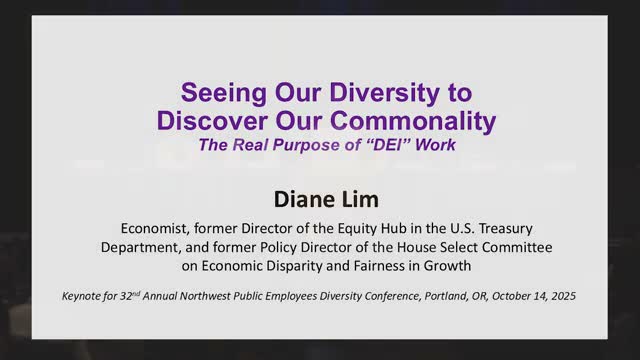
Diane Lim, a veteran economist and former director of the Treasury Department’s Equity Hub, told attendees at the Northwest Public Employees Diversity Conference that economists should adopt an 'intersectional' approach to economic policy to better understand who is missing from aggregate measures and why. "President Biden's executive order is the one that actually created my office at Treasury called the Equity Hub," Lim said, recounting the office’s aims to make the empirical case for what she called a modern supply-side approach that invests in people.
Lim framed intersectional economics as a move beyond coarse categories toward disaggregated analysis of subgroups — for example, comparing Asian women, Asian men and white women across education, family and labor-force roles. She argued that those more granular comparisons can reveal circumstances that are overrepresented in a subgroup and point to targeted policy responses rather than blunt redistribution. "We need to bring more personal stories into economic analysis," she said, urging economists to pair quantitative work with interviews and journalism.
Lim described persistent data limitations that complicate that work. She said the Bureau of Labor Statistics did not produce monthly statistics that separate Asian women from Asians overall and noted that the IRS 1040 tax form does not collect race, which limits direct tax-data disaggregation. Those gaps, she said, motivated her to run independent intersectional analyses during the pandemic to examine labor-force impacts on women who were also primary caregivers.
Lim also addressed the political resistance that can surround equity-focused offices and language, saying labels such as 'DEI' can generate polarization even within allied advisory groups. She recounted that she served about a year and a half at the Equity Hub before the office was closed after the 2020 transition and urged attendees not to let partisan debates eclipse evidence-based policy design.
She closed by stressing commonality as a route to broader support for equity policies: "I am Asian, I'm American, and I am human, and I am an intersectional economist," Lim said. The keynote included a brief committee-produced documentary showing personal stories used in congressional field hearings; Lim encouraged attendees to view the 30-minute video on YouTube for examples of using narratives to build bipartisan buy-in.
Lim’s talk combined personal experience, technical critique of federal data practices, and a call for interdisciplinary methods to inform policy that lifts broader economic potential without assuming a zero-sum tradeoff.
The conference then moved to an awards ceremony recognizing regional diversity leadership.
Lim framed intersectional economics as a move beyond coarse categories toward disaggregated analysis of subgroups — for example, comparing Asian women, Asian men and white women across education, family and labor-force roles. She argued that those more granular comparisons can reveal circumstances that are overrepresented in a subgroup and point to targeted policy responses rather than blunt redistribution. "We need to bring more personal stories into economic analysis," she said, urging economists to pair quantitative work with interviews and journalism.
Lim described persistent data limitations that complicate that work. She said the Bureau of Labor Statistics did not produce monthly statistics that separate Asian women from Asians overall and noted that the IRS 1040 tax form does not collect race, which limits direct tax-data disaggregation. Those gaps, she said, motivated her to run independent intersectional analyses during the pandemic to examine labor-force impacts on women who were also primary caregivers.
Lim also addressed the political resistance that can surround equity-focused offices and language, saying labels such as 'DEI' can generate polarization even within allied advisory groups. She recounted that she served about a year and a half at the Equity Hub before the office was closed after the 2020 transition and urged attendees not to let partisan debates eclipse evidence-based policy design.
She closed by stressing commonality as a route to broader support for equity policies: "I am Asian, I'm American, and I am human, and I am an intersectional economist," Lim said. The keynote included a brief committee-produced documentary showing personal stories used in congressional field hearings; Lim encouraged attendees to view the 30-minute video on YouTube for examples of using narratives to build bipartisan buy-in.
Lim’s talk combined personal experience, technical critique of federal data practices, and a call for interdisciplinary methods to inform policy that lifts broader economic potential without assuming a zero-sum tradeoff.
The conference then moved to an awards ceremony recognizing regional diversity leadership.
View the Full Meeting & All Its Details
This article offers just a summary. Unlock complete video, transcripts, and insights as a Founder Member.
✓
Watch full, unedited meeting videos
✓
Search every word spoken in unlimited transcripts
✓
AI summaries & real-time alerts (all government levels)
✓
Permanent access to expanding government content
30-day money-back guarantee
