Maine tax panel debates pass‑through entity tax: retroactivity, sourcing and New Hampshire credits divide experts
February 26, 2026 | 2026 Legislature ME, Maine
This article was created by AI summarizing key points discussed. AI makes mistakes, so for full details and context, please refer to the video of the full meeting. Please report any errors so we can fix them. Report an error »
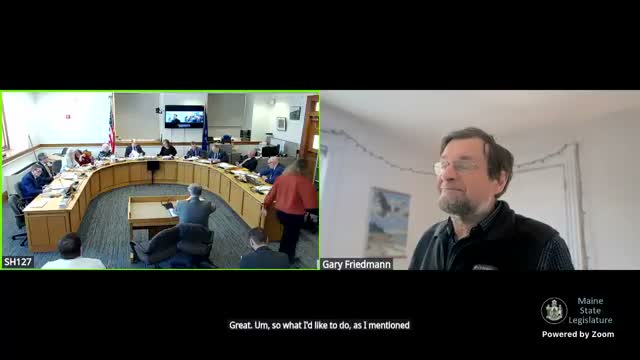
Members of the joint standing committee on taxation spent most of a work session probing technical and fiscal trade‑offs in LD 191, the proposal to implement a pass‑through entity tax (PTET) and the governor’s overlapping budget language.
Representative Hassonfos, who led stakeholder outreach, asked the committee to use two documents in members’ packets — the governor’s budget language and a redline amendment submitted by the Maine Society of CPAs — to frame a series of decisions about tax base, sourcing and credit eligibility. He told the committee the CPA amendment “would generate more revenue for the state and larger benefits to the pass through entity owners,” and that choosing between language options would materially affect state receipts.
Maine Revenue Services (MRS) officials warned of administrative complexity if the committee adopted retroactivity to the 2025 tax year. MRS fiscal staff explained that states that adopt PTETs often see a front‑loaded revenue spike (estimated by the director in the packet as about $56.5 million in FY27 under one model), followed by reconciliation and refunds the next year. An MRS economist described that pattern as a typical consequence of elections and estimated filing‑season timing.
A central technical dispute centered on whether Maine should allow a credit for taxes paid to other states that levy entity‑level taxes — notably New Hampshire’s business profits tax. Daniel Balisandro, deputy tax policy counsel at MRS, summarized the state’s long‑standing rule: individuals receive credits for taxes they personally paid, but tax paid at the entity level generally does not create a credit for Maine residents. Olga Goldberg, speaking for the Maine Society of CPAs, argued the redline would treat Maine residents more equitably and urged making the change retroactive to 2025 to correct years of perceived double taxation for some small business owners.
Committee members asked for concrete, comparative numbers. Several members requested: (1) a side‑by‑side fiscal comparison of the CPA amendment and the governor’s language, (2) representative mock tax returns demonstrating the mechanics (so members could see how credits and refunds flow), and (3) an estimate of the number and size of taxpayers affected by sourcing choices. Chair Rehoske and staff asked MRS and stakeholder groups to provide those materials before the next scheduled work session so the committee could weigh implementation burdens against taxpayer benefits.
The committee paused the PTET discussion for further work; no final vote was taken on LD 191. The chair scheduled follow‑up work sessions and asked staff to compile the specific technical requests and revenue scenarios for members to review in advance.
Representative Hassonfos, who led stakeholder outreach, asked the committee to use two documents in members’ packets — the governor’s budget language and a redline amendment submitted by the Maine Society of CPAs — to frame a series of decisions about tax base, sourcing and credit eligibility. He told the committee the CPA amendment “would generate more revenue for the state and larger benefits to the pass through entity owners,” and that choosing between language options would materially affect state receipts.
Maine Revenue Services (MRS) officials warned of administrative complexity if the committee adopted retroactivity to the 2025 tax year. MRS fiscal staff explained that states that adopt PTETs often see a front‑loaded revenue spike (estimated by the director in the packet as about $56.5 million in FY27 under one model), followed by reconciliation and refunds the next year. An MRS economist described that pattern as a typical consequence of elections and estimated filing‑season timing.
A central technical dispute centered on whether Maine should allow a credit for taxes paid to other states that levy entity‑level taxes — notably New Hampshire’s business profits tax. Daniel Balisandro, deputy tax policy counsel at MRS, summarized the state’s long‑standing rule: individuals receive credits for taxes they personally paid, but tax paid at the entity level generally does not create a credit for Maine residents. Olga Goldberg, speaking for the Maine Society of CPAs, argued the redline would treat Maine residents more equitably and urged making the change retroactive to 2025 to correct years of perceived double taxation for some small business owners.
Committee members asked for concrete, comparative numbers. Several members requested: (1) a side‑by‑side fiscal comparison of the CPA amendment and the governor’s language, (2) representative mock tax returns demonstrating the mechanics (so members could see how credits and refunds flow), and (3) an estimate of the number and size of taxpayers affected by sourcing choices. Chair Rehoske and staff asked MRS and stakeholder groups to provide those materials before the next scheduled work session so the committee could weigh implementation burdens against taxpayer benefits.
The committee paused the PTET discussion for further work; no final vote was taken on LD 191. The chair scheduled follow‑up work sessions and asked staff to compile the specific technical requests and revenue scenarios for members to review in advance.
View the Full Meeting & All Its Details
This article offers just a summary. Unlock complete video, transcripts, and insights as a Founder Member.
✓
Watch full, unedited meeting videos
✓
Search every word spoken in unlimited transcripts
✓
AI summaries & real-time alerts (all government levels)
✓
Permanent access to expanding government content
30-day money-back guarantee
