First work session on LD 2173 exposes technical gaps: fire review, wastewater and growth-cap language to be revised
February 26, 2026 | 2026 Legislature ME, Maine
This article was created by AI summarizing key points discussed. AI makes mistakes, so for full details and context, please refer to the video of the full meeting. Please report any errors so we can fix them. Report an error »
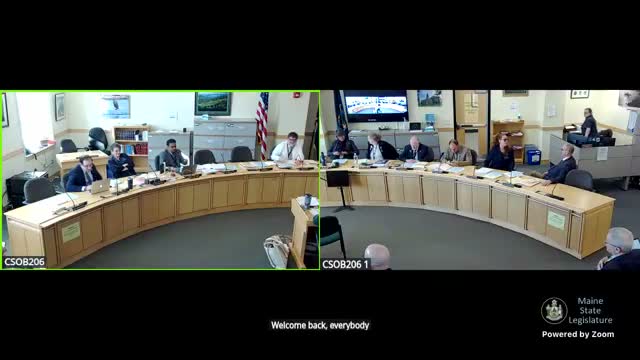
The Committee on Housing and Economic Development opened the first work session on LD 2173, legislation that would modify multiple land-use and housing rules, including rate-of-growth ordinance mechanics, affordable-housing density and height allowances, accessory dwelling unit rules, and subsurface wastewater preemption.
Analyst Lynn Westfall summarized the bill's scope: changes to rate-of-growth ordinances (moving some provisions from 105% over 10 years to 130% over 5 years in designated growth areas), clarifications to affordable-housing density and height (allowing additional story or up to 55 feet for eligible affordable projects), alterations to ADU approval paths, and a prohibition on municipal subsurface wastewater standards that exceed DHHS rules unless explicitly carved out.
Stakeholders, municipal planners and agency officials flagged technical and policy gaps. Jenny Poulin Franceschi, director of planning and code enforcement for Westbrook, said the bill's language requires refinement so towns can apply different growth caps to growth areas, transitional areas, and rural areas. Jimmy Dailman (Brunswick principal planner) urged explicit recognition of transitional zones and proposed alternative metrics to avoid penalizing communities with recent growth.
State Fire Marshal Sean testified that the bill's use of the word "review" could unintentionally impose technical plan-review duties on municipalities that lack the capacity to perform them. He recommended switching to "approval" for municipal fire officials and pairing MUBEC references with National Fire Protection Association (NFPA) codes; he also referenced an LD 1005 working-group report that recommends adding capacity to the State Fire Marshal's plan-review team if technical review is intended.
Ed Mollio of the Maine Water Utilities Association asked that the committee explicitly preserve a municipality's ability to set standards more stringent than DHHS when necessary to protect public water supplies, and offered draft language to exempt source-water protection areas and flood-prone or hazard-prone zones.
Committee members repeatedly returned to effective dates and mandate concerns: whether new municipal duties would trigger state-mandate provisions and the logistical difficulty for towns to implement differing standards in short timeframes. Representative(s) urged pushing effective dates to give municipalities and state agencies time to align local ordinances and to coordinate any delegated review authority or state-level plan review expansion.
After hearing testimony and discussing options, Representative Calabrio moved to table the bill to allow staff to draft targeted technical fixes (floodplain and source-water carve-outs, consistent effective dates, and clarifications about municipal authority and delegated review). The motion to table passed; the committee will reconvene on LD 2173 after draft language is circulated.
Representative/Member quotes: State Fire Marshal Sean warned, "Using the word review here, we do question what does review mean ... fire chiefs across the state are utilizing the National Fire Protection Association codes to conduct reviews on these buildings." Ed Mollio of the Maine Water Utilities Association urged an exception for water-source protection: "Notwithstanding the foregoing, a municipality may require standards more stringent than what is required pursuant to rules adopted by DHHS if such standards are adopted for protection of a current or future source of public water supply."
Next steps: Staff will incorporate stakeholder drafting suggestions and model language for source-water and floodplain safeguards and circulate revisions before the next work session. The committee asked MOCA, Maine Water Utilities Association and municipal planners to provide specific datasets and model language for the next meeting.
Analyst Lynn Westfall summarized the bill's scope: changes to rate-of-growth ordinances (moving some provisions from 105% over 10 years to 130% over 5 years in designated growth areas), clarifications to affordable-housing density and height (allowing additional story or up to 55 feet for eligible affordable projects), alterations to ADU approval paths, and a prohibition on municipal subsurface wastewater standards that exceed DHHS rules unless explicitly carved out.
Stakeholders, municipal planners and agency officials flagged technical and policy gaps. Jenny Poulin Franceschi, director of planning and code enforcement for Westbrook, said the bill's language requires refinement so towns can apply different growth caps to growth areas, transitional areas, and rural areas. Jimmy Dailman (Brunswick principal planner) urged explicit recognition of transitional zones and proposed alternative metrics to avoid penalizing communities with recent growth.
State Fire Marshal Sean testified that the bill's use of the word "review" could unintentionally impose technical plan-review duties on municipalities that lack the capacity to perform them. He recommended switching to "approval" for municipal fire officials and pairing MUBEC references with National Fire Protection Association (NFPA) codes; he also referenced an LD 1005 working-group report that recommends adding capacity to the State Fire Marshal's plan-review team if technical review is intended.
Ed Mollio of the Maine Water Utilities Association asked that the committee explicitly preserve a municipality's ability to set standards more stringent than DHHS when necessary to protect public water supplies, and offered draft language to exempt source-water protection areas and flood-prone or hazard-prone zones.
Committee members repeatedly returned to effective dates and mandate concerns: whether new municipal duties would trigger state-mandate provisions and the logistical difficulty for towns to implement differing standards in short timeframes. Representative(s) urged pushing effective dates to give municipalities and state agencies time to align local ordinances and to coordinate any delegated review authority or state-level plan review expansion.
After hearing testimony and discussing options, Representative Calabrio moved to table the bill to allow staff to draft targeted technical fixes (floodplain and source-water carve-outs, consistent effective dates, and clarifications about municipal authority and delegated review). The motion to table passed; the committee will reconvene on LD 2173 after draft language is circulated.
Representative/Member quotes: State Fire Marshal Sean warned, "Using the word review here, we do question what does review mean ... fire chiefs across the state are utilizing the National Fire Protection Association codes to conduct reviews on these buildings." Ed Mollio of the Maine Water Utilities Association urged an exception for water-source protection: "Notwithstanding the foregoing, a municipality may require standards more stringent than what is required pursuant to rules adopted by DHHS if such standards are adopted for protection of a current or future source of public water supply."
Next steps: Staff will incorporate stakeholder drafting suggestions and model language for source-water and floodplain safeguards and circulate revisions before the next work session. The committee asked MOCA, Maine Water Utilities Association and municipal planners to provide specific datasets and model language for the next meeting.
View the Full Meeting & All Its Details
This article offers just a summary. Unlock complete video, transcripts, and insights as a Founder Member.
✓
Watch full, unedited meeting videos
✓
Search every word spoken in unlimited transcripts
✓
AI summaries & real-time alerts (all government levels)
✓
Permanent access to expanding government content
30-day money-back guarantee
