Committee hears bill to exclude military-base school space from SCAP, adds 15% funding bump for on-base projects
February 26, 2026 | Legislative Sessions, Washington
This article was created by AI summarizing key points discussed. AI makes mistakes, so for full details and context, please refer to the video of the full meeting. Please report any errors so we can fix them. Report an error »
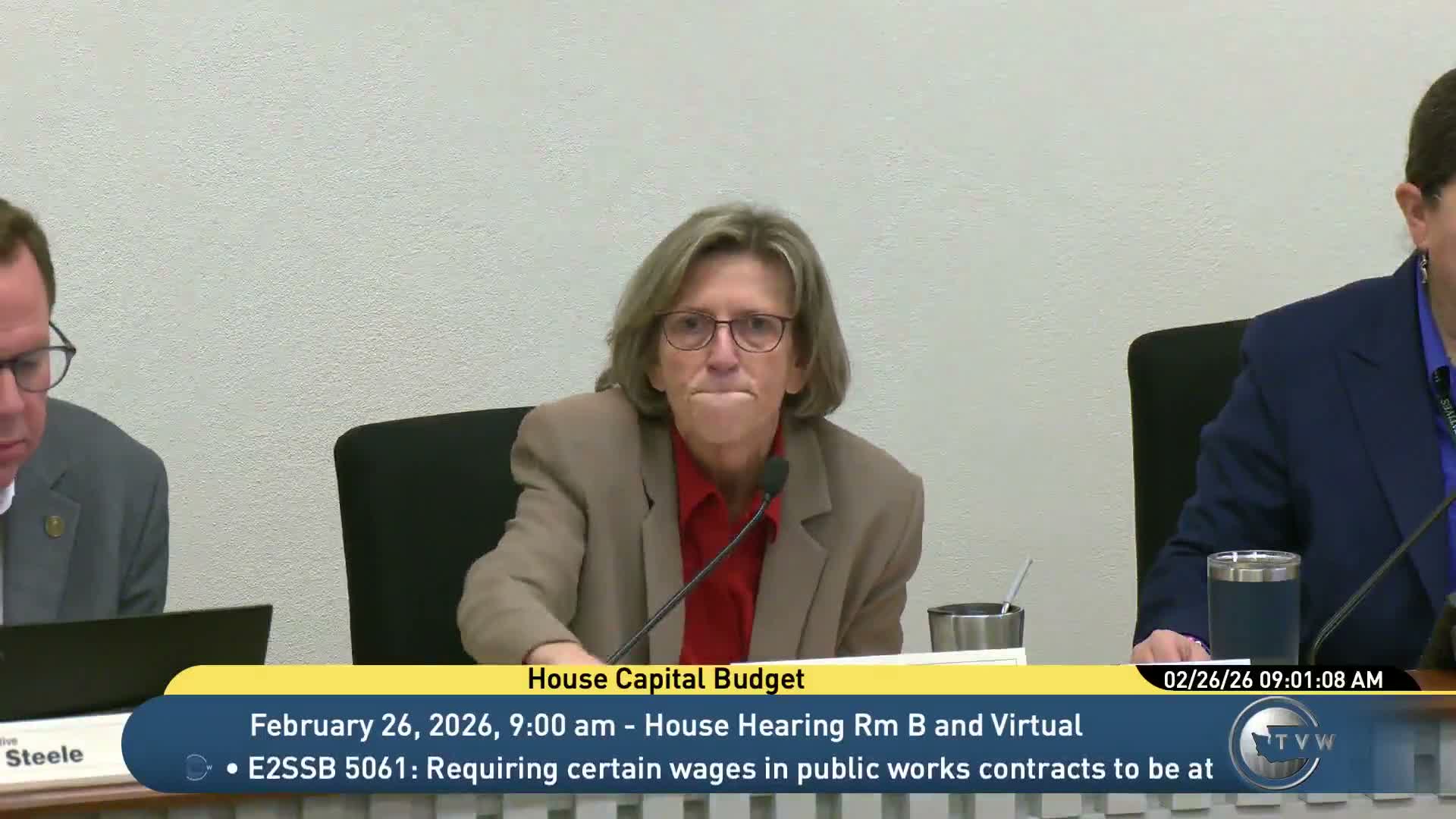
A Washington state Capital Committee public hearing reopened on substitute Senate Bill 5901, which would change the School Construction Assistance Program (SCAP) formulas by excluding instructional facilities located on military bases from a district's inventory and by increasing the computed state funding assistance percentage by 15% for any project on a military base.
Senator Leonard Christian, sponsor of SB 5901, told the committee he learned of the issue while meeting with superintendents at Fairchild Air Force Base. He said base-located schools are often built for dual-use military purposes, which can leave civilian districts with excess capacity on paper and make them ineligible for state matching funds. "That extra capacity . . . was hurting them to be able to get SCAP funding for off base projects as well," Christian said, describing Michael Anderson Elementary on Fairchild as built for 600 students while serving about 400 and behind a security fence.
Tyler Munch, representing the superintendent of public instruction's office, expressed support and said the bill had passed the Senate unanimously and that House leadership signaled it could be scheduled out of rules. "This policy is long overdue," Munch said.
Kimberly Hedrick, superintendent of the Medical Lake School District, told the committee Michael Anderson Elementary remains on Medical Lake’s inventory because it is located behind Fairchild’s security fence, effectively disqualifying the district from receiving state match for in-town modernization. "SB 5901 is a common sense fix," Hedrick said, urging passage so the district can modernize town schools without bearing the entire local cost.
A committee staff fiscal-note briefing noted uncertainty in timing of district applications and included an illustrative example in which the state share of a 50,000-square-foot project might be in the $35 million to $40 million range; staff emphasized that figure is an example and that application timing and affected-district uptake are unknown.
Other public commenters voiced related concerns. Charlie Brown, speaking for Clover Park School District (which includes Joint Base Lewis–McChord facilities), said the district would benefit from any measure that helps low-income districts modernize facilities. Ed Bowen, a Clallam County resident, said he was not opposed but urged the committee to consider where additional funding would come from, citing the state's common school trust and payment-in-lieu-of-taxes (PILT) receipts as broader context for school funding.
The hearing record contains no formal motion or committee vote on SB 5901; the chair closed public testimony after several proponents spoke and moved on to other agenda items. The bill’s fiscal estimates remain illustrative and contingent on whether and when eligible districts apply for SCAP assistance.
What's next: No committee vote was taken on SB 5901 during this meeting; the committee paused the public hearing and proceeded with other items on the agenda.
Senator Leonard Christian, sponsor of SB 5901, told the committee he learned of the issue while meeting with superintendents at Fairchild Air Force Base. He said base-located schools are often built for dual-use military purposes, which can leave civilian districts with excess capacity on paper and make them ineligible for state matching funds. "That extra capacity . . . was hurting them to be able to get SCAP funding for off base projects as well," Christian said, describing Michael Anderson Elementary on Fairchild as built for 600 students while serving about 400 and behind a security fence.
Tyler Munch, representing the superintendent of public instruction's office, expressed support and said the bill had passed the Senate unanimously and that House leadership signaled it could be scheduled out of rules. "This policy is long overdue," Munch said.
Kimberly Hedrick, superintendent of the Medical Lake School District, told the committee Michael Anderson Elementary remains on Medical Lake’s inventory because it is located behind Fairchild’s security fence, effectively disqualifying the district from receiving state match for in-town modernization. "SB 5901 is a common sense fix," Hedrick said, urging passage so the district can modernize town schools without bearing the entire local cost.
A committee staff fiscal-note briefing noted uncertainty in timing of district applications and included an illustrative example in which the state share of a 50,000-square-foot project might be in the $35 million to $40 million range; staff emphasized that figure is an example and that application timing and affected-district uptake are unknown.
Other public commenters voiced related concerns. Charlie Brown, speaking for Clover Park School District (which includes Joint Base Lewis–McChord facilities), said the district would benefit from any measure that helps low-income districts modernize facilities. Ed Bowen, a Clallam County resident, said he was not opposed but urged the committee to consider where additional funding would come from, citing the state's common school trust and payment-in-lieu-of-taxes (PILT) receipts as broader context for school funding.
The hearing record contains no formal motion or committee vote on SB 5901; the chair closed public testimony after several proponents spoke and moved on to other agenda items. The bill’s fiscal estimates remain illustrative and contingent on whether and when eligible districts apply for SCAP assistance.
What's next: No committee vote was taken on SB 5901 during this meeting; the committee paused the public hearing and proceeded with other items on the agenda.
View the Full Meeting & All Its Details
This article offers just a summary. Unlock complete video, transcripts, and insights as a Founder Member.
✓
Watch full, unedited meeting videos
✓
Search every word spoken in unlimited transcripts
✓
AI summaries & real-time alerts (all government levels)
✓
Permanent access to expanding government content
30-day money-back guarantee
