Committee hears debate on annualizing prevailing-wage adjustments for public works; proponents and contractors disagree on predictability and fiscal impact
February 26, 2026 | Legislative Sessions, Washington
This article was created by AI summarizing key points discussed. AI makes mistakes, so for full details and context, please refer to the video of the full meeting. Please report any errors so we can fix them. Report an error »
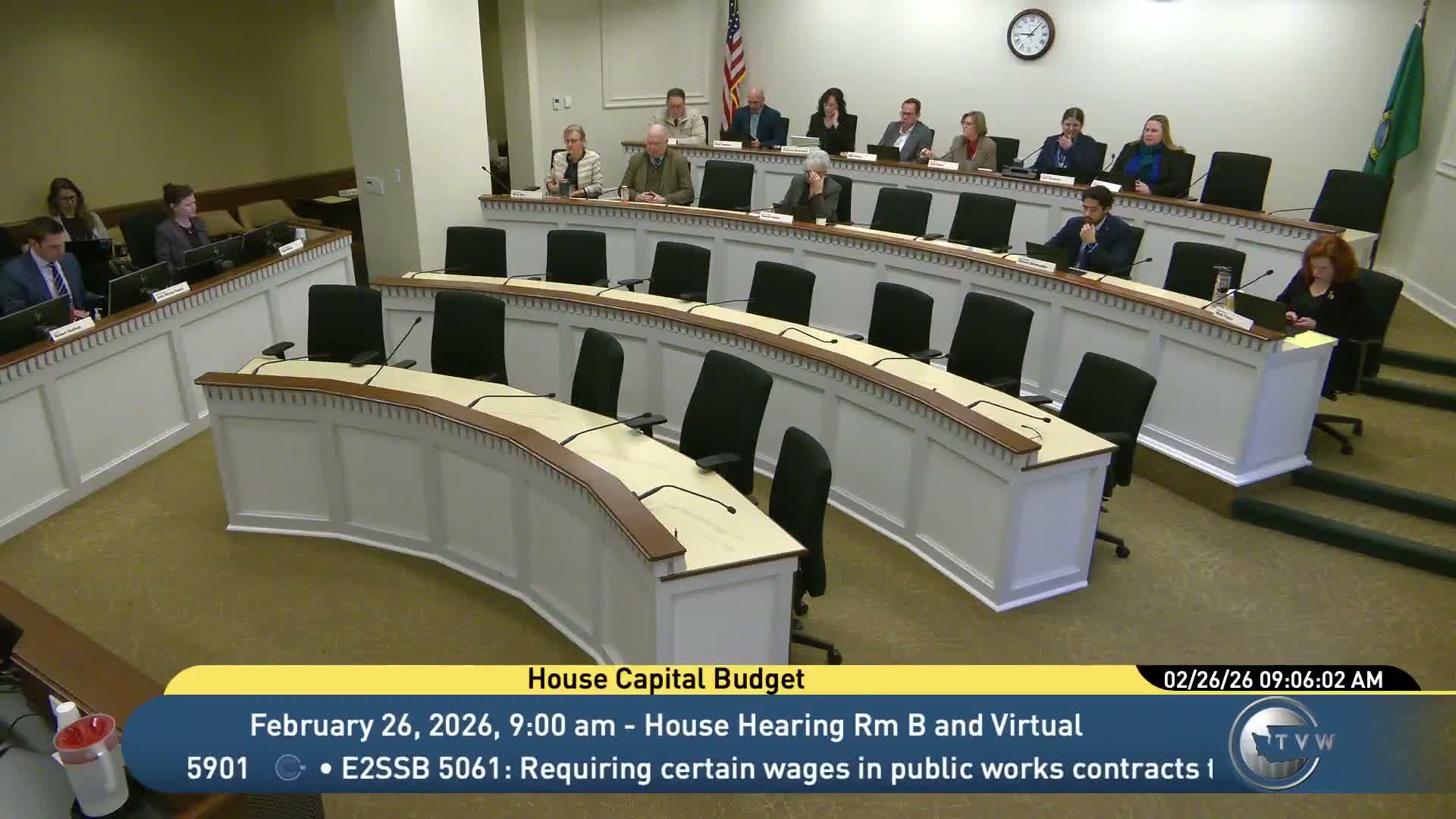
The Capital Committee heard extended testimony on engrossed second substitute Senate Bill 5061, which would require most public works contracts (excluding small works roster and residential construction) to include annual adjustments so the contract minimum wage would not be less than the latest prevailing wage rate.
Rob Hatfield, staff to the committee, summarized the bill and said Department of Labor & Industries (L&I) publishes prevailing wage rates each February and August and that the bill would set the contract wage on a contract-specific anniversary so it updates each year rather than remaining frozen at the bid or award date. Hatfield described an OFM illustrative scenario suggesting a potential capital budget impact of about $18 million per biennium under specific assumptions (30 state agency projects over $20 million in the 23-25 biennium and an assumed 4% wage increase in the second year), and noted the fiscal note lists operating and IT costs for L&I.
Senator Steve Conway, sponsor, described the measure as a technical fix to align contract pay with negotiated wage schedules and said exemptions for small works and many housing projects were added in other committee action. Conway emphasized the bill's intent to help retain skilled workers over long projects.
Supporters included representatives of the building and construction trades and unionized contractors who argued that freezing prevailing wages mid-project effectively reduces workers' real pay and that collective-bargaining schedules are publicly available for bidding. Mallory Davies (District Council of Labor) told the committee that wage schedules are posted publicly and that many contractors already factor scheduled increases into bids.
Opponents — including Associated Builders & Contractors and the Associated General Contractors — warned that the state's prevailing-wage-setting methodology can produce sharp, localized increases for particular trades and counties, and that mid-project increases could endanger small contractors. Several business groups requested a guardrail such as a change-order mechanism if the prevailing wage increased more than a specified threshold (for example, 5%). Jerry Bandroyd of AGC cited examples of steep percent increases in some lines and asked the committee not to pass the bill without additional protections.
Tammy Fallon of the Department of Labor & Industries told members the department stands by its fiscal note and explained the IT and process work required to implement contract‑specific annual adjustments, saying the department must be able to record and publish contract-level annual rates instead of relying solely on the current fixed dates.
No committee vote was taken on SB 5061 during this hearing. Members raised predictability and budgeting concerns for contractors, while proponents emphasized workforce stability and the public availability of collective-bargaining schedules. Several witnesses proposed technical amendments, including exemptions and change‑order language to address large, unexpected increases.
What's next: The committee closed the hearing on SB 5061 and did not vote during this session; proponents and opponents signaled willingness to negotiate technical fixes and guardrails.
Rob Hatfield, staff to the committee, summarized the bill and said Department of Labor & Industries (L&I) publishes prevailing wage rates each February and August and that the bill would set the contract wage on a contract-specific anniversary so it updates each year rather than remaining frozen at the bid or award date. Hatfield described an OFM illustrative scenario suggesting a potential capital budget impact of about $18 million per biennium under specific assumptions (30 state agency projects over $20 million in the 23-25 biennium and an assumed 4% wage increase in the second year), and noted the fiscal note lists operating and IT costs for L&I.
Senator Steve Conway, sponsor, described the measure as a technical fix to align contract pay with negotiated wage schedules and said exemptions for small works and many housing projects were added in other committee action. Conway emphasized the bill's intent to help retain skilled workers over long projects.
Supporters included representatives of the building and construction trades and unionized contractors who argued that freezing prevailing wages mid-project effectively reduces workers' real pay and that collective-bargaining schedules are publicly available for bidding. Mallory Davies (District Council of Labor) told the committee that wage schedules are posted publicly and that many contractors already factor scheduled increases into bids.
Opponents — including Associated Builders & Contractors and the Associated General Contractors — warned that the state's prevailing-wage-setting methodology can produce sharp, localized increases for particular trades and counties, and that mid-project increases could endanger small contractors. Several business groups requested a guardrail such as a change-order mechanism if the prevailing wage increased more than a specified threshold (for example, 5%). Jerry Bandroyd of AGC cited examples of steep percent increases in some lines and asked the committee not to pass the bill without additional protections.
Tammy Fallon of the Department of Labor & Industries told members the department stands by its fiscal note and explained the IT and process work required to implement contract‑specific annual adjustments, saying the department must be able to record and publish contract-level annual rates instead of relying solely on the current fixed dates.
No committee vote was taken on SB 5061 during this hearing. Members raised predictability and budgeting concerns for contractors, while proponents emphasized workforce stability and the public availability of collective-bargaining schedules. Several witnesses proposed technical amendments, including exemptions and change‑order language to address large, unexpected increases.
What's next: The committee closed the hearing on SB 5061 and did not vote during this session; proponents and opponents signaled willingness to negotiate technical fixes and guardrails.
View the Full Meeting & All Its Details
This article offers just a summary. Unlock complete video, transcripts, and insights as a Founder Member.
✓
Watch full, unedited meeting videos
✓
Search every word spoken in unlimited transcripts
✓
AI summaries & real-time alerts (all government levels)
✓
Permanent access to expanding government content
30-day money-back guarantee
