Sri Lanka single-center study finds late presentation, low surgical rates for pancreatic cancer
January 02, 2026 | National Cancer Institute (NCI), National Institutes of Health (NIH), Department of Health and Human Services (HHS), Executive, Federal
This article was created by AI summarizing key points discussed. AI makes mistakes, so for full details and context, please refer to the video of the full meeting. Please report any errors so we can fix them. Report an error »
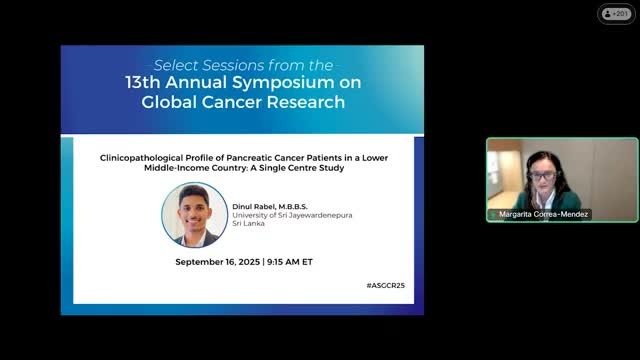
Dr. Dinu Rabel presented a retrospective cohort of 380 pancreatic cancer patients treated at Colombo South Teaching Hospital in Sri Lanka between 2018 and 2023. The study found a mean age near 60, a slight male predominance, adenocarcinoma as the predominant pathology (about 46%), and most tumors located in the head of the pancreas (71%).
"Patients presented late leading to poor outcomes," Dr. Rabel said, summarizing the main finding and linking late-stage presentation with limited curative options and higher mortality. Only about 36% of patients in the cohort underwent curative-intent surgery; the majority were managed with palliative approaches owing to advanced disease and constrained local resources.
Rabel highlighted structural limitations at the national level: a single radiotherapy center and frequent drug shortages that increase waiting times and limit access to systemic therapy. He recommended investments in early-detection research (including biomarker work), improved diagnostic pathways, and expanded surgical and oncology capacity to improve survival in lower-middle-income settings.
The study is presented as preliminary, and Rabel noted plans for continued follow-up to assess survival outcomes and refine recommendations for system-level interventions. The presentation underscores the gap between global benchmarks and outcomes in resource-limited settings, particularly the need to shift diagnosis earlier in the disease course.
"Patients presented late leading to poor outcomes," Dr. Rabel said, summarizing the main finding and linking late-stage presentation with limited curative options and higher mortality. Only about 36% of patients in the cohort underwent curative-intent surgery; the majority were managed with palliative approaches owing to advanced disease and constrained local resources.
Rabel highlighted structural limitations at the national level: a single radiotherapy center and frequent drug shortages that increase waiting times and limit access to systemic therapy. He recommended investments in early-detection research (including biomarker work), improved diagnostic pathways, and expanded surgical and oncology capacity to improve survival in lower-middle-income settings.
The study is presented as preliminary, and Rabel noted plans for continued follow-up to assess survival outcomes and refine recommendations for system-level interventions. The presentation underscores the gap between global benchmarks and outcomes in resource-limited settings, particularly the need to shift diagnosis earlier in the disease course.
Don't Miss a Word: See the Full Meeting!
Go beyond summaries. Unlock every video, transcript, and key insight with a Founder Membership.
✓
Get instant access to full meeting videos
✓
Search and clip any phrase from complete transcripts
✓
Receive AI-powered summaries & custom alerts
✓
Enjoy lifetime, unrestricted access to government data
30-day money-back guarantee
