Tanzania center reports improved pediatric cancer detection but survival remains low
January 02, 2026 | National Cancer Institute (NCI), National Institutes of Health (NIH), Department of Health and Human Services (HHS), Executive, Federal
This article was created by AI summarizing key points discussed. AI makes mistakes, so for full details and context, please refer to the video of the full meeting. Please report any errors so we can fix them. Report an error »
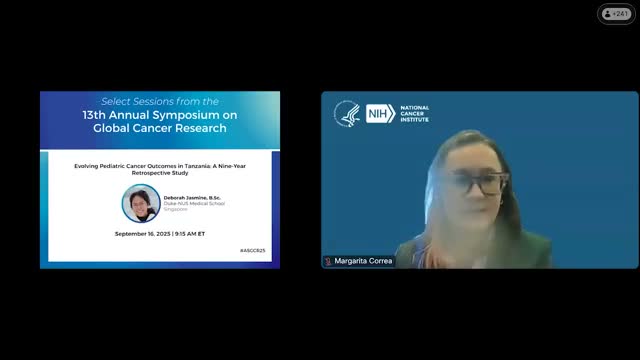
Deborah Jasmine presented retrospective data from Bugando Medical Center (BMC) documenting changes in pediatric cancer detection and outcomes between 2014 and 2022. The study reviewed roughly 1,500 records with survival analysis performed on about 1,000 children from 2016 onward. The three most common diagnoses at BMC were Wilms tumor, Burkitt lymphoma and retinoblastoma, conditions often detectable by visible masses.
Key survival metrics reported included one-year overall survival of 46.4%, two-year overall survival of 35.2%, and a median overall survival of 10.5 months. Event-free survival was lower due to abandonment and relapse (one-year EFS 27.9%, two-year 18.6%). Jasmine attributed improved case detection and diagnostic diversity to sustained outreach, registry development, establishment of a family hostel to reduce abandonment, training of healthcare workers and the institution of tumor boards.
Jasmine stressed that despite progress, survival remains far below the WHO childhood-cancer target of 60% by 2030 and recommended sustained multisector efforts, registry expansion and integration of pediatric cancer into national cancer-control programs.
Key survival metrics reported included one-year overall survival of 46.4%, two-year overall survival of 35.2%, and a median overall survival of 10.5 months. Event-free survival was lower due to abandonment and relapse (one-year EFS 27.9%, two-year 18.6%). Jasmine attributed improved case detection and diagnostic diversity to sustained outreach, registry development, establishment of a family hostel to reduce abandonment, training of healthcare workers and the institution of tumor boards.
Jasmine stressed that despite progress, survival remains far below the WHO childhood-cancer target of 60% by 2030 and recommended sustained multisector efforts, registry expansion and integration of pediatric cancer into national cancer-control programs.
Don't Miss a Word: See the Full Meeting!
Go beyond summaries. Unlock every video, transcript, and key insight with a Founder Membership.
✓
Get instant access to full meeting videos
✓
Search and clip any phrase from complete transcripts
✓
Receive AI-powered summaries & custom alerts
✓
Enjoy lifetime, unrestricted access to government data
30-day money-back guarantee
