Doctors and officials urge focus on residency programs and incentives, not just new construction, to boost trauma care in western Puerto Rico
February 26, 2026 | House of Representatives, House, Committees, Legislative, Puerto Rico, International
This article was created by AI summarizing key points discussed. AI makes mistakes, so for full details and context, please refer to the video of the full meeting. Please report any errors so we can fix them. Report an error »
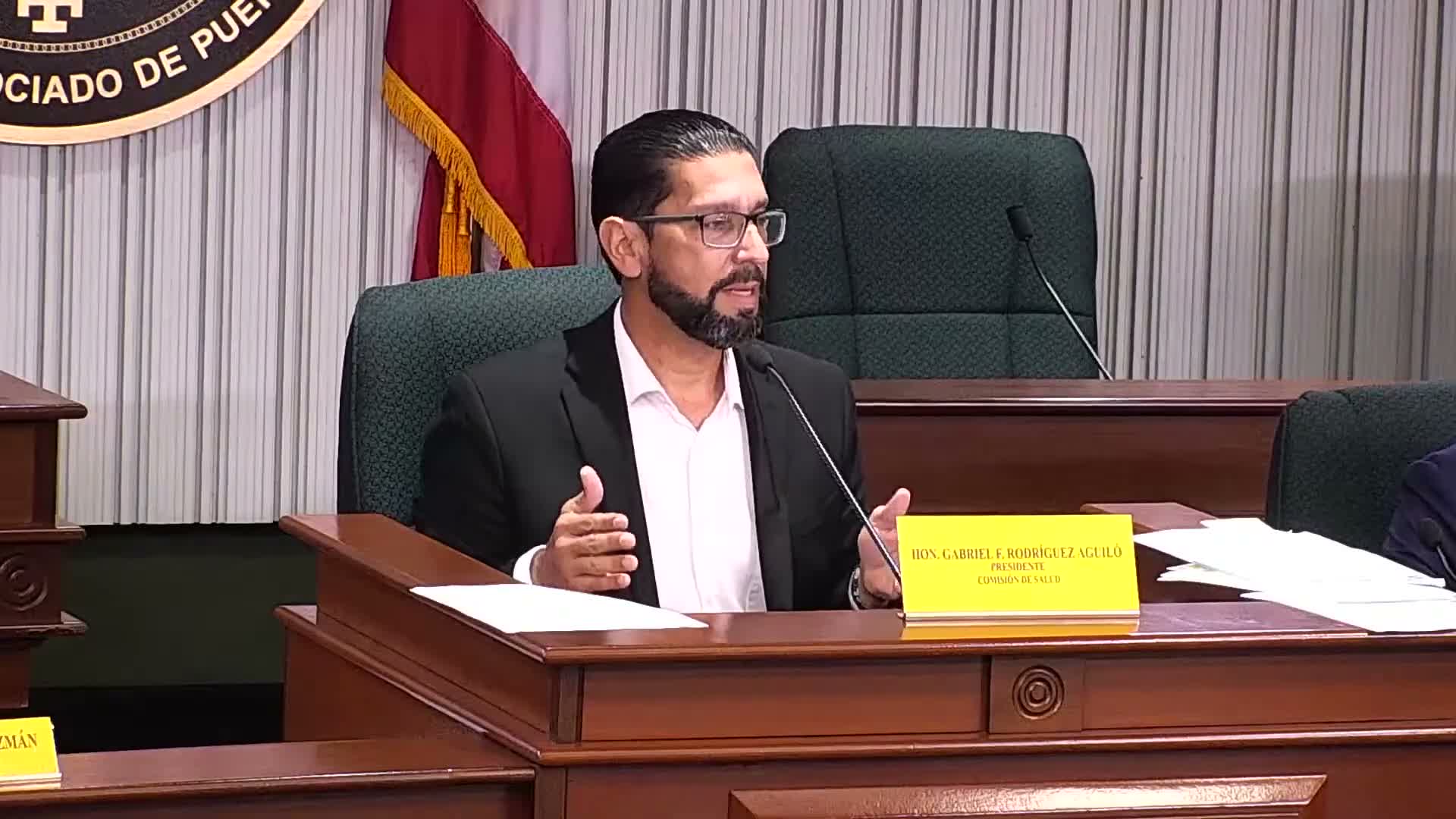
Mayagüez medical leaders and the Department of Health told the House Health Committee on Feb. 25 that strengthening trauma care in western Puerto Rico depends less on more "first stones" and more on building clinical training capacity and recruiting professors.
Why it matters: presenters said lack of on‑site surgical educators is the principal obstacle to restoring a surgical residency in Mayagüez. Without professors and sub‑specialists, accreditation applications have been denied even when the hospital’s clinical volume and equipment are adequate.
What presenters said: Dr. Milton Carrero Quiñones, medical director of Mayagüez Medical Center, and Dr. Norman Ramírez Yush, director of graduate medical education, reviewed the hospital’s history of accredited residencies and said that after 2000 the surgery residency closed and recent attempts fell short because the accreditor found an insufficient number of in‑house professors. Dr. Ramírez described a proposal to rotate residents through a partner hospital in Dallas but said the accreditor limited allowable months outside the program’s home site, which led to denial.
Officials and legislators discussed concrete incentives: the secretary of health described a stipend program that provides roughly $1,000 per month and a contractual service obligation (two years of service in Puerto Rico for each year of stipend). Members discussed housing, tax and credentialing accelerators to attract faculty and specialists to the west and whether such measures require legislation or can be implemented administratively.
Proposals and constraints highlighted at the hearing:
- Recruit five specialty professors (vascular, head & neck, oncology, breast, trauma) to meet accreditor expectations and provide local service while teaching.
- Consider targeted incentives (stipends, moving assistance, tax differentials) or regulatory pathways to make private hospitals able to host residencies and to ensure contracts with insurers and credentialing processes are timely.
- Evaluate mixed training models (some months in Puerto Rico, some months in partner U.S. hospitals) though the accreditor may limit the months allowed off‑site.
Quotes from the hearing:
- "ya está bueno de primeras piedras, lo que hace falta es acción." — phrase attributed to a medical presenter and repeated by the chair to emphasize the focus on workforce rather than more construction.
- "Por cada año que él recibe de beca o estipendio, tiene que trabajar 2 años en Puerto Rico" — Dr. Carrero describing the stipend service requirement.
Ending: The committee asked staff and the Department of Health to explore legal and administrative mechanisms for incentives, to align any incentive proposals with accreditation rules, and to convene a focused working meeting (not public) with health‑system stakeholders to design a practicable recruitment and residency plan.
Why it matters: presenters said lack of on‑site surgical educators is the principal obstacle to restoring a surgical residency in Mayagüez. Without professors and sub‑specialists, accreditation applications have been denied even when the hospital’s clinical volume and equipment are adequate.
What presenters said: Dr. Milton Carrero Quiñones, medical director of Mayagüez Medical Center, and Dr. Norman Ramírez Yush, director of graduate medical education, reviewed the hospital’s history of accredited residencies and said that after 2000 the surgery residency closed and recent attempts fell short because the accreditor found an insufficient number of in‑house professors. Dr. Ramírez described a proposal to rotate residents through a partner hospital in Dallas but said the accreditor limited allowable months outside the program’s home site, which led to denial.
Officials and legislators discussed concrete incentives: the secretary of health described a stipend program that provides roughly $1,000 per month and a contractual service obligation (two years of service in Puerto Rico for each year of stipend). Members discussed housing, tax and credentialing accelerators to attract faculty and specialists to the west and whether such measures require legislation or can be implemented administratively.
Proposals and constraints highlighted at the hearing:
- Recruit five specialty professors (vascular, head & neck, oncology, breast, trauma) to meet accreditor expectations and provide local service while teaching.
- Consider targeted incentives (stipends, moving assistance, tax differentials) or regulatory pathways to make private hospitals able to host residencies and to ensure contracts with insurers and credentialing processes are timely.
- Evaluate mixed training models (some months in Puerto Rico, some months in partner U.S. hospitals) though the accreditor may limit the months allowed off‑site.
Quotes from the hearing:
- "ya está bueno de primeras piedras, lo que hace falta es acción." — phrase attributed to a medical presenter and repeated by the chair to emphasize the focus on workforce rather than more construction.
- "Por cada año que él recibe de beca o estipendio, tiene que trabajar 2 años en Puerto Rico" — Dr. Carrero describing the stipend service requirement.
Ending: The committee asked staff and the Department of Health to explore legal and administrative mechanisms for incentives, to align any incentive proposals with accreditation rules, and to convene a focused working meeting (not public) with health‑system stakeholders to design a practicable recruitment and residency plan.
Don't Miss a Word: See the Full Meeting!
Go beyond summaries. Unlock every video, transcript, and key insight with a Founder Membership.
✓
Get instant access to full meeting videos
✓
Search and clip any phrase from complete transcripts
✓
Receive AI-powered summaries & custom alerts
✓
Enjoy lifetime, unrestricted access to government data
30-day money-back guarantee
