Senate committee reviews MnDOT bill to align bridge/tunnel inspections with federal standards and authorize truck‑parking partnerships
February 26, 2026 | 2026 Legislature MN, Minnesota
This article was created by AI summarizing key points discussed. AI makes mistakes, so for full details and context, please refer to the video of the full meeting. Please report any errors so we can fix them. Report an error »
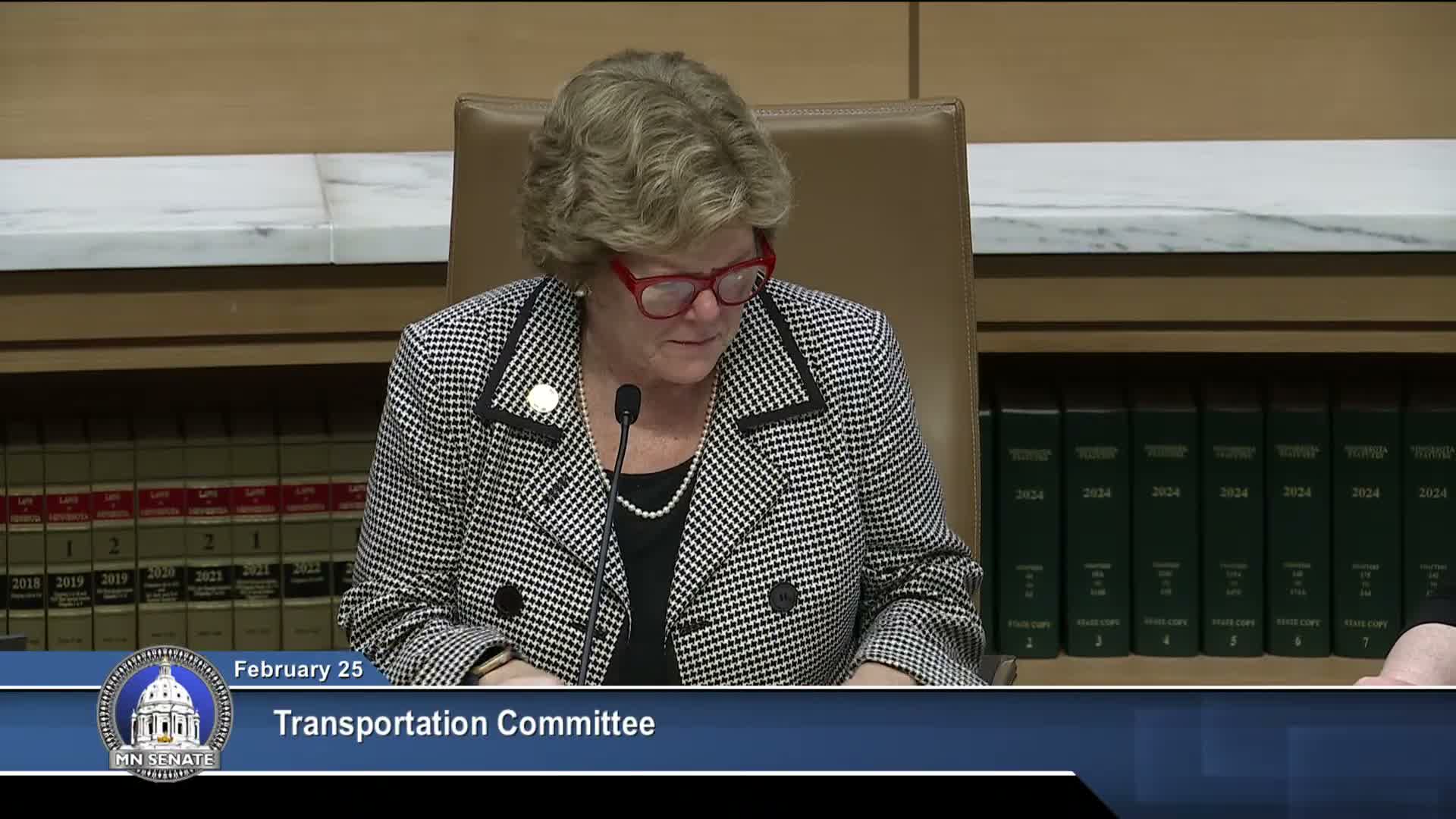
Sen. Kari Dibble introduced Senate File 3824 to the Minnesota Senate Transportation Committee on Feb. 25, 2026, describing it as MnDOT's annual agency bill that updates a range of transportation statutes to align with federal inspection standards and modern practice. The committee heard detailed testimony from Jennifer Witt of MnDOT's Office of Government Affairs and from Andrew Drusco, MnDOT's statewide freight and railroad planning director.
Why it matters: The bill would formally bring tunnels into Minnesota's inspection statutes, clarify responsibilities for load rating and posting, and align inspection intervals for low‑risk structures with federal national bridge inspection standards. MnDOT said the change is intended to reduce administrative burden while maintaining oversight of critical infrastructure.
"We're conforming to those federal mandates," Jennifer Witt told the committee, briefing members on the proposal's technical updates. She said the bill would allow extended inspection intervals for bridges deemed low risk — citing examples that move inspection cycles from 12 months to 24 or 48 months — and estimated the change could mean roughly 2,000 fewer inspections statewide each year.
Committee members repeatedly pressed on possible cost and mandate implications. Sen. Jason Jasinski asked whether the new schedule would increase long‑term inspection costs for local governments; Witt responded that the bill does not impose new mandates and primarily adjusts intervals for low‑risk structures rather than requiring additional inspections. Senators also requested a breakdown of which inspections MnDOT performs in‑house versus which are contracted; Witt agreed to provide that data to the chair for distribution.
The bill also creates a framework to address Minnesota's truck‑parking shortage by authorizing MnDOT to pursue grants and public‑private partnerships to expand capacity. MnDOT cited a statewide shortfall during the hearing: "we have over 26,000 long‑haul truck trips per day in Minnesota and only 4,800 publicly accessible parking spaces," Witt said; Andrew Drusco added that working with private sector partners is likely the most efficient way to increase safe parking.
MnDOT emphasized the measure does not include a direct appropriation for truck parking but would allow the agency to pursue partnerships and potential limited public incentives. The bill would also change active‑transportation program rules so that the education set‑aside moves from a fixed $500,000 to a 10 percent share of the program — an amount Witt said would be about $265,000 under current funding levels — giving the office more programmatic flexibility while retaining youth safety education.
Finally, SF 3824 would remove certain dated statutory designations, including four scenic byways from statute, clarifying that national scenic‑byway status is unaffected while removing state‑level signing obligations that currently rely on trunk‑highway funds.
Procedural outcome: After questions and discussion, Sen. Dibble asked that SF 3824 be laid on the table for possible future inclusion in the transportation omnibus; the chair announced it was laid over for that purpose. No roll‑call vote on adoption occurred during the Feb. 25 hearing.
Next steps: The bill was left on the table for consideration with the committee's omnibus package; MnDOT pledged to supply requested follow‑up materials, including the inspection workload breakdown and additional information on specific private bridges identified by members.
Why it matters: The bill would formally bring tunnels into Minnesota's inspection statutes, clarify responsibilities for load rating and posting, and align inspection intervals for low‑risk structures with federal national bridge inspection standards. MnDOT said the change is intended to reduce administrative burden while maintaining oversight of critical infrastructure.
"We're conforming to those federal mandates," Jennifer Witt told the committee, briefing members on the proposal's technical updates. She said the bill would allow extended inspection intervals for bridges deemed low risk — citing examples that move inspection cycles from 12 months to 24 or 48 months — and estimated the change could mean roughly 2,000 fewer inspections statewide each year.
Committee members repeatedly pressed on possible cost and mandate implications. Sen. Jason Jasinski asked whether the new schedule would increase long‑term inspection costs for local governments; Witt responded that the bill does not impose new mandates and primarily adjusts intervals for low‑risk structures rather than requiring additional inspections. Senators also requested a breakdown of which inspections MnDOT performs in‑house versus which are contracted; Witt agreed to provide that data to the chair for distribution.
The bill also creates a framework to address Minnesota's truck‑parking shortage by authorizing MnDOT to pursue grants and public‑private partnerships to expand capacity. MnDOT cited a statewide shortfall during the hearing: "we have over 26,000 long‑haul truck trips per day in Minnesota and only 4,800 publicly accessible parking spaces," Witt said; Andrew Drusco added that working with private sector partners is likely the most efficient way to increase safe parking.
MnDOT emphasized the measure does not include a direct appropriation for truck parking but would allow the agency to pursue partnerships and potential limited public incentives. The bill would also change active‑transportation program rules so that the education set‑aside moves from a fixed $500,000 to a 10 percent share of the program — an amount Witt said would be about $265,000 under current funding levels — giving the office more programmatic flexibility while retaining youth safety education.
Finally, SF 3824 would remove certain dated statutory designations, including four scenic byways from statute, clarifying that national scenic‑byway status is unaffected while removing state‑level signing obligations that currently rely on trunk‑highway funds.
Procedural outcome: After questions and discussion, Sen. Dibble asked that SF 3824 be laid on the table for possible future inclusion in the transportation omnibus; the chair announced it was laid over for that purpose. No roll‑call vote on adoption occurred during the Feb. 25 hearing.
Next steps: The bill was left on the table for consideration with the committee's omnibus package; MnDOT pledged to supply requested follow‑up materials, including the inspection workload breakdown and additional information on specific private bridges identified by members.
Don't Miss a Word: See the Full Meeting!
Go beyond summaries. Unlock every video, transcript, and key insight with a Founder Membership.
✓
Get instant access to full meeting videos
✓
Search and clip any phrase from complete transcripts
✓
Receive AI-powered summaries & custom alerts
✓
Enjoy lifetime, unrestricted access to government data
30-day money-back guarantee
