Minn. committee advances bill to raise third-party medical-record fees, adopts amendments and lays bill over
February 26, 2026 | 2026 Legislature MN, Minnesota
This article was created by AI summarizing key points discussed. AI makes mistakes, so for full details and context, please refer to the video of the full meeting. Please report any errors so we can fix them. Report an error »
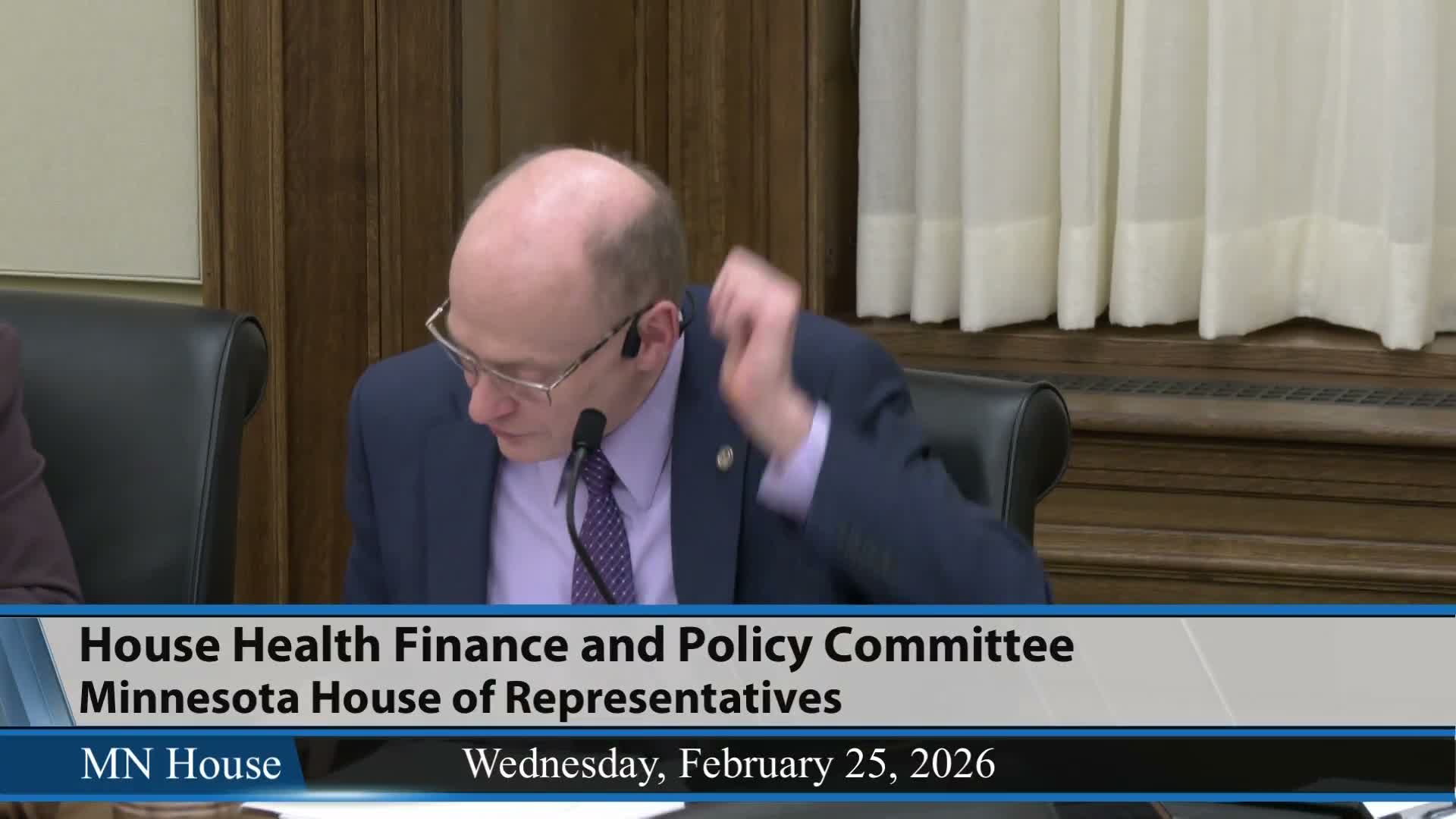
The Minnesota House Health Committee took up House File 2070 on Thursday evening, a bill that would change how providers and third-party requesters are charged for the retrieval and reproduction of medical records. The committee adopted two amendments and laid the bill over for further work.
Representative DePel, the bill’s sponsor, told the committee the measure aims to address an “onerous” administrative burden on providers who must follow lengthy procedures to fulfill third-party requests. He said many providers face a multi-step process and that the current $20 cap “is very, very low” given privacy safeguards and the infrastructure required to comply, arguing the proposal would allow providers to recover costs for time spent fulfilling requests.
The A1 amendment, moved by Representative DePel and adopted by voice vote, has two parts: it requires refunding any prepayment when requested records are later found not to exist, and it updates statutory dates and ties the maximum annual charge to a price index. An oral amendment to strike proposed changes on lines 2.21–2.24 — offered to address concerns from the Minnesota Association for Justice — was also adopted; Cody Holiday of Frederickson Government Relations, representing the Alliance of Health Information Operations and Standards, said the intent is to keep retrieval fees consistent with current statute so that retrieval fees would remain capped at no more than $10 and not create an unbounded retrieval-fee loophole.
Attorneys and advocates raised objections. Joel Carlson of the Minnesota Association for Justice and attorney Chuck Slane warned the committee that restoring or permitting per-page or per-data-point charges could generate excessive bills for people seeking records. Slane told the panel he had seen an invoice from a records company seeking “18,580” to obtain a single client’s records from one facility, and said high record charges reduce the money available to injured people in settlements.
Health information professionals who testified in favor of the bill urged the committee to consider the time and security costs of retrieving records from multiple systems. Sue Nathie, executive director of the Minnesota Health Information Management Association, representing more than 2,500 health information professionals, said the current fee caps "do not reflect the current cost of processing health information requests and protecting patient data," and emphasized that the proposed fees only apply to third-party requesters and not to patients seeking records for treatment. Liz McElhoney, a health information professional, described a case in which charging a patient for records could have disclosed a domestic-violence survivor’s care to an abuser and stressed the importance of trained professionals handling sensitive releases.
Committee members pressed the sponsor on how fee levels were determined and on whether a single flat fee would unfairly affect smaller providers. Sponsor representatives said initial figures were informed by provider input and industry experience, and that the bill’s dollar limits would be adjusted for inflation going forward. After extended questioning and public testimony, the committee agreed to lay the bill over as amended to allow additional drafting and stakeholder engagement.
The committee did not take a final vote to send the bill to the House floor; instead, HF2070 was laid over for further work. The committee is scheduled to reconvene Monday, and committee chairs said they will continue stakeholder conversations before returning the bill to committee for possible further action.
Representative DePel, the bill’s sponsor, told the committee the measure aims to address an “onerous” administrative burden on providers who must follow lengthy procedures to fulfill third-party requests. He said many providers face a multi-step process and that the current $20 cap “is very, very low” given privacy safeguards and the infrastructure required to comply, arguing the proposal would allow providers to recover costs for time spent fulfilling requests.
The A1 amendment, moved by Representative DePel and adopted by voice vote, has two parts: it requires refunding any prepayment when requested records are later found not to exist, and it updates statutory dates and ties the maximum annual charge to a price index. An oral amendment to strike proposed changes on lines 2.21–2.24 — offered to address concerns from the Minnesota Association for Justice — was also adopted; Cody Holiday of Frederickson Government Relations, representing the Alliance of Health Information Operations and Standards, said the intent is to keep retrieval fees consistent with current statute so that retrieval fees would remain capped at no more than $10 and not create an unbounded retrieval-fee loophole.
Attorneys and advocates raised objections. Joel Carlson of the Minnesota Association for Justice and attorney Chuck Slane warned the committee that restoring or permitting per-page or per-data-point charges could generate excessive bills for people seeking records. Slane told the panel he had seen an invoice from a records company seeking “18,580” to obtain a single client’s records from one facility, and said high record charges reduce the money available to injured people in settlements.
Health information professionals who testified in favor of the bill urged the committee to consider the time and security costs of retrieving records from multiple systems. Sue Nathie, executive director of the Minnesota Health Information Management Association, representing more than 2,500 health information professionals, said the current fee caps "do not reflect the current cost of processing health information requests and protecting patient data," and emphasized that the proposed fees only apply to third-party requesters and not to patients seeking records for treatment. Liz McElhoney, a health information professional, described a case in which charging a patient for records could have disclosed a domestic-violence survivor’s care to an abuser and stressed the importance of trained professionals handling sensitive releases.
Committee members pressed the sponsor on how fee levels were determined and on whether a single flat fee would unfairly affect smaller providers. Sponsor representatives said initial figures were informed by provider input and industry experience, and that the bill’s dollar limits would be adjusted for inflation going forward. After extended questioning and public testimony, the committee agreed to lay the bill over as amended to allow additional drafting and stakeholder engagement.
The committee did not take a final vote to send the bill to the House floor; instead, HF2070 was laid over for further work. The committee is scheduled to reconvene Monday, and committee chairs said they will continue stakeholder conversations before returning the bill to committee for possible further action.
Don't Miss a Word: See the Full Meeting!
Go beyond summaries. Unlock every video, transcript, and key insight with a Founder Membership.
✓
Get instant access to full meeting videos
✓
Search and clip any phrase from complete transcripts
✓
Receive AI-powered summaries & custom alerts
✓
Enjoy lifetime, unrestricted access to government data
30-day money-back guarantee
