Republican leaders decry proposed income tax, urge verification of public testimony and referendum option
February 25, 2026 | Leadership Media Availability, Legislative Agencies, Legislative Sessions, Washington
This article was created by AI summarizing key points discussed. AI makes mistakes, so for full details and context, please refer to the video of the full meeting. Please report any errors so we can fix them. Report an error »
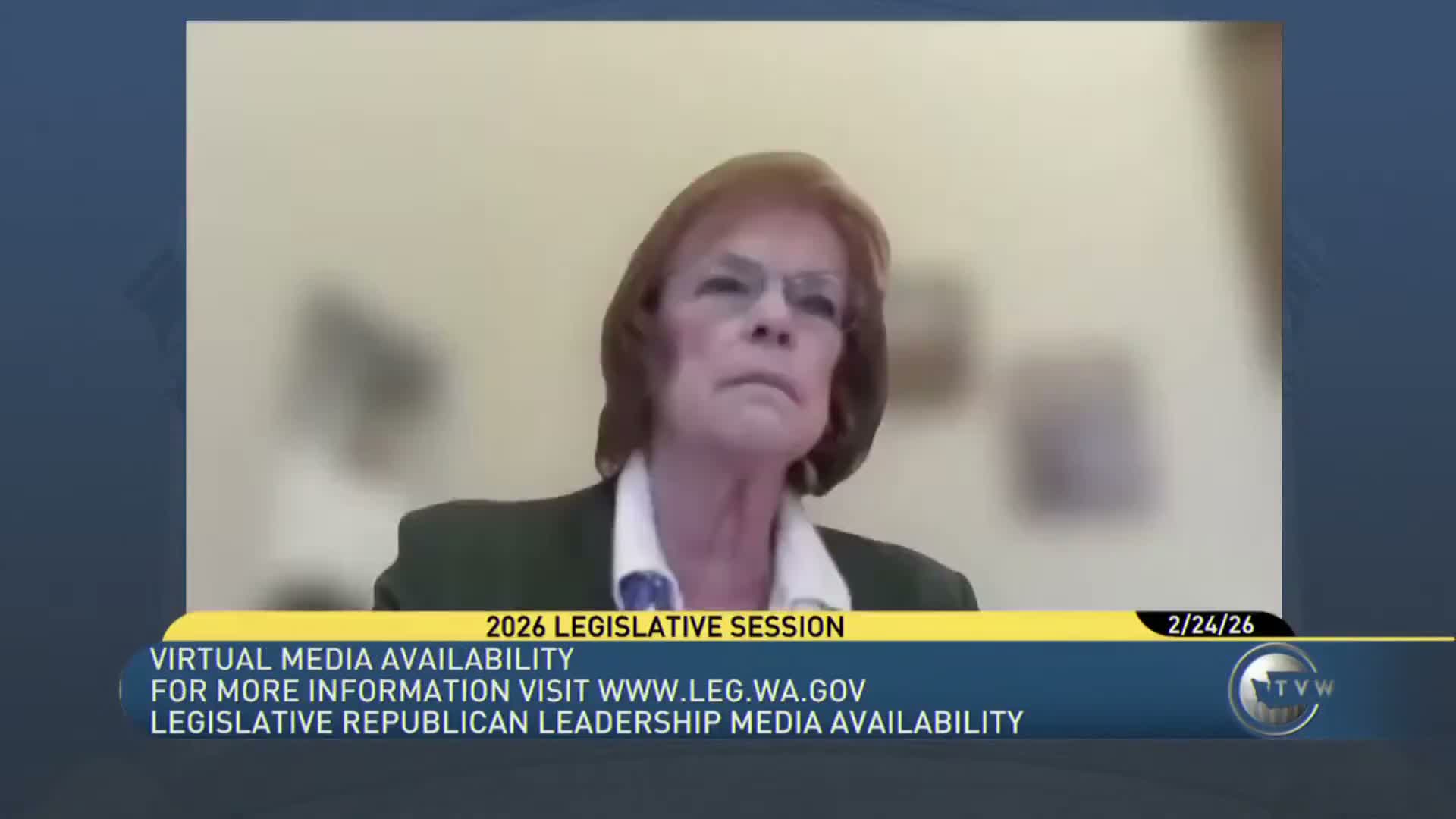
At a Capitol media availability, House and Senate Republican leaders sharply criticized the majority's proposed operating budget and the income-tax bill, and called for changes to how the Legislature accepts and verifies public testimony.
Representative Chris Corey, the House Republican deputy leader, said Republicans had begun their own checks after reports that many people who signed in "con" to the income-tax bill claimed their names were submitted without consent. "Any abuse of the system should be roundly condemned," Corey said, adding that internal sampling shows some duplicate entries but that "just over a 100,000 people signed in con with unique email addresses that are clearly not bots." He urged legislative administrators to strengthen verification and proposed removing the bill's emergency clause and sending it to a public referendum: "Let's send it to a referendum of the people, and the voters can tell us." (Representative Chris Corey spoke during the availability.)
Senate Republican caucus chair Judy Warnecke said she was concerned the operating budget had reduced the rainy day fund and that current spending priorities shortchange education. "Where are we going to go in the future if we don't have that rainy day fund?" Warnecke asked, warning that drawing down reserves could reduce flexibility for future emergencies. She called the capital and transportation budgets "coming up" for further scrutiny and urged attention to school spending.
Republican participants also highlighted several budget trade-offs they said were problematic: they cited a roughly $2 billion increase in spending across the two budgets, proposed cuts to Medicaid (which one speaker described as totaling about $1 billion in the biennium), and reductions to transitional kindergarten and other school supports that they said would disproportionately harm rural, property-poor districts. "These things will...be devastating to rural communities in Washington State," Representative Travis Couture said, urging targeted reforms and accountability for childcare programs.
On pensions, Republican senators said using Plan 1 pension assets to balance the budget would be "legally dubious" and an unacceptable approach to closing shortfalls. "I'm not in favor of that," one senator said, adding that taking money from pension systems would be a "slap in the face" to plan participants.
The GOP speakers said they would continue to press their objections on the floor during the final weeks of the 60-day session and to demand more transparency on budget assumptions and vote authorship. They also urged the house and senate administrations to investigate the sign-in anomalies and to consider technical fixes such as improved verification or CAPTCHA for testimony forms.
The session closed with the Republican leaders repeating their intention to contest proposals they called fiscally irresponsible and to press for referendum rights where an emergency clause would otherwise prevent public challenge.
Representative Chris Corey, the House Republican deputy leader, said Republicans had begun their own checks after reports that many people who signed in "con" to the income-tax bill claimed their names were submitted without consent. "Any abuse of the system should be roundly condemned," Corey said, adding that internal sampling shows some duplicate entries but that "just over a 100,000 people signed in con with unique email addresses that are clearly not bots." He urged legislative administrators to strengthen verification and proposed removing the bill's emergency clause and sending it to a public referendum: "Let's send it to a referendum of the people, and the voters can tell us." (Representative Chris Corey spoke during the availability.)
Senate Republican caucus chair Judy Warnecke said she was concerned the operating budget had reduced the rainy day fund and that current spending priorities shortchange education. "Where are we going to go in the future if we don't have that rainy day fund?" Warnecke asked, warning that drawing down reserves could reduce flexibility for future emergencies. She called the capital and transportation budgets "coming up" for further scrutiny and urged attention to school spending.
Republican participants also highlighted several budget trade-offs they said were problematic: they cited a roughly $2 billion increase in spending across the two budgets, proposed cuts to Medicaid (which one speaker described as totaling about $1 billion in the biennium), and reductions to transitional kindergarten and other school supports that they said would disproportionately harm rural, property-poor districts. "These things will...be devastating to rural communities in Washington State," Representative Travis Couture said, urging targeted reforms and accountability for childcare programs.
On pensions, Republican senators said using Plan 1 pension assets to balance the budget would be "legally dubious" and an unacceptable approach to closing shortfalls. "I'm not in favor of that," one senator said, adding that taking money from pension systems would be a "slap in the face" to plan participants.
The GOP speakers said they would continue to press their objections on the floor during the final weeks of the 60-day session and to demand more transparency on budget assumptions and vote authorship. They also urged the house and senate administrations to investigate the sign-in anomalies and to consider technical fixes such as improved verification or CAPTCHA for testimony forms.
The session closed with the Republican leaders repeating their intention to contest proposals they called fiscally irresponsible and to press for referendum rights where an emergency clause would otherwise prevent public challenge.
Don't Miss a Word: See the Full Meeting!
Go beyond summaries. Unlock every video, transcript, and key insight with a Founder Membership.
✓
Get instant access to full meeting videos
✓
Search and clip any phrase from complete transcripts
✓
Receive AI-powered summaries & custom alerts
✓
Enjoy lifetime, unrestricted access to government data
30-day money-back guarantee
