Leaders expect House Finance to alter millionaires tax with greater tax reductions; concordance, not conference, preferred
February 25, 2026 | Leadership Media Availability, Legislative Agencies, Legislative Sessions, Washington
This article was created by AI summarizing key points discussed. AI makes mistakes, so for full details and context, please refer to the video of the full meeting. Please report any errors so we can fix them. Report an error »
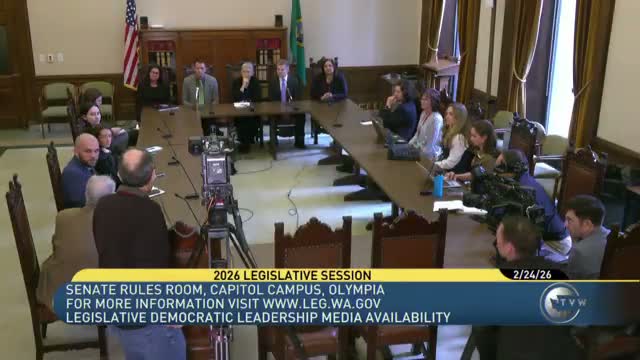
Representative Joe Fitzgibbon and other leaders said they expect the House Finance Committee to produce a version of the millionaires tax that includes greater tax reductions than the version heard in the Senate and that their early goal is to pass a bill the other chamber can concur on rather than send the matter to a conference committee.
"We expect the number of tax reductions in the bill to increase," Representative Fitzgibbon said, adding that the House aims to identify reductions that "would help Washingtonians the most." He said leaders hope to pass a bill with finance committee amendments and floor amendments the Senate could concur on.
Leaders signaled several areas of negotiation: greater tax reductions (leaders cited a target range of roughly 25%–40% of revenue as an aspiration discussed in the meeting), discussion of the prior year’s retail sales tax changes and specific amendments affecting the sales tax on services, and work on technical and operational fixes. The transcript refers to a multi‑part bill (transcribed as "5814") and to an amendment by Senator Lee that takes effect in 2030; leaders said comparisons must account for multi‑year fiscal notes rather than single‑year numbers.
Leaders repeatedly sought to reassure voters that the proposal under consideration would not extend taxation to lower incomes. "I don't support that, and my colleagues don't … support an income tax on incomes below 1,000,000," one leader said, adding that they do not propose taxing incomes below $1,000,000 now but cannot bind future legislatures decades hence.
Policy context given in the briefing included rising program costs, expanded early learning and child care spending since passage of the Fair Start for Kids Act, expanded higher‑education aid under the Workforce Education Investment Act, and growth in jury verdict payouts for state liability — all factors leaders said contribute to budget pressure.
Leaders said the House and Senate finance chairs (named in the transcript as Senator Grama and Representative Berg) are in close communication and that the preference is alignment so the bill can proceed without conference if possible.
"We expect the number of tax reductions in the bill to increase," Representative Fitzgibbon said, adding that the House aims to identify reductions that "would help Washingtonians the most." He said leaders hope to pass a bill with finance committee amendments and floor amendments the Senate could concur on.
Leaders signaled several areas of negotiation: greater tax reductions (leaders cited a target range of roughly 25%–40% of revenue as an aspiration discussed in the meeting), discussion of the prior year’s retail sales tax changes and specific amendments affecting the sales tax on services, and work on technical and operational fixes. The transcript refers to a multi‑part bill (transcribed as "5814") and to an amendment by Senator Lee that takes effect in 2030; leaders said comparisons must account for multi‑year fiscal notes rather than single‑year numbers.
Leaders repeatedly sought to reassure voters that the proposal under consideration would not extend taxation to lower incomes. "I don't support that, and my colleagues don't … support an income tax on incomes below 1,000,000," one leader said, adding that they do not propose taxing incomes below $1,000,000 now but cannot bind future legislatures decades hence.
Policy context given in the briefing included rising program costs, expanded early learning and child care spending since passage of the Fair Start for Kids Act, expanded higher‑education aid under the Workforce Education Investment Act, and growth in jury verdict payouts for state liability — all factors leaders said contribute to budget pressure.
Leaders said the House and Senate finance chairs (named in the transcript as Senator Grama and Representative Berg) are in close communication and that the preference is alignment so the bill can proceed without conference if possible.
Don't Miss a Word: See the Full Meeting!
Go beyond summaries. Unlock every video, transcript, and key insight with a Founder Membership.
✓
Get instant access to full meeting videos
✓
Search and clip any phrase from complete transcripts
✓
Receive AI-powered summaries & custom alerts
✓
Enjoy lifetime, unrestricted access to government data
30-day money-back guarantee
