Howard County BZA tables variance request for pole barn after neighbor objections, directs staff to draft commitments
February 25, 2026 | Howard County, Indiana
This article was created by AI summarizing key points discussed. AI makes mistakes, so for full details and context, please refer to the video of the full meeting. Please report any errors so we can fix them. Report an error »
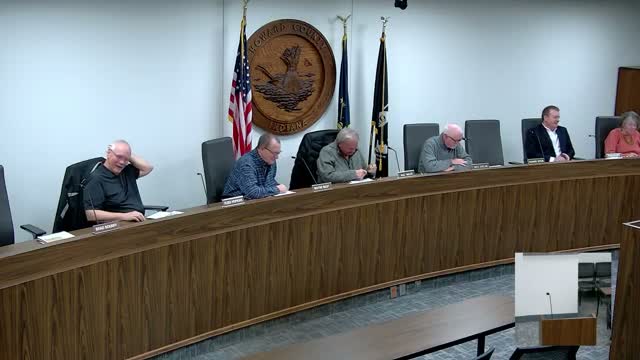
The Howard County Board of Zoning Appeals voted to table a variance request from Michael and Christy Melinex after neighboring property owners raised deed-restriction and visual-impact concerns and the board directed staff to draft written commitments.
The Melinex petition sought a variance to Howard County Zoning Ordinance Section 5.03 to construct an accessory structure (a pole barn) on a lot that would not contain a primary dwelling at 1485 South 1038 East. Petitioners said the lot is low-lying, drains from the east side of the county, and that building a house would require bringing large amounts of fill to raise the lot to road level. A representative identified himself as Mike Walnicks described the barn as intended for agricultural storage.
A neighbor objected, citing deed restrictions recorded after a 2000 land auction that, according to the neighbor’s reading, require minimum home sizes, two-car attached garages and prohibit manufactured housing. The neighbor said many property owners in the subdivision complied with those restrictions and argued that allowing a barn-only structure would degrade neighborhood character and property values. The neighbor also presented photos and described mud on accessing roads and prior unpermitted outbuildings on the petitioners’ existing property; referenced interactions with state Department of Natural Resources (DNR) and county staff about fill and drainage.
Petitioners said they had paid to subdivide and survey the lot (they cited a subdivision-related cost of $7,000), had begun planting trees along the property and were working with the drainage board to address water issues. They said the seller had disclosed no deed restrictions to them and that they intended to comply with law and permit processes.
Board members discussed using written commitments to address the dispute, noting the board does not enforce private covenants but can make approval conditional on mutually agreed written commitments. Members discussed specific mitigation details — whether a buffer should cover road frontage or the entire side, the cost and feasibility of planting 6–8-foot trees across nearly two acres, and the legal limit on fence heights (6 feet). Several board members said written commitments should specify minimum tree sizes and a timeframe to avoid planting small saplings that would take years to screen the property.
The board voted to table the case for 30 days so staff can draft written commitments for the parties to consider; if the petitioner and complainant agree, the board will vote on those commitments at the next meeting; if not, the board will hear the case as it stands.
"We would probably put some size limit in the commitment," a board member said, arguing that saplings would not solve the problem. Staff (Alan) agreed to draft the commitments and bring them back for board review.
The case remains unresolved; the board’s action pauses formal consideration to allow negotiation on mitigation measures.
The Melinex petition sought a variance to Howard County Zoning Ordinance Section 5.03 to construct an accessory structure (a pole barn) on a lot that would not contain a primary dwelling at 1485 South 1038 East. Petitioners said the lot is low-lying, drains from the east side of the county, and that building a house would require bringing large amounts of fill to raise the lot to road level. A representative identified himself as Mike Walnicks described the barn as intended for agricultural storage.
A neighbor objected, citing deed restrictions recorded after a 2000 land auction that, according to the neighbor’s reading, require minimum home sizes, two-car attached garages and prohibit manufactured housing. The neighbor said many property owners in the subdivision complied with those restrictions and argued that allowing a barn-only structure would degrade neighborhood character and property values. The neighbor also presented photos and described mud on accessing roads and prior unpermitted outbuildings on the petitioners’ existing property; referenced interactions with state Department of Natural Resources (DNR) and county staff about fill and drainage.
Petitioners said they had paid to subdivide and survey the lot (they cited a subdivision-related cost of $7,000), had begun planting trees along the property and were working with the drainage board to address water issues. They said the seller had disclosed no deed restrictions to them and that they intended to comply with law and permit processes.
Board members discussed using written commitments to address the dispute, noting the board does not enforce private covenants but can make approval conditional on mutually agreed written commitments. Members discussed specific mitigation details — whether a buffer should cover road frontage or the entire side, the cost and feasibility of planting 6–8-foot trees across nearly two acres, and the legal limit on fence heights (6 feet). Several board members said written commitments should specify minimum tree sizes and a timeframe to avoid planting small saplings that would take years to screen the property.
The board voted to table the case for 30 days so staff can draft written commitments for the parties to consider; if the petitioner and complainant agree, the board will vote on those commitments at the next meeting; if not, the board will hear the case as it stands.
"We would probably put some size limit in the commitment," a board member said, arguing that saplings would not solve the problem. Staff (Alan) agreed to draft the commitments and bring them back for board review.
The case remains unresolved; the board’s action pauses formal consideration to allow negotiation on mitigation measures.
View the Full Meeting & All Its Details
This article offers just a summary. Unlock complete video, transcripts, and insights as a Founder Member.
✓
Watch full, unedited meeting videos
✓
Search every word spoken in unlimited transcripts
✓
AI summaries & real-time alerts (all government levels)
✓
Permanent access to expanding government content
30-day money-back guarantee
