Howard County Council approves roughly $6.16 million in additional appropriations, including major jail site payments
February 25, 2026 | Howard County, Indiana
This article was created by AI summarizing key points discussed. AI makes mistakes, so for full details and context, please refer to the video of the full meeting. Please report any errors so we can fix them. Report an error »
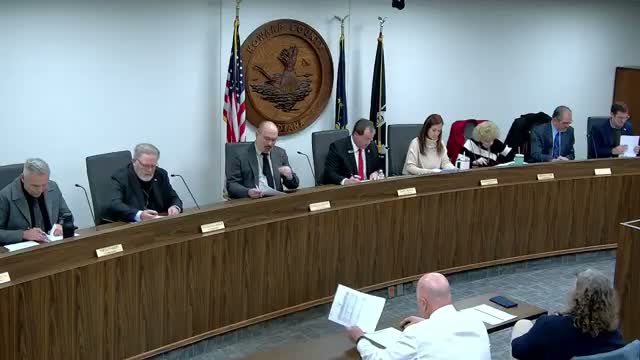
Howard County Council voted to approve additional appropriations on second reading at its February monthly meeting, approving a motion that cited $6,156,009.88 as the revised total.
The ordinance as read by the auditor listed line items across multiple funds — county general, cumulative capital, correctional facilities, public safety and several grant funds — and originally included a total read aloud earlier in the meeting of $6,234,725.11. During discussion the council considered revised figures and a motion to approve the appropriations used $6,156,009.88; Councilman Faulkner moved the motion and Councilman Roberts seconded. The presiding officer announced the motion carried. (The transcript does not provide a roll‑call tally of individual votes.)
What the appropriations cover: the auditor’s reading specified multiple line items including a $1,000,000 appropriation for contract services in the correctional facilities fund and a $4,900,000 appropriation for contract services in the new public safety fund tied to site/survey work for the county’s new jail. Other line items included technology purchases, drug‑court and reentry‑court grant allocations and smaller program amounts; the auditor read a detailed list of items and sums during the meeting.
Sheriff Asher, who asked to appear early in the agenda after returning from a conference, described a separate appropriation request to fund 24‑hour nursing coverage at the jail. The sheriff said his original Form 1 requested $261,004.19 but that he would instead ask the council to approve $183,682.50; he said county commissioners committed $30,000 from opioid funds and that $25,000 would come from commissary funds. "We're gonna ask for less," Sheriff Asher said when explaining the revised figure.
Judge Tate and court staff also briefed the council on allocations for drug court and reentry court grant funds. Tate described how grant and user‑fee sources will be allocated among incentives, drug testing, participant needs, graduation supplies and training, and emphasized that grant rules restrict payment of salaries even as user fees are used to cover coordinator salary costs.
Jeremy, director of information systems, asked for an additional $24,000 to cover a vendor price increase on servers (attributed in the meeting to higher memory costs tied to demand for AI‑grade hardware). County Extension representative Allison requested $3,606.11 for previously invoiced computer purchases and projected a further need (about $3,200) for additional machines this year through Purdue Extension procurement.
During the meeting public commenter and local nurse Lisa Washington urged the council to consider the "human cost" of not having continuous nursing coverage at the jail, citing cardiac, stroke and diabetes emergencies as time‑sensitive conditions that could increase county liability in the absence of on‑site nursing care.
The council also adopted Ordinance 20 26‑HCCO‑09, a salary ordinance amendment for the 2026 calendar year, during the same meeting.
Next steps: the appropriations will be processed through county fiscal channels; council members said some short‑term borrowing between internal funds may be used to pay immediate bills and that the administration may later reimburse those temporary transfers when fund cash is available.
Sources: ordinance reading and presentations as spoken at the Howard County Council February monthly meeting (auditor read by title and line items; Judge Tate, Sheriff Asher, Jeremy and Allison made presentations; public comment by Lisa Washington).
The ordinance as read by the auditor listed line items across multiple funds — county general, cumulative capital, correctional facilities, public safety and several grant funds — and originally included a total read aloud earlier in the meeting of $6,234,725.11. During discussion the council considered revised figures and a motion to approve the appropriations used $6,156,009.88; Councilman Faulkner moved the motion and Councilman Roberts seconded. The presiding officer announced the motion carried. (The transcript does not provide a roll‑call tally of individual votes.)
What the appropriations cover: the auditor’s reading specified multiple line items including a $1,000,000 appropriation for contract services in the correctional facilities fund and a $4,900,000 appropriation for contract services in the new public safety fund tied to site/survey work for the county’s new jail. Other line items included technology purchases, drug‑court and reentry‑court grant allocations and smaller program amounts; the auditor read a detailed list of items and sums during the meeting.
Sheriff Asher, who asked to appear early in the agenda after returning from a conference, described a separate appropriation request to fund 24‑hour nursing coverage at the jail. The sheriff said his original Form 1 requested $261,004.19 but that he would instead ask the council to approve $183,682.50; he said county commissioners committed $30,000 from opioid funds and that $25,000 would come from commissary funds. "We're gonna ask for less," Sheriff Asher said when explaining the revised figure.
Judge Tate and court staff also briefed the council on allocations for drug court and reentry court grant funds. Tate described how grant and user‑fee sources will be allocated among incentives, drug testing, participant needs, graduation supplies and training, and emphasized that grant rules restrict payment of salaries even as user fees are used to cover coordinator salary costs.
Jeremy, director of information systems, asked for an additional $24,000 to cover a vendor price increase on servers (attributed in the meeting to higher memory costs tied to demand for AI‑grade hardware). County Extension representative Allison requested $3,606.11 for previously invoiced computer purchases and projected a further need (about $3,200) for additional machines this year through Purdue Extension procurement.
During the meeting public commenter and local nurse Lisa Washington urged the council to consider the "human cost" of not having continuous nursing coverage at the jail, citing cardiac, stroke and diabetes emergencies as time‑sensitive conditions that could increase county liability in the absence of on‑site nursing care.
The council also adopted Ordinance 20 26‑HCCO‑09, a salary ordinance amendment for the 2026 calendar year, during the same meeting.
Next steps: the appropriations will be processed through county fiscal channels; council members said some short‑term borrowing between internal funds may be used to pay immediate bills and that the administration may later reimburse those temporary transfers when fund cash is available.
Sources: ordinance reading and presentations as spoken at the Howard County Council February monthly meeting (auditor read by title and line items; Judge Tate, Sheriff Asher, Jeremy and Allison made presentations; public comment by Lisa Washington).
Don't Miss a Word: See the Full Meeting!
Go beyond summaries. Unlock every video, transcript, and key insight with a Founder Membership.
✓
Get instant access to full meeting videos
✓
Search and clip any phrase from complete transcripts
✓
Receive AI-powered summaries & custom alerts
✓
Enjoy lifetime, unrestricted access to government data
30-day money-back guarantee
