Committee advances bill to protect students from compelled advocacy in state higher education
February 25, 2026 | 2026 Utah Legislature, Utah Legislature, Utah Legislative Branch, Utah
This article was created by AI summarizing key points discussed. AI makes mistakes, so for full details and context, please refer to the video of the full meeting. Please report any errors so we can fix them. Report an error »
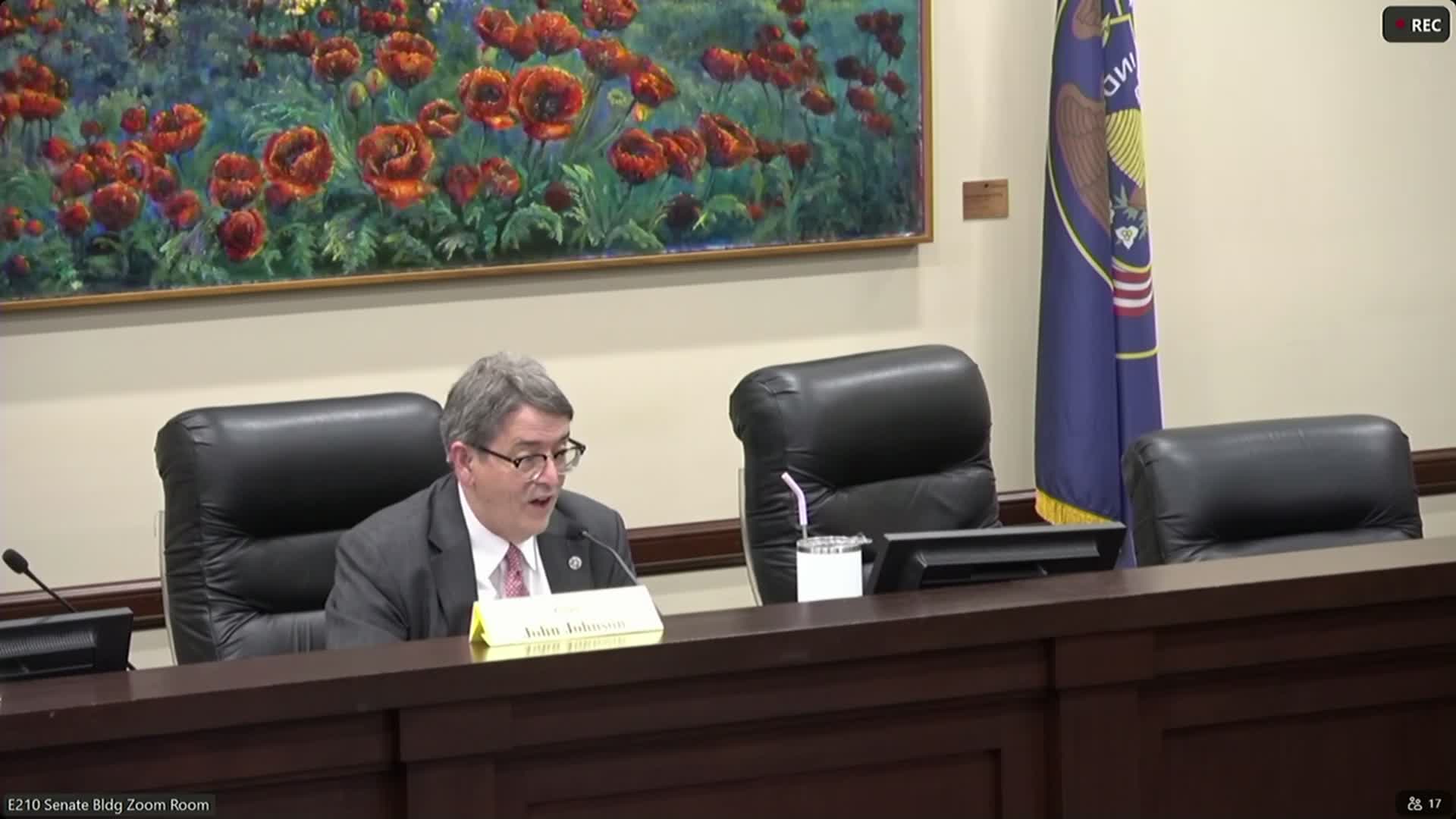
Representative Mike Peterson told the Senate Education Committee HB 204 responds to cases where students said professors required public advocacy as part of graded work. Peterson recounted receiving reports — including from his daughter in graduate school — that prompted the legislation.
Law professor Robin Frewell Wilson, speaking as a consultant to the sponsor, framed two core protections in the bill: a prohibition on instructors compelling students to publicly advocate a specific viewpoint, and a process allowing accommodations for students whose religious belief or conscience conflicts with mandated assignments in required courses, majors, or graduation requirements so long as the accommodation does not produce a "fundamental alteration" of the program.
Wilson described the compelled-advocacy concern as classic First Amendment territory: "These assignments to write one's lawmaker or newspaper or otherwise take a public position ... are classic instances of compelled speech by the state," she said, and noted the bill limits its coverage to public (state) institutions.
The bill requires written prior notice of objections and establishes a neutral arbiter process (with guidance from the state's higher-education oversight) to determine whether accommodation is reasonable or would fundamentally alter the course. Sponsor and supporters said the proposal protects conscience while preserving curricular integrity.
Public comment was sharply divided. Higher-education faculty and unions warned the bill's undefined terms (notably "activity") and requirements for alternative assignments could impose large burdens on faculty and institutions, cause overcompliance, chill classroom discussion, or delay students' progress. The AFT and many university faculty argued existing complaint processes and ombuds/title IX offices are adequate and that the bill's broad wording would be exploited.
Civil-liberties and free-speech groups (Foundation for Individual Rights and Expression) supported the compelled-speech prohibition but warned that mandated alternative assignments could raise practical and academic-freedom concerns.
Sponsor Peterson acknowledged drafting gaps (he said he had intended to define "activity") and agreed to file or accept an amendment to clarify that term and to work on other drafting fixes. After debate, the committee voted to send the first-substitute as amended to the full body; the chair recorded the vote as passing (2–1).
The next steps are refinement of language to narrow ambiguous terms and floor consideration in the full Senate.
Law professor Robin Frewell Wilson, speaking as a consultant to the sponsor, framed two core protections in the bill: a prohibition on instructors compelling students to publicly advocate a specific viewpoint, and a process allowing accommodations for students whose religious belief or conscience conflicts with mandated assignments in required courses, majors, or graduation requirements so long as the accommodation does not produce a "fundamental alteration" of the program.
Wilson described the compelled-advocacy concern as classic First Amendment territory: "These assignments to write one's lawmaker or newspaper or otherwise take a public position ... are classic instances of compelled speech by the state," she said, and noted the bill limits its coverage to public (state) institutions.
The bill requires written prior notice of objections and establishes a neutral arbiter process (with guidance from the state's higher-education oversight) to determine whether accommodation is reasonable or would fundamentally alter the course. Sponsor and supporters said the proposal protects conscience while preserving curricular integrity.
Public comment was sharply divided. Higher-education faculty and unions warned the bill's undefined terms (notably "activity") and requirements for alternative assignments could impose large burdens on faculty and institutions, cause overcompliance, chill classroom discussion, or delay students' progress. The AFT and many university faculty argued existing complaint processes and ombuds/title IX offices are adequate and that the bill's broad wording would be exploited.
Civil-liberties and free-speech groups (Foundation for Individual Rights and Expression) supported the compelled-speech prohibition but warned that mandated alternative assignments could raise practical and academic-freedom concerns.
Sponsor Peterson acknowledged drafting gaps (he said he had intended to define "activity") and agreed to file or accept an amendment to clarify that term and to work on other drafting fixes. After debate, the committee voted to send the first-substitute as amended to the full body; the chair recorded the vote as passing (2–1).
The next steps are refinement of language to narrow ambiguous terms and floor consideration in the full Senate.
Don't Miss a Word: See the Full Meeting!
Go beyond summaries. Unlock every video, transcript, and key insight with a Founder Membership.
✓
Get instant access to full meeting videos
✓
Search and clip any phrase from complete transcripts
✓
Receive AI-powered summaries & custom alerts
✓
Enjoy lifetime, unrestricted access to government data
30-day money-back guarantee
