Municipal leaders and consultants push for municipal aggregation as affordability tool; consumer groups urge safeguards
February 25, 2026 | Energy and Technology, House of Representatives, Committees, Legislative, Connecticut
This article was created by AI summarizing key points discussed. AI makes mistakes, so for full details and context, please refer to the video of the full meeting. Please report any errors so we can fix them. Report an error »
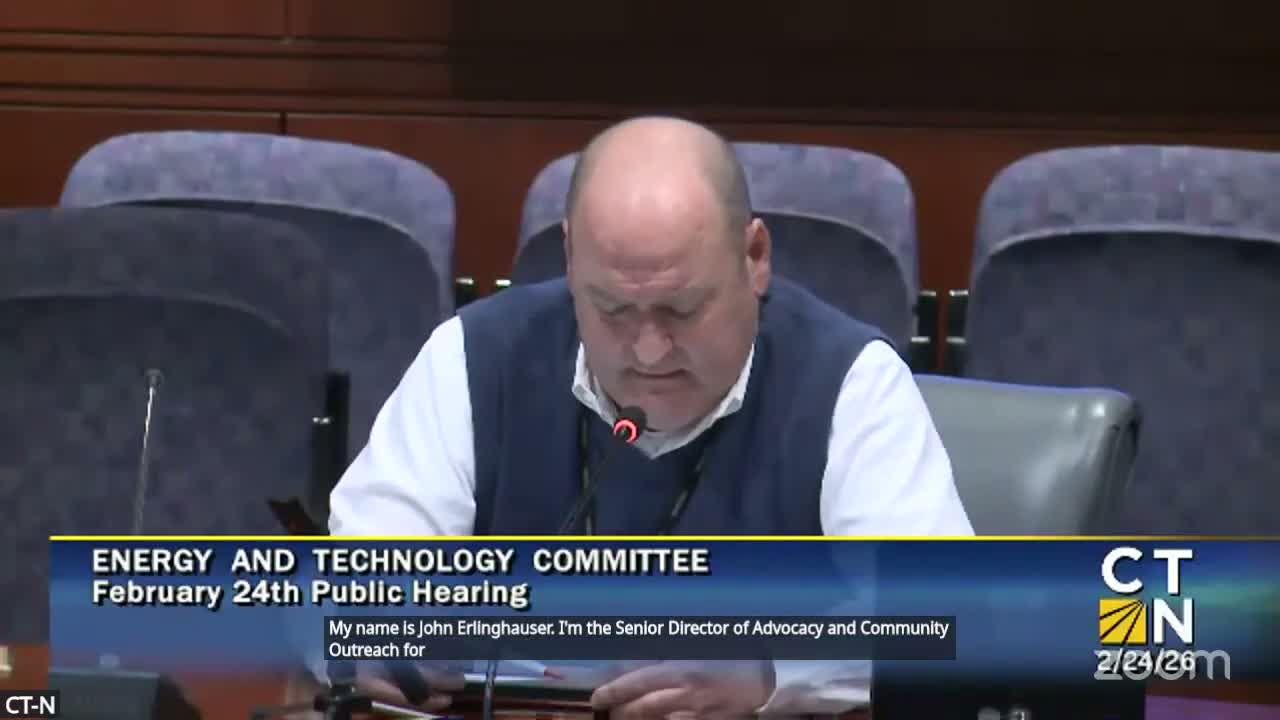
Municipal officials, the Connecticut Conference of Municipalities (CCM), consumer advocates and procurement consultants debated municipal aggregation (HB 5245) at the Energy and Technology Committee hearing.
Representatives of CCM and municipal aggregation consultants (Good Energy, Titan) described how municipal aggregation — where a city or town competitively procures electricity supply on behalf of its residents — has reduced supply costs and delivered price stability in states such as Massachusetts and New York. CCM said aggregation is voluntary for municipalities, preserves local transmission and distribution providers, and gives residents an easy opt‑out.
Good Energy and other bidders emphasized the importance of state regulatory oversight to protect consumers; firms recommended clarifying access to historical usage data for competitive bidding and allowing more flexible start/end dates for supplier contracts to win best pricing. Municipal leaders said aggregation can keep more energy dollars local and support tailored procurement that advances clean‑energy choices.
Consumer advocates including AARP and the Office of Consumer Counsel urged heightened consumer protections for opt‑out models. OCC stressed that an opt‑out framework can destabilize standard service procurement and that special safeguards for hardship customers and clear opt‑out notifications are essential. AARP said municipalities should focus on public engagement and opt‑in remains a viable alternative.
The committee did not take action; members requested additional data on Massachusetts outcomes and the effect of aggregation on standard service pricing and asked for drafting clarifications on data access and scheduling.
Representatives of CCM and municipal aggregation consultants (Good Energy, Titan) described how municipal aggregation — where a city or town competitively procures electricity supply on behalf of its residents — has reduced supply costs and delivered price stability in states such as Massachusetts and New York. CCM said aggregation is voluntary for municipalities, preserves local transmission and distribution providers, and gives residents an easy opt‑out.
Good Energy and other bidders emphasized the importance of state regulatory oversight to protect consumers; firms recommended clarifying access to historical usage data for competitive bidding and allowing more flexible start/end dates for supplier contracts to win best pricing. Municipal leaders said aggregation can keep more energy dollars local and support tailored procurement that advances clean‑energy choices.
Consumer advocates including AARP and the Office of Consumer Counsel urged heightened consumer protections for opt‑out models. OCC stressed that an opt‑out framework can destabilize standard service procurement and that special safeguards for hardship customers and clear opt‑out notifications are essential. AARP said municipalities should focus on public engagement and opt‑in remains a viable alternative.
The committee did not take action; members requested additional data on Massachusetts outcomes and the effect of aggregation on standard service pricing and asked for drafting clarifications on data access and scheduling.
View the Full Meeting & All Its Details
This article offers just a summary. Unlock complete video, transcripts, and insights as a Founder Member.
✓
Watch full, unedited meeting videos
✓
Search every word spoken in unlimited transcripts
✓
AI summaries & real-time alerts (all government levels)
✓
Permanent access to expanding government content
30-day money-back guarantee
