Building inspector proposes fee increases to narrow $200K revenue gap; committee asks for modeled permit breakdown
February 25, 2026 | Town of Charlton, Worcester County, Massachusetts
This article was created by AI summarizing key points discussed. AI makes mistakes, so for full details and context, please refer to the video of the full meeting. Please report any errors so we can fix them. Report an error »
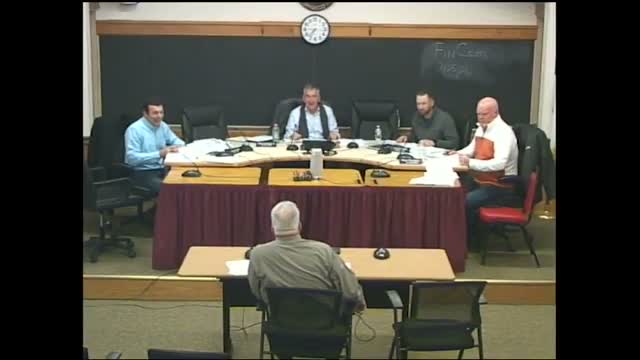
Kurt Meskes, Charlton’s building inspector and zoning enforcement officer, presented a comprehensive review of permit fees and a draft schedule of proposed increases to the finance committee on Feb. 25.
Kurt said the building department brings in roughly $220,000 in permit revenue per year while the total cost to run the department (including direct insurance and other costs) approaches $420,000, leaving a significant subsidy from general revenues. He presented comparative data showing peer towns charging higher fees for a typical single-family home permit (examples ranged up to $5,000) and proposed several changes: increasing a standard single-family permit fee from $1,300 to $3,000, raising per-inspection fees for plumbing and electrical from $75 to $100 (with the town retaining $20 for administrative costs and $80 to the inspector), and adjusting other line items such as in-ground pool permits and garage permits.
Kurt said the fee adjustments aim to better align chargeable work with the time inspectors spend in the field and to help the department move toward covering a larger share of its operating costs without changing inspection count rules (inspections would remain charged per visit). Committee members expressed concern about the size of the jump for some line items and whether higher fees could deter construction; others argued the changes would better align fees with modern construction costs and reduce taxpayer subsidy.
Before any formal motion, committee members asked Kurt to run a modeled analysis applying proposed fees to a recent sample of permits (e.g., calendar 2025 permit activity) so members can see the likely revenue impact. Some committee members indicated in-principle support if the modeled figures narrow the revenue gap as expected; others said they would withhold a motion until the analysis arrives.
The committee did approve minutes for a previous meeting that night, but took no final vote on the fee schedule; Kurt agreed to provide the requested permit breakdown and impact modeling to the committee prior to the next deliberation.
Kurt said the building department brings in roughly $220,000 in permit revenue per year while the total cost to run the department (including direct insurance and other costs) approaches $420,000, leaving a significant subsidy from general revenues. He presented comparative data showing peer towns charging higher fees for a typical single-family home permit (examples ranged up to $5,000) and proposed several changes: increasing a standard single-family permit fee from $1,300 to $3,000, raising per-inspection fees for plumbing and electrical from $75 to $100 (with the town retaining $20 for administrative costs and $80 to the inspector), and adjusting other line items such as in-ground pool permits and garage permits.
Kurt said the fee adjustments aim to better align chargeable work with the time inspectors spend in the field and to help the department move toward covering a larger share of its operating costs without changing inspection count rules (inspections would remain charged per visit). Committee members expressed concern about the size of the jump for some line items and whether higher fees could deter construction; others argued the changes would better align fees with modern construction costs and reduce taxpayer subsidy.
Before any formal motion, committee members asked Kurt to run a modeled analysis applying proposed fees to a recent sample of permits (e.g., calendar 2025 permit activity) so members can see the likely revenue impact. Some committee members indicated in-principle support if the modeled figures narrow the revenue gap as expected; others said they would withhold a motion until the analysis arrives.
The committee did approve minutes for a previous meeting that night, but took no final vote on the fee schedule; Kurt agreed to provide the requested permit breakdown and impact modeling to the committee prior to the next deliberation.
Don't Miss a Word: See the Full Meeting!
Go beyond summaries. Unlock every video, transcript, and key insight with a Founder Membership.
✓
Get instant access to full meeting videos
✓
Search and clip any phrase from complete transcripts
✓
Receive AI-powered summaries & custom alerts
✓
Enjoy lifetime, unrestricted access to government data
30-day money-back guarantee
