House Appropriations Committee reports substitute House Bill 22‑89 out of committee after debate over dozens of budget amendments
February 25, 2026 | Legislative Sessions, Washington
This article was created by AI summarizing key points discussed. AI makes mistakes, so for full details and context, please refer to the video of the full meeting. Please report any errors so we can fix them. Report an error »
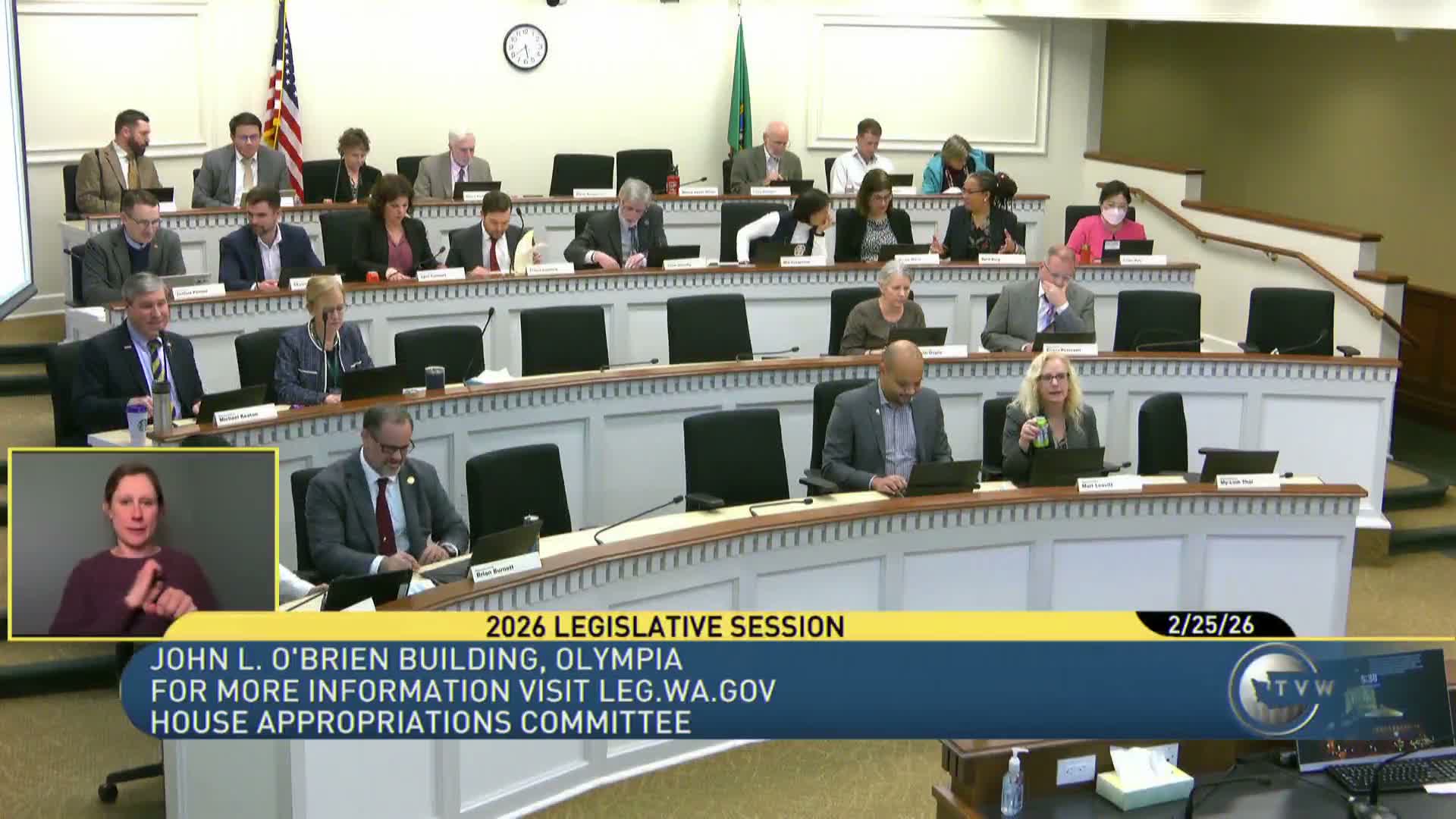
The Washington House Appropriations Committee on the evening of the session considered a lengthy packet of amendments to the proposed substitute operating budget and ultimately voted to report substitute House Bill 22‑89 out of committee with a due‑pass recommendation by a roll‑call tally of 18 ayes, 12 nays and one member excused.
The packet included dozens of targeted amendments affecting health care, early learning, public safety, natural‑resources programs and local grants. Committee members tested amendments ranging from a $494,000 one‑time allocation for Thurston County court filings to multi‑million‑dollar proposals to extend or restore funding for neonatal and family reunification programs.
Representative Dawn Walker (counsel) and staff walked members through the electronic bill book and hard‑copy packet before the committee considered motions. Early in the evening members debated an amendment (Walker 487) to provide one‑time funding intended to offset disproportionate civil‑filing costs in Thurston County. Representative Couture urged adoption to relieve local court backlogs; the chair and others recommended a no vote, citing statewide judiciary funding pressures. The amendment failed on a voice vote.
A recurring flashpoint in debate involved funding for programs serving infants born exposed to opioids and other substances. Representative Couture pushed to increase funding for Maddie’s Place — a Spokane‑area program the sponsor described as a family‑centered model that nursed infants and worked on family reunification. Supporters argued such programs save lives and reduce downstream costs. Opponents and the chair cited fiscal constraints and the need to reconcile with the Senate’s budget before committing additional state general‑fund dollars; amendments to increase Maddie’s Place funding were not adopted.
Members also extensively debated child‑welfare contracting with an established pediatric interim care center (PICC/PIC Center). Proponents described decades of outcomes and urged the Department of Children, Youth and Families (DCYF) to restore contracts that would allow placement referrals and on‑site family supports. Opponents said agency contracting choices and best‑practice considerations required further review. Those amendments did not pass the committee.
On long‑term care, Representative Marshall argued for restoring the assisted‑living rebase to help providers cover current costs and retain staff; the motion was rejected in committee. Likewise, multiple public‑safety and law‑enforcement training amendments — including a request for operational funding for an already‑built regional basic law enforcement academy in Lacey — drew debate about regional capacity, integration with the Criminal Justice Training Commission and long‑term operational vetting; these proposals were not adopted.
Other policy areas drew sustained attention. Representative Connors moved to remove one‑time funding for an Attorney General task force studying domestic extremism, arguing the task force lacked a clear definition and risked mission creep; Representative Berg and others defended the community‑and‑public‑health approach. That amendment likewise failed.
The committee adopted several narrowly focused amendments and technical corrections. Representative Pringle’s amendment (Pringle 775) made technical corrections identified by nonpartisan staff and was adopted with no net change to appropriations. The committee also adopted an amendment clarifying intent for the Pre‑K Promise account to support up to 10,000 additional early‑childhood education assistance program (ECEAP/TTK) slots; members noted the change did not itself alter appropriated amounts but increased account authority and planning intent.
After extended debate and multiple voice votes on individual amendments, Vice Chair Gregerson moved that the committee incorporate the adopted amendments into the proposed substitute and report substitute House Bill 22‑89 out of committee with a due‑pass recommendation. The roll call produced 18 ayes, 12 nays and one excused, sending the substitute operating budget out of Appropriations for further floor action and eventual conference with the Senate.
Votes at a glance
- Final: Substitute House Bill 22‑89 — reported out of committee with a due‑pass recommendation (roll call: 18 ayes, 12 nays, 1 excused).
- Selected amendment outcomes (voice votes unless otherwise noted):
• Walker 487 (Thurston County civil filings funding) — not adopted.
• VanHorn 227 (remove AG task force funding for domestic extremism work) — not adopted.
• VanHorn 217 (Yakima aquatics grant) — not adopted.
• VanHorn 218 (North Mason mobile integrated health grant) — not adopted.
• Jones 4‑19 (paint recovery / recovery program amendment) — adopted (voice vote recorded in packet).
• Stevens 070 (birth‑center licensing fee cap) — adopted.
• Clark 3‑43 (PreK Promise intent language for up to 10,000 additional slots) — adopted.
• Pringle 775 (technical corrections) — adopted (no net fiscal change).
The record shows many other amendments were moved and debated; the committee adopted a small number of focused changes while rejecting numerous others after members cited overall fiscal constraints and differing policy priorities. Where amendments were adopted the committee’s packet lists the specific fiscal notes and four‑year outlook impacts.
What’s next
Reporting the substitute out of Appropriations sends the budget proposal to the House floor, where the full membership will debate and may offer further amendments before final passage or going to conference with the Senate to reconcile differences between chambers. Committee members on both sides signaled they expect continued negotiations and additional floor debate on priorities the committee raised during the hearing.
Sources and attributions
This article is based on the Appropriations Committee meeting transcript and the amendment packet read into the record during consideration of substitute House Bill 22‑89. Direct quotes and claims are attributed to speakers as recorded in the committee transcript.
The packet included dozens of targeted amendments affecting health care, early learning, public safety, natural‑resources programs and local grants. Committee members tested amendments ranging from a $494,000 one‑time allocation for Thurston County court filings to multi‑million‑dollar proposals to extend or restore funding for neonatal and family reunification programs.
Representative Dawn Walker (counsel) and staff walked members through the electronic bill book and hard‑copy packet before the committee considered motions. Early in the evening members debated an amendment (Walker 487) to provide one‑time funding intended to offset disproportionate civil‑filing costs in Thurston County. Representative Couture urged adoption to relieve local court backlogs; the chair and others recommended a no vote, citing statewide judiciary funding pressures. The amendment failed on a voice vote.
A recurring flashpoint in debate involved funding for programs serving infants born exposed to opioids and other substances. Representative Couture pushed to increase funding for Maddie’s Place — a Spokane‑area program the sponsor described as a family‑centered model that nursed infants and worked on family reunification. Supporters argued such programs save lives and reduce downstream costs. Opponents and the chair cited fiscal constraints and the need to reconcile with the Senate’s budget before committing additional state general‑fund dollars; amendments to increase Maddie’s Place funding were not adopted.
Members also extensively debated child‑welfare contracting with an established pediatric interim care center (PICC/PIC Center). Proponents described decades of outcomes and urged the Department of Children, Youth and Families (DCYF) to restore contracts that would allow placement referrals and on‑site family supports. Opponents said agency contracting choices and best‑practice considerations required further review. Those amendments did not pass the committee.
On long‑term care, Representative Marshall argued for restoring the assisted‑living rebase to help providers cover current costs and retain staff; the motion was rejected in committee. Likewise, multiple public‑safety and law‑enforcement training amendments — including a request for operational funding for an already‑built regional basic law enforcement academy in Lacey — drew debate about regional capacity, integration with the Criminal Justice Training Commission and long‑term operational vetting; these proposals were not adopted.
Other policy areas drew sustained attention. Representative Connors moved to remove one‑time funding for an Attorney General task force studying domestic extremism, arguing the task force lacked a clear definition and risked mission creep; Representative Berg and others defended the community‑and‑public‑health approach. That amendment likewise failed.
The committee adopted several narrowly focused amendments and technical corrections. Representative Pringle’s amendment (Pringle 775) made technical corrections identified by nonpartisan staff and was adopted with no net change to appropriations. The committee also adopted an amendment clarifying intent for the Pre‑K Promise account to support up to 10,000 additional early‑childhood education assistance program (ECEAP/TTK) slots; members noted the change did not itself alter appropriated amounts but increased account authority and planning intent.
After extended debate and multiple voice votes on individual amendments, Vice Chair Gregerson moved that the committee incorporate the adopted amendments into the proposed substitute and report substitute House Bill 22‑89 out of committee with a due‑pass recommendation. The roll call produced 18 ayes, 12 nays and one excused, sending the substitute operating budget out of Appropriations for further floor action and eventual conference with the Senate.
Votes at a glance
- Final: Substitute House Bill 22‑89 — reported out of committee with a due‑pass recommendation (roll call: 18 ayes, 12 nays, 1 excused).
- Selected amendment outcomes (voice votes unless otherwise noted):
• Walker 487 (Thurston County civil filings funding) — not adopted.
• VanHorn 227 (remove AG task force funding for domestic extremism work) — not adopted.
• VanHorn 217 (Yakima aquatics grant) — not adopted.
• VanHorn 218 (North Mason mobile integrated health grant) — not adopted.
• Jones 4‑19 (paint recovery / recovery program amendment) — adopted (voice vote recorded in packet).
• Stevens 070 (birth‑center licensing fee cap) — adopted.
• Clark 3‑43 (PreK Promise intent language for up to 10,000 additional slots) — adopted.
• Pringle 775 (technical corrections) — adopted (no net fiscal change).
The record shows many other amendments were moved and debated; the committee adopted a small number of focused changes while rejecting numerous others after members cited overall fiscal constraints and differing policy priorities. Where amendments were adopted the committee’s packet lists the specific fiscal notes and four‑year outlook impacts.
What’s next
Reporting the substitute out of Appropriations sends the budget proposal to the House floor, where the full membership will debate and may offer further amendments before final passage or going to conference with the Senate to reconcile differences between chambers. Committee members on both sides signaled they expect continued negotiations and additional floor debate on priorities the committee raised during the hearing.
Sources and attributions
This article is based on the Appropriations Committee meeting transcript and the amendment packet read into the record during consideration of substitute House Bill 22‑89. Direct quotes and claims are attributed to speakers as recorded in the committee transcript.
View the Full Meeting & All Its Details
This article offers just a summary. Unlock complete video, transcripts, and insights as a Founder Member.
✓
Watch full, unedited meeting videos
✓
Search every word spoken in unlimited transcripts
✓
AI summaries & real-time alerts (all government levels)
✓
Permanent access to expanding government content
30-day money-back guarantee
