Knox County ethics subcommittee narrows complaint authority, clarifies disclosures and training timeline
February 26, 2026 | Knox County, Tennessee
This article was created by AI summarizing key points discussed. AI makes mistakes, so for full details and context, please refer to the video of the full meeting. Please report any errors so we can fix them. Report an error »
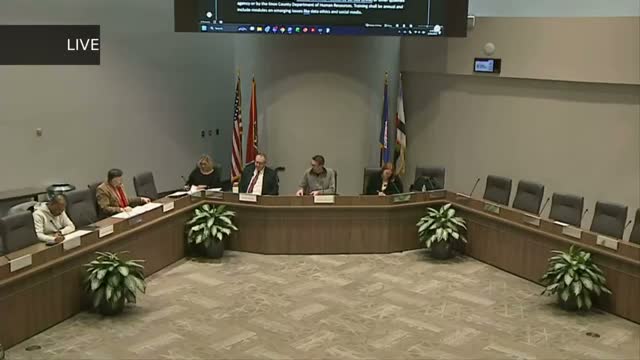
Knox County — The Knox County Ethics Subcommittee spent the majority of its meeting reviewing proposed changes to the county code of ethics, agreeing to tighten complaint-handling language, require periodic review of the code and set a timeline for annual training.
The committee approved the January 28 minutes and discussed a suite of edits to definitions, complaint procedures, disclosures and recordkeeping. Committee members agreed to change draft language so that the law director, not the ethics committee, is the office charged with investigating "any credible complaint against an official or employee charged with a violation of the code of ethics," a phrasing Steven Goodpaster suggested and members accepted in principle.
"It says under Section 9.08 f, no elected or appointed official or employee of Knox County shall advocate, recommend, etcetera, for advancement of his or her relative to an office or position within the Knox County government," said Mister Sanders while reviewing charter language; he noted the county charter's definition of "relative" differs from the draft policy and that the charter cannot be amended except by citizens' vote.
The subcommittee discussed a broader policy definition that includes stepchildren; Sanders observed the draft policy's inclusion of stepchildren appears to align with the charter's spirit but cautioned about making changes that conflict with the charter without the required amendment process.
Marcus Kennedy, speaking on an HR-related draft, said the forthcoming team-member handbook will add a personal-relationships policy requiring employees to notify supervisors when a relationship exists and prohibiting supervisory relationships between managers and subordinates. Committee members agreed that committee members should "participate in" annual ethics training rather than "conduct" training, and the chair proposed a specific timing: view the annual training video "within 30 days of the reorganization meeting." Kennedy confirmed the training is posted online.
On complaints and disclosures, members moved to clarify that the ethics committee's role is to refer informal submissions to the sworn complaint process and that the Knox County law director is the entity with investigatory authority. Goodpaster recommended replacing language that currently reads "may investigate" by the law director with narrower phrasing that limits the ethics committee to referral duties. "The ethics committee shall refer any submission it receives to the formal complaint process," Goodpaster said, recommending an explicit link to procedures.
The committee also kept a recusal sentence requiring any member involved in the facts of a complaint to recuse themselves from proceedings. Members discussed the practicalities of storing disclosure forms and records: Kennedy suggested employee disclosures be placed in personnel files while some members proposed a digital chairman's file or an attachments-to-minutes approach so disclosures are retained in the record. Mister Sanders warned that disclosure records may present public-records and confidentiality challenges for sensitive business ownership details.
The chair requested members review a flowchart from internal audit before the next meeting and proposed moving the next meeting to March 18, 2026, at 8:30 a.m. The subcommittee agreed to review the draft flowchart for 10–15 minutes at the start of that meeting and to continue finalizing the code of ethics.
The meeting closed after a voice vote to adjourn.
The committee approved the January 28 minutes and discussed a suite of edits to definitions, complaint procedures, disclosures and recordkeeping. Committee members agreed to change draft language so that the law director, not the ethics committee, is the office charged with investigating "any credible complaint against an official or employee charged with a violation of the code of ethics," a phrasing Steven Goodpaster suggested and members accepted in principle.
"It says under Section 9.08 f, no elected or appointed official or employee of Knox County shall advocate, recommend, etcetera, for advancement of his or her relative to an office or position within the Knox County government," said Mister Sanders while reviewing charter language; he noted the county charter's definition of "relative" differs from the draft policy and that the charter cannot be amended except by citizens' vote.
The subcommittee discussed a broader policy definition that includes stepchildren; Sanders observed the draft policy's inclusion of stepchildren appears to align with the charter's spirit but cautioned about making changes that conflict with the charter without the required amendment process.
Marcus Kennedy, speaking on an HR-related draft, said the forthcoming team-member handbook will add a personal-relationships policy requiring employees to notify supervisors when a relationship exists and prohibiting supervisory relationships between managers and subordinates. Committee members agreed that committee members should "participate in" annual ethics training rather than "conduct" training, and the chair proposed a specific timing: view the annual training video "within 30 days of the reorganization meeting." Kennedy confirmed the training is posted online.
On complaints and disclosures, members moved to clarify that the ethics committee's role is to refer informal submissions to the sworn complaint process and that the Knox County law director is the entity with investigatory authority. Goodpaster recommended replacing language that currently reads "may investigate" by the law director with narrower phrasing that limits the ethics committee to referral duties. "The ethics committee shall refer any submission it receives to the formal complaint process," Goodpaster said, recommending an explicit link to procedures.
The committee also kept a recusal sentence requiring any member involved in the facts of a complaint to recuse themselves from proceedings. Members discussed the practicalities of storing disclosure forms and records: Kennedy suggested employee disclosures be placed in personnel files while some members proposed a digital chairman's file or an attachments-to-minutes approach so disclosures are retained in the record. Mister Sanders warned that disclosure records may present public-records and confidentiality challenges for sensitive business ownership details.
The chair requested members review a flowchart from internal audit before the next meeting and proposed moving the next meeting to March 18, 2026, at 8:30 a.m. The subcommittee agreed to review the draft flowchart for 10–15 minutes at the start of that meeting and to continue finalizing the code of ethics.
The meeting closed after a voice vote to adjourn.
View the Full Meeting & All Its Details
This article offers just a summary. Unlock complete video, transcripts, and insights as a Founder Member.
✓
Watch full, unedited meeting videos
✓
Search every word spoken in unlimited transcripts
✓
AI summaries & real-time alerts (all government levels)
✓
Permanent access to expanding government content
30-day money-back guarantee
