House committee backs bill tightening rules for residential property tax exemption
February 25, 2026 | 2026 Utah Legislature, Utah Legislature, Utah Legislative Branch, Utah
This article was created by AI summarizing key points discussed. AI makes mistakes, so for full details and context, please refer to the video of the full meeting. Please report any errors so we can fix them. Report an error »
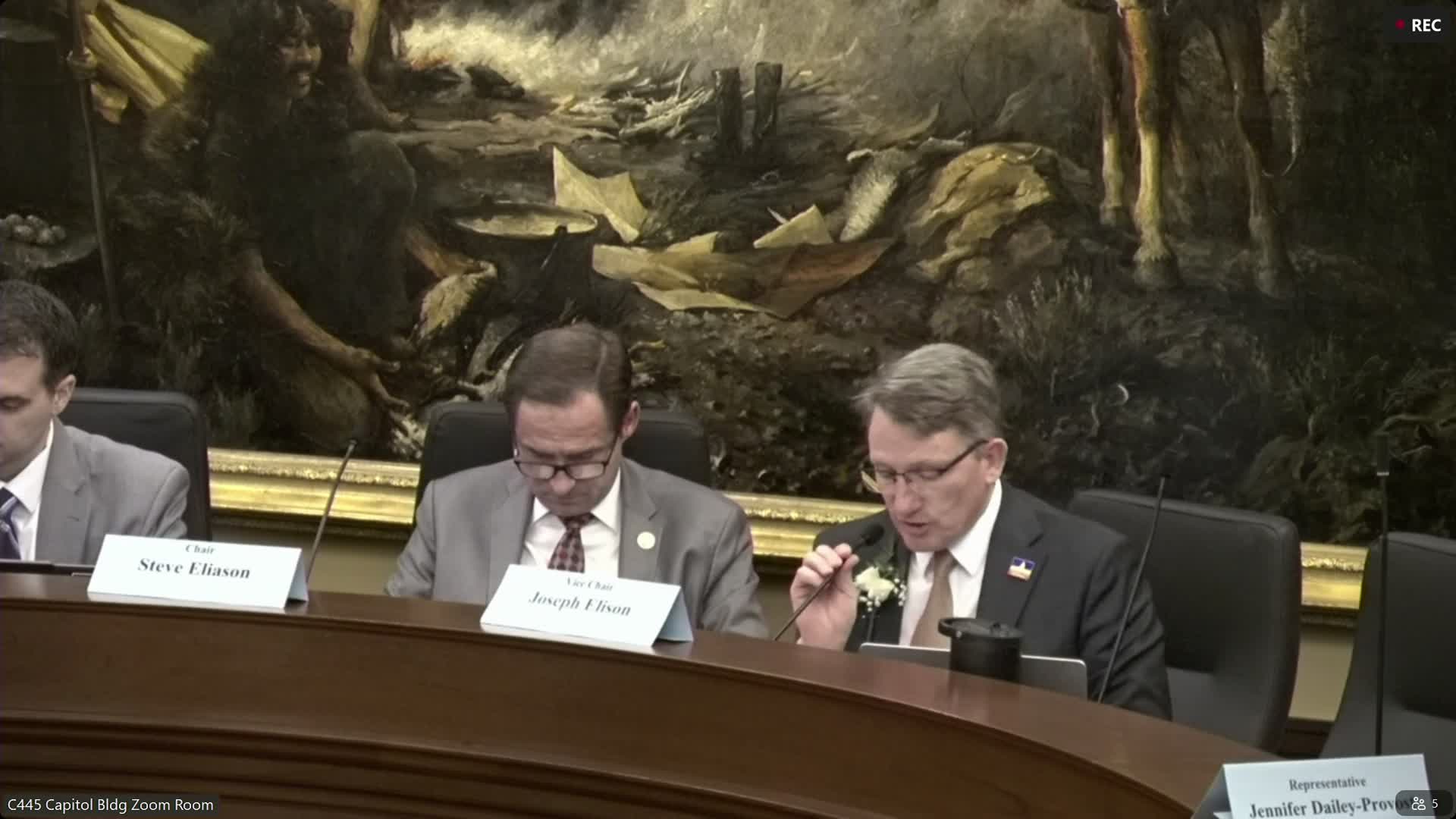
SALT LAKE CITY — The House Revenue and Taxation Committee on Thursday recommended favorably for Senate Bill 238, a package of changes aimed at tightening administration of Utah’s residential property tax exemption and refining the truth-in-taxation process.
Senator Wilson, the bill sponsor, told the committee SB 238 would require a residential property owner to file an application with the county board of equalization to receive the residential exemption and would repeal a requirement that county assessors issue notices following changes in ownership. "This bill is intended to improve compliance and administration of the residential exemption," the sponsor said during opening remarks.
The bill also clarifies burden-of-proof standards in valuation appeals involving state-assessed property, modifies advertising requirements for judgment levies by shifting from newspaper publication to electronic publication, and requires levy notices to include the amount and term of the levy and the tax impact on an average residential and business property. Sponsors said the provisions align judgment-levy notice and hearing timing with existing truth-in-taxation requirements and require taxing entities to publish a consolidated countywide list of entities undergoing truth-in-taxation hearings and instructions for virtual participation.
Representative Jason B. Kyle asked how the new application requirement would work when ownership transfers late in the year. Josh Nelson, director of property tax for the Utah State Tax Commission, said counties that already require applications send an application when property changes hands; applications submitted before the tax notice typically take effect for the following Jan. 1. "If you buy a home in November, December, it should go automatically for the January 1 of the following year," Nelson said.
Nelson and the sponsor said the change responds to a legislative audit that found inconsistent county practices and instances where taxpayers appeared to be claiming more than one primary residence. "The loophole we're trying to close is people claiming more than one primary residence, which means they get the discount on how much property tax they pay," the sponsor said. Counties will have discretion to require proof — such as a driver's license, voter registration or evidence of 183 days' occupancy — to confirm a property's primary-residence status, Nelson said.
Representatives and witnesses, including Todd Haber, business administrator for Grant School District, and Cameron Dale, executive director of the Utah League of Cities and Towns, told the committee the clarifications to truth-in-taxation procedures were helpful to school districts and local governments that stumbled on ambiguities during the last tax season.
Representative Kristofferson moved to pass SB 238 with a favorable recommendation; the committee approved the motion by voice vote. The committee record does not include a roll-call tally in the transcript.
Next steps: SB 238 advances from committee for further consideration in the House.
Senator Wilson, the bill sponsor, told the committee SB 238 would require a residential property owner to file an application with the county board of equalization to receive the residential exemption and would repeal a requirement that county assessors issue notices following changes in ownership. "This bill is intended to improve compliance and administration of the residential exemption," the sponsor said during opening remarks.
The bill also clarifies burden-of-proof standards in valuation appeals involving state-assessed property, modifies advertising requirements for judgment levies by shifting from newspaper publication to electronic publication, and requires levy notices to include the amount and term of the levy and the tax impact on an average residential and business property. Sponsors said the provisions align judgment-levy notice and hearing timing with existing truth-in-taxation requirements and require taxing entities to publish a consolidated countywide list of entities undergoing truth-in-taxation hearings and instructions for virtual participation.
Representative Jason B. Kyle asked how the new application requirement would work when ownership transfers late in the year. Josh Nelson, director of property tax for the Utah State Tax Commission, said counties that already require applications send an application when property changes hands; applications submitted before the tax notice typically take effect for the following Jan. 1. "If you buy a home in November, December, it should go automatically for the January 1 of the following year," Nelson said.
Nelson and the sponsor said the change responds to a legislative audit that found inconsistent county practices and instances where taxpayers appeared to be claiming more than one primary residence. "The loophole we're trying to close is people claiming more than one primary residence, which means they get the discount on how much property tax they pay," the sponsor said. Counties will have discretion to require proof — such as a driver's license, voter registration or evidence of 183 days' occupancy — to confirm a property's primary-residence status, Nelson said.
Representatives and witnesses, including Todd Haber, business administrator for Grant School District, and Cameron Dale, executive director of the Utah League of Cities and Towns, told the committee the clarifications to truth-in-taxation procedures were helpful to school districts and local governments that stumbled on ambiguities during the last tax season.
Representative Kristofferson moved to pass SB 238 with a favorable recommendation; the committee approved the motion by voice vote. The committee record does not include a roll-call tally in the transcript.
Next steps: SB 238 advances from committee for further consideration in the House.
Don't Miss a Word: See the Full Meeting!
Go beyond summaries. Unlock every video, transcript, and key insight with a Founder Membership.
✓
Get instant access to full meeting videos
✓
Search and clip any phrase from complete transcripts
✓
Receive AI-powered summaries & custom alerts
✓
Enjoy lifetime, unrestricted access to government data
30-day money-back guarantee
