Connecticut housing hearing spotlights push to expand "just cause" eviction protections
February 25, 2026 | Housing, House of Representatives, Committees, Legislative, Connecticut
This article was created by AI summarizing key points discussed. AI makes mistakes, so for full details and context, please refer to the video of the full meeting. Please report any errors so we can fix them. Report an error »
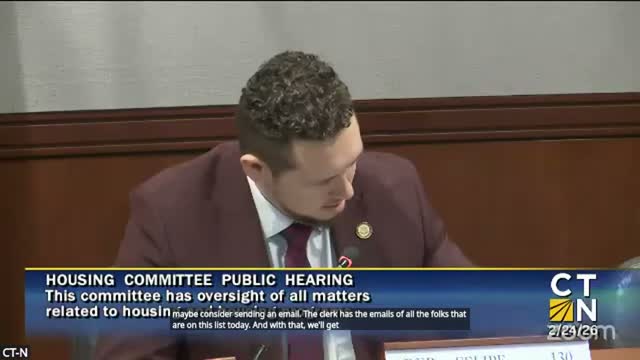
A broad coalition of tenants, health professionals and local officials urged Connecticut lawmakers on Thursday to expand the state’s limited “just cause” eviction protections, saying no‑fault nonrenewals and sudden post‑sale rent hikes are displacing long‑term residents and harming children.
Speakers at a marathon House Housing Committee hearing described landlords issuing nonrenewal notices after buildings change hands, tenants living with mold and vermin who fear retaliation if they complain, and families forced into homelessness after abrupt rent increases. ‘‘The essence of just cause is that if the tenant resists moving, the reason must be disclosed,’’ said Rafi Podolsky of Connecticut Legal Aid programs, summarizing the change advocates seek.
Why it matters: Connecticut already protects people who are 62 or older and some disabled tenants from no‑fault nonrenewals. Supporters want the same disclosure‑and‑cause requirement extended to all tenants, arguing it would give renters recourse when landlords seek to push them out for reasons unrelated to lease breaches. Pediatricians and legal advocates testified that housing instability worsens child health, school continuity and family wellbeing.
What advocates and tenants said: Dozens of individual tenants told the committee they were pushed to move after ownership changes or short notices and that many avoid reporting dangerous conditions for fear of eviction. ‘‘When families are forced to move because of nonrenewals or excessive rent increases, children lose routines, lose friends, fall behind academically, and carry emotional stress,’’ said Joelle Fishman of the People’s Center.
Landlords’ concerns: Owner and developer witnesses said the bill would effectively convert leases into perpetual tenancies, reduce flexibility at lease rollover, and make it harder to repair or upgrade aging housing stock. ‘‘Behavior‑based evictions are slow, expensive and hard to prove,’’ said a property manager, adding that large rehabilitations often require temporarily vacating units for lead or asbestos abatement and that contractors will not work in occupied units for safety reasons.
Middle ground and next steps: Some testifiers proposed procedural fixes — for example, clearer pathways for time‑limited relocations during major renovations, stronger enforcement against bad actors, and expanded state programs to help tenants move or to fund repairs. The committee did not take votes at the hearing; members asked agencies for additional data and analysis of likely effects on investment, financing and tenant outcomes.
The hearing: The hearing lasted most of the day and drew more than 100 remote and in‑person speakers, from tenants and tenant unions to municipal officials, health providers and landlord groups. Lawmakers pressed both sides for evidence and for specifics about how proposed rules would interact with permitting, fair‑rent commissions and Department of Housing lending.
What’s next: Committee members said they will consider amendment language and requested follow‑up materials from the Department of Housing and other witnesses. No committee vote was taken at the close of testimony.
Speakers at a marathon House Housing Committee hearing described landlords issuing nonrenewal notices after buildings change hands, tenants living with mold and vermin who fear retaliation if they complain, and families forced into homelessness after abrupt rent increases. ‘‘The essence of just cause is that if the tenant resists moving, the reason must be disclosed,’’ said Rafi Podolsky of Connecticut Legal Aid programs, summarizing the change advocates seek.
Why it matters: Connecticut already protects people who are 62 or older and some disabled tenants from no‑fault nonrenewals. Supporters want the same disclosure‑and‑cause requirement extended to all tenants, arguing it would give renters recourse when landlords seek to push them out for reasons unrelated to lease breaches. Pediatricians and legal advocates testified that housing instability worsens child health, school continuity and family wellbeing.
What advocates and tenants said: Dozens of individual tenants told the committee they were pushed to move after ownership changes or short notices and that many avoid reporting dangerous conditions for fear of eviction. ‘‘When families are forced to move because of nonrenewals or excessive rent increases, children lose routines, lose friends, fall behind academically, and carry emotional stress,’’ said Joelle Fishman of the People’s Center.
Landlords’ concerns: Owner and developer witnesses said the bill would effectively convert leases into perpetual tenancies, reduce flexibility at lease rollover, and make it harder to repair or upgrade aging housing stock. ‘‘Behavior‑based evictions are slow, expensive and hard to prove,’’ said a property manager, adding that large rehabilitations often require temporarily vacating units for lead or asbestos abatement and that contractors will not work in occupied units for safety reasons.
Middle ground and next steps: Some testifiers proposed procedural fixes — for example, clearer pathways for time‑limited relocations during major renovations, stronger enforcement against bad actors, and expanded state programs to help tenants move or to fund repairs. The committee did not take votes at the hearing; members asked agencies for additional data and analysis of likely effects on investment, financing and tenant outcomes.
The hearing: The hearing lasted most of the day and drew more than 100 remote and in‑person speakers, from tenants and tenant unions to municipal officials, health providers and landlord groups. Lawmakers pressed both sides for evidence and for specifics about how proposed rules would interact with permitting, fair‑rent commissions and Department of Housing lending.
What’s next: Committee members said they will consider amendment language and requested follow‑up materials from the Department of Housing and other witnesses. No committee vote was taken at the close of testimony.
Don't Miss a Word: See the Full Meeting!
Go beyond summaries. Unlock every video, transcript, and key insight with a Founder Membership.
✓
Get instant access to full meeting videos
✓
Search and clip any phrase from complete transcripts
✓
Receive AI-powered summaries & custom alerts
✓
Enjoy lifetime, unrestricted access to government data
30-day money-back guarantee
