Committee reviews H 73 to let PAs and other health professionals certify emergency exams with state training requirement
February 25, 2026 | Health Care, HOUSE OF REPRESENTATIVES, Committees, Legislative , Vermont
This article was created by AI summarizing key points discussed. AI makes mistakes, so for full details and context, please refer to the video of the full meeting. Please report any errors so we can fix them. Report an error »
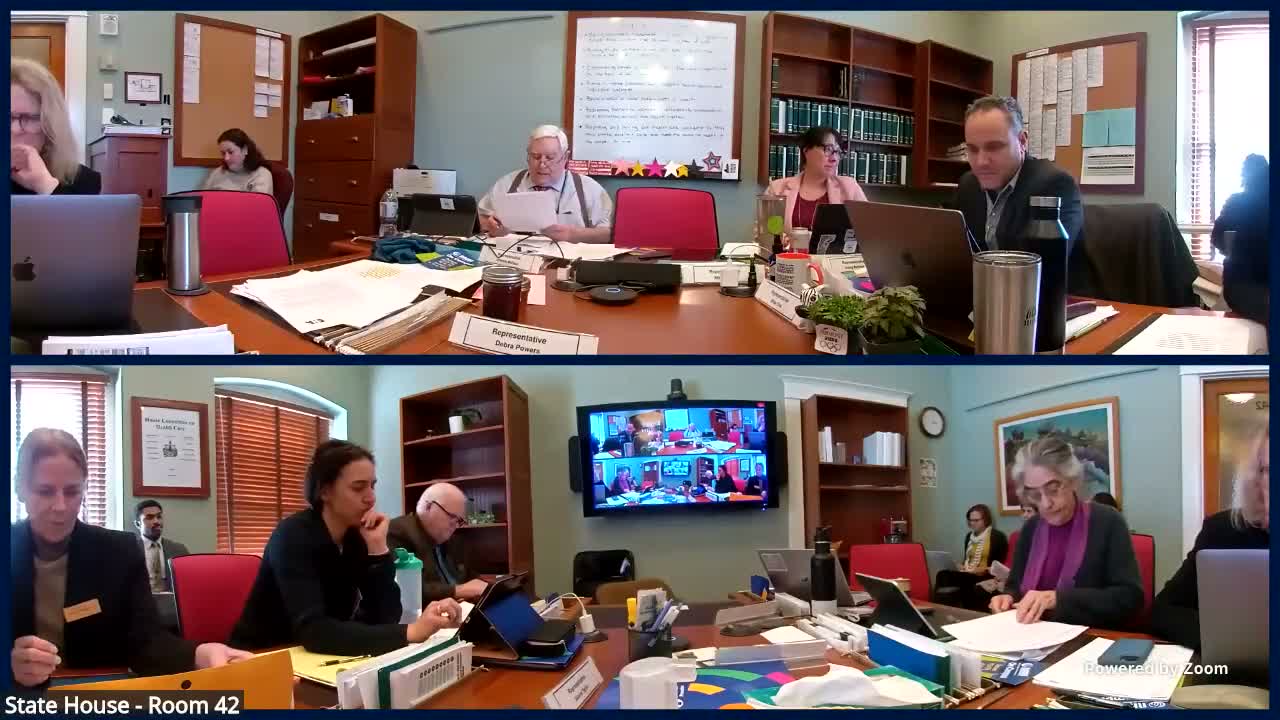
The Health Care Committee on an afternoon session reviewed H 73, a bill that would change who may complete the certificate that initiates an emergency psychiatric examination and add a state training requirement for certifiers.
Legislative counsel Katie Glenn told the committee that "this first section a of your draft is being struck out instead of amended" because the draft language conflicted with Section 2 over whether a psychiatrist, physician or other health care professional performs the initial certification. She said the revised text replaces the phrase "licensed physician" in the certificate requirements with a definition that can include other "health care professional" categories and that the bill adds a new subsection requiring that "a health care professional shall successfully complete a training developed and administered by the department," meaning the Department of Mental Health.
Representative Anne Donahue, who testified as a witness, urged caution even as she expressed conditional support. "This is almost practically the only circumstance in which you can take away someone's freedom to leave a locked facility unless you've been charged with a crime," she said, arguing the committee must view the proposed change in the context of the three parts of the involuntary‑commitment process: how someone is brought to a hospital, the emergency‑room evaluation, and the threshold for involuntary admission. Donahue raised concerns that teleconference psychiatric evaluations and implicit diagnostic bias can weaken the protections at the admission stage, and said provider shortages — particularly of psychiatrists in rural areas — complicate the decision.
Jennifer Cohen, director of the Office of Professional Regulation, said the current iteration narrows the listed regulated professions and leaves APRNs in the bill. "In this iteration of the bill, in section C . . . there were numerous professionals listed that are regulated by the Office of Professional Regulation. In this iteration of the bill, those have all been chopped out," she testified, and noted that the Board of Medical Practice regulates physician assistants.
Several practicing clinicians testified in favor of allowing trained nonphysician certifiers. Phil Schafer, a physician assistant at Grace Cottage Hospital, described routine practice at critical‑access hospitals where "often the only emergency provider is a PA or an APRN," and said requiring a separate physician to repeat the certification process can extend stressful emergency‑department stays for psychiatric patients. He welcomed the bill's training requirement and said the first step in emergency evaluation is already to rule out medical causes through tests and observation.
Dr. Trey Dobson, an emergency physician at Dartmouth Health, said trained PAs can assess decision‑making capacity and that physicians commonly rely on colleagues' assessments. "I have no problem with this bill," he testified, adding that in his experience physicians rarely overturn competent certifiers' decisions.
The committee discussed whether the bill's language is sufficiently precise (for example, whether the statutory "department" reference is clear) and whether the department‑administered training should explicitly address implicit bias and medical causes that mimic psychiatric symptoms. No formal vote or motion appears in the transcript.
The next procedural steps were not recorded in this transcript. The bill's supporters say the measure would widen access to timely evaluations in understaffed emergency settings while opponents and some members urged safeguards to protect civil liberties and ensure adequate review at the admission stage.
Legislative counsel Katie Glenn told the committee that "this first section a of your draft is being struck out instead of amended" because the draft language conflicted with Section 2 over whether a psychiatrist, physician or other health care professional performs the initial certification. She said the revised text replaces the phrase "licensed physician" in the certificate requirements with a definition that can include other "health care professional" categories and that the bill adds a new subsection requiring that "a health care professional shall successfully complete a training developed and administered by the department," meaning the Department of Mental Health.
Representative Anne Donahue, who testified as a witness, urged caution even as she expressed conditional support. "This is almost practically the only circumstance in which you can take away someone's freedom to leave a locked facility unless you've been charged with a crime," she said, arguing the committee must view the proposed change in the context of the three parts of the involuntary‑commitment process: how someone is brought to a hospital, the emergency‑room evaluation, and the threshold for involuntary admission. Donahue raised concerns that teleconference psychiatric evaluations and implicit diagnostic bias can weaken the protections at the admission stage, and said provider shortages — particularly of psychiatrists in rural areas — complicate the decision.
Jennifer Cohen, director of the Office of Professional Regulation, said the current iteration narrows the listed regulated professions and leaves APRNs in the bill. "In this iteration of the bill, in section C . . . there were numerous professionals listed that are regulated by the Office of Professional Regulation. In this iteration of the bill, those have all been chopped out," she testified, and noted that the Board of Medical Practice regulates physician assistants.
Several practicing clinicians testified in favor of allowing trained nonphysician certifiers. Phil Schafer, a physician assistant at Grace Cottage Hospital, described routine practice at critical‑access hospitals where "often the only emergency provider is a PA or an APRN," and said requiring a separate physician to repeat the certification process can extend stressful emergency‑department stays for psychiatric patients. He welcomed the bill's training requirement and said the first step in emergency evaluation is already to rule out medical causes through tests and observation.
Dr. Trey Dobson, an emergency physician at Dartmouth Health, said trained PAs can assess decision‑making capacity and that physicians commonly rely on colleagues' assessments. "I have no problem with this bill," he testified, adding that in his experience physicians rarely overturn competent certifiers' decisions.
The committee discussed whether the bill's language is sufficiently precise (for example, whether the statutory "department" reference is clear) and whether the department‑administered training should explicitly address implicit bias and medical causes that mimic psychiatric symptoms. No formal vote or motion appears in the transcript.
The next procedural steps were not recorded in this transcript. The bill's supporters say the measure would widen access to timely evaluations in understaffed emergency settings while opponents and some members urged safeguards to protect civil liberties and ensure adequate review at the admission stage.
View the Full Meeting & All Its Details
This article offers just a summary. Unlock complete video, transcripts, and insights as a Founder Member.
✓
Watch full, unedited meeting videos
✓
Search every word spoken in unlimited transcripts
✓
AI summaries & real-time alerts (all government levels)
✓
Permanent access to expanding government content
30-day money-back guarantee
